Saint Saturninus and the Martyrs of Abitina
Arrested February 304; died 304
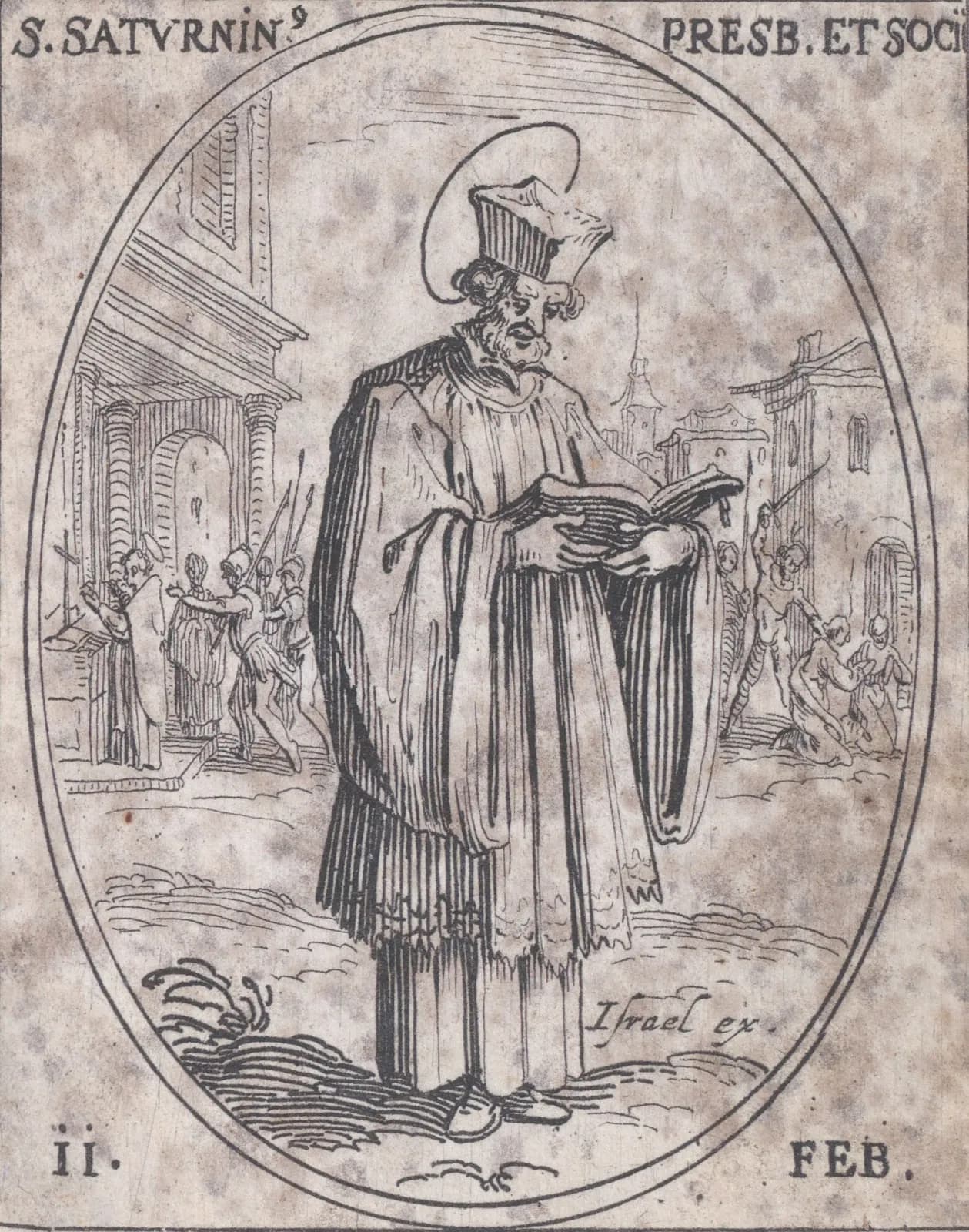
The Martyrs of Abitina were forty-nine Christians of a small town in Roman Africa who were arrested in 304 while celebrating Sunday Mass in defiance of the emperor Diocletian. 13 Taken to Carthage and tortured, they kept answering that they could not go without the Lord's day, and in Benedict XVI's telling one of them said it in three words: "Sine dominico non possumus." 3 The Roman Martyrology names the priest Saturninus first among them. 1
A congregation without its bishop
Diocletian's first edict against the Christians, published in February 303, ordered churches destroyed and the sacred books handed over to be burned, katolsk.no says. 2 Benedict XVI summarized the decree as forbidding Christians, "on pain of death, from possessing the Scriptures, from gathering on Sundays to celebrate the Eucharist and from building places in which to hold their assemblies." 3
At Abitina the bishop, Fundanus, complied. katolsk.no, following the martyrs' Acts, says he gave up the books to the magistrate to be burned, and that the Acts report a sudden downpour that put out the fire. 2 John Chapman, writing on the Donatists in the 1909 Catholic Encyclopedia, puts it more plainly: the faithful of Abitina met "under the leadership of the priest Saturninus, for their bishop was a traditor and they disowned him." 7 A traditor was one who had handed over the Scriptures. 2
The persecution had been running for almost a year, katolsk.no says, when Saturninus celebrated the Eucharist one Sunday in February 304 and soldiers arrested the whole congregation of forty-nine. 2 Benedict XVI places the Mass "in the house of Octavius Felix." 3
Who they were
The current Roman Martyrology lists them by name. 1 Saturninus was there with his four children: Saturninus the younger and Felix, both lectors; Mary, a consecrated virgin; and Hilarion, still a small boy. 12 Dativus was a senator. 2 Emeritus and Ampelius were lectors too, and the list runs on through Rogatianus, Quintus, Maximianus, Telica and many more, to a Victoria, a virgin of Carthage, and the women Secunda, Matrona and Januaria. 1
katolsk.no notes that a child as young as Hilarion being present at Mass is one of the rare glimpses of the practice in that period. 2 It also says the prisoners were questioned first in the forum of their own town, answered boldly enough to win the magistrates' admiration, and were sent in chains to the proconsul at Carthage, singing as they went. 2
Before Anulinus
The proconsul Anulinus examined them at Carthage on February 12, the date given in the Acts and, katolsk.no adds, confirmed by Augustine. 2 Dativus was questioned first. 2 He said he was a Christian and had been at the assembly, and before he could be asked who presided, Anulinus had him put on the rack and torn with hooks. 2
A prisoner named Telica pushed forward to say that all of them were Christians, and was tortured in turn. 2 Victoria's brother Fortunatianus, a lawyer who still kept to the old gods, came forward to accuse Dativus of luring his sister to Abitina; she answered that she had gone of her own will and had joined the assembly as a Christian. 2 Asked again who had led the gathering, Dativus answered that it was the priest Saturninus, and all of them. 2
Then Saturninus was asked why he had held the service, and he said that it could not be left undone. 2 Emeritus, a lector, said the assembly had met in his own house. 2 Asked why he had allowed it, he called the Christians his brothers, whom he could not refuse. 2 It is Emeritus to whom Benedict XVI gives the line: asked why they had disobeyed the emperor, "He replied: 'Sine dominico non possumus'." 3
The others gave the same answers one after another. 2 Saturninus's elder son, asked whether he had the Scriptures, said that he carried them in his heart. 2 Victoria refused her brother's claim that she was out of her mind and refused to go home with him, saying she was a Christian and had been at the assembly. 2 Last came the boy Hilarion, whom Anulinus expected to frighten; threatened with having his nose and ears cut off, he answered that the proconsul could do it, and he was a Christian all the same. 2 Sent back to prison with the rest, he said "Deo gratias." 2
John Paul II, in Dies Domini, quotes the Acts directly: "Without fear of any kind we have celebrated the Lord's Supper, because it cannot be missed; that is our law"; "We cannot live without the Lord's Supper". 6 And one of the women: "Yes, I went to the assembly and I celebrated the Lord's Supper with my brothers and sisters, because I am a Christian". 6
How they died
The sources do not agree. Benedict XVI says: "After atrocious tortures, these 49 martyrs of Abitene were killed." 3 katolsk.no says it seems none of them was executed: two named Felix died of their wounds, Dativus soon after in prison, and the rest in prison, most of them starved, on days that are mostly unknown. 2 The current Martyrology says they shed their blood in different places and at different times. 1
The starvation belongs to the part of the Acts that historians distrust. In the form that survives, the Acts say that Mensurius, bishop of Carthage, and his deacon Caecilian set men with whips at the prison door so that no food could reach the confessors. 7 Chapman calls that "incredible" and says "we may safely reject all the latter part of the Acts as fictitious," written to serve the Donatist party a century later. 7 He is just as clear about the rest: "The earlier part is authentic," the account of the Sunday service, the arrest, the "bold replies when interrogated," and the imprisonment by Anulinus. 7 katolsk.no agrees that the martyrdom itself is preserved unaltered. 2
"Sine dominico non possumus"
The phrase is hard to put in English, and Benedict XVI explained why at Vienna in 2007. In dominicum, he said, "two meanings are inextricably intertwined": the gift of the Lord, who is the Lord himself, and the day that belongs to him. 4 "For these Christians, the Sunday Eucharist was not a commandment, but an inner necessity." 4
He had already made the words the theme of the Italian Eucharistic Congress at Bari in 2005, where he rendered them "we cannot live without joining together on Sunday to celebrate the Eucharist." 3 In Sacramentum Caritatis two years later he asked that "these martyrs of Abitinae" intercede for the Church and teach it "to be faithful to our encounter with the risen Christ." 5 John Paul II had cited them in 1998 as the plainest early case of Christians who "accepted death rather than miss the Sunday Eucharist." 6
What are the Martyrs of Abitina the patron saints of?
None of the sources consulted names a patronage for the Martyrs of Abitina. 12 katolsk.no says they are also called martyrs of the Sunday and martyrs of the sacred books, and are counted among the martyrs of the Eucharist. 2 Benedict XVI and John Paul II both present them as witnesses to the Sunday Eucharist. 36
The Martyrs of Abitina's feast day
The Martyrs of Abitina's feast day is February 12. 12 The current Roman Martyrology keeps them on that day, as a commemoration at Carthage. 1 The older Martyrology placed them on February 11, as "Saturninus, priest, Dativus, Felix, Ampelius, and their companions, who, being assembled for Mass, according to custom, were, in the persecution of Diocletian, arrested by the soldiers and put to death, under the proconsul Anolinus." 8 katolsk.no says the 2004 edition moved the day from the 11th to the 12th, the date of the trial; it notes that February 20 is also found. 2
Praying with the Martyrs of Abitina
They were not the leaders of their church. Their bishop had given in, and the people who kept meeting were a priest and his children, a senator, a few lectors, and a household of women and men whose names survive only in a list. 127
What they defended was ordinary. Asked again and again why they had broken the law, they gave the same small answer: it was Sunday, and they had gone to Mass. 26 Benedict XVI found in that answer the whole meaning of the day, and told a congregation in Vienna that they needed it as much. 4
Their end was not quick. Most of them seem to have died slowly, in prison, on days nobody recorded, and the account of it was later bent to serve a schism. 27 The trial itself survived, and in it a small boy told a Roman proconsul that he was a Christian all the same. 2
Saint Saturninus and the Martyrs of Abitina, pray for us.
Sources
- 1.Roman Martyrology, entry for February 12, "Santi martiri di Abitene," as printed in "Santo del giorno," Conferenza Episcopale Italiana (in Italian).
- 2."Den hellige Saturnin av Abitina og 48 ledsagere (d. 304)," Den katolske kirke (katolsk.no), Catholic Diocese of Oslo (in Norwegian).
- 3.Benedict XVI, Homily at the closing Mass of the 24th Italian National Eucharistic Congress, Bari, May 29, 2005.
- 4.Benedict XVI, Homily at Mass in St. Stephen's Cathedral, Vienna, September 9, 2007.
- 5.Benedict XVI, Post-Synodal Apostolic Exhortation Sacramentum Caritatis (February 22, 2007), no. 95.
- 6.John Paul II, Apostolic Letter Dies Domini (May 31, 1998), no. 46.
- 7.John Chapman, "Donatists," The Catholic Encyclopedia, Vol. 5 (New York: Robert Appleton Company, 1909).
- 8.The Roman Martyrology, entry for February 11 (Baltimore: John Murphy & Co., 1897), translated from the Roman edition of 1845, Internet Archive.
Saints to turn to next
Others in this collection who are turned to for some of the same things.