Saint Rupert of Salzburg
Died March 27, about 710 or 718
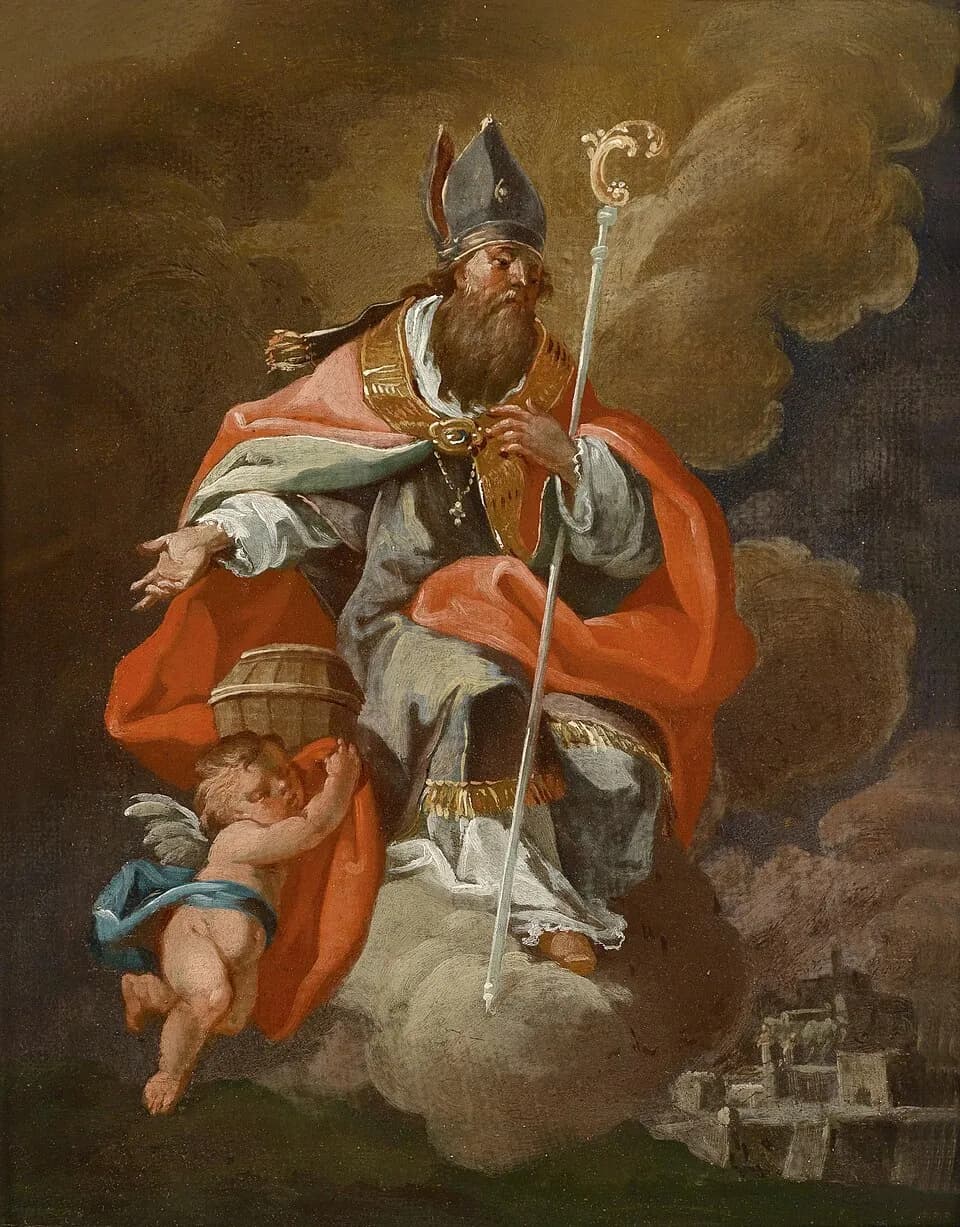
- Also called
- Ruprecht, Hrodperht, Rudbertus, Robert 1
- Founded
- Saint Peter's Abbey and the convent on the Nonnberg at Salzburg, on the ruins of Roman Juvavum 15
- Shown in art
- Holding a vessel of salt 1
Saint Rupert of Salzburg was a bishop of Worms who went to Bavaria in the 690s and built a monastery and a convent on the ruins of a Roman town called Juvavum. 15 The town that grew up around them is Salzburg, and he is counted its first bishop. 13 He died on Easter Sunday, March 27, in either 710 or 718, and the Church remembers him on that day. 134
A bishop of Worms
His birth is not recorded. The Catholic Encyclopedia says the year 660 sometimes given for it "is merely legendary," and reports "an old tradition" that he belonged to the Frankish Merovingian royal family. 1 The Archdiocese of Salzburg likewise describes him as a high noble closely related to the Merovingian house, and Vatican News says only that he was born of a noble family. 35
Before he came to Bavaria he was bishop of Worms. 145 The oldest short notices of his life, as the encyclopedia summarizes them, say he was "noted for simplicity, prudence, and the fear of God," truthful in speech and "far-seeing in his charity." 1 His name comes down in many forms. The encyclopedia lists Ruprecht, Hrodperht, Rudbertus and Robert among them. 1
For a long time it was unclear when he lived. The encyclopedia says older writers placed him around the year 500, and that "the most exhaustive and reliable investigations" settled on the late seventh and early eighth centuries. 1 The deciding evidence was a ninth-century catalog of gifts to the church of Salzburg, in which Saint Virgil, bishop from 745 to 784, appears as Rupert's direct disciple. 1
The invitation from Bavaria
Bavaria at the time was, in the encyclopedia's words, "only superficially Christian." Earlier missionaries had worked there, but the faith that remained was partly Arian and tangled up with pagan custom. 1 Duke Theodo, who wanted that changed, heard of the bishop of Worms and sent messengers asking him to come. 1 Rupert first sent men of his own to learn about the country and its people, and then agreed. 1
One of the sources tells the departure less comfortably. The account that Catholic Culture excerpts from Faith ND says his people in Worms welcomed him at first, but that "the relationship between Rupert and the people of Worms soured," and that the duke's invitation came at a convenient moment. 4 The encyclopedia says nothing of the kind. 1
Theodo received him with ceremony at Ratisbon, which the Faith ND account calls Regensburg, in 696. 14 His mission reached from the Danube country to the borders of Lower Pannonia, and in the course of it he came to Lorch. 1
Did he baptize the duke? Pictures of Rupert often show it. The encyclopedia's article on him says flatly that "this scene has no historical foundation." 1 The same encyclopedia's article on Salzburg, by a different author, states that he "baptized Duke Theodo of Bavaria," and the Faith ND account says he "is often credited" with it. 24
Juvavum becomes Salzburg
From Lorch he went to the shores of the Wallersee and built a church there in honor of Saint Peter. The market town of Seekirchen grew from it. 15 People living nearby told him about the old Roman town of Juvavum, where, the encyclopedia says, there were still many ruined buildings "overgrown with briars and brushwood." 1
Rupert went to see the place for himself, and then asked the duke for it. 1 Theodo gave him the territory, which the encyclopedia puts at two square miles. 1 At the foot of the Mönchberg he built a church of Saint Peter and a monastery beside it, and on the height called the Nonnberg he founded a convent of nuns. 1 The Archdiocese of Salzburg calls Saint Peter's the oldest monastery in Austria, and the Nonnberg the oldest women's convent in the world with an unbroken history. 5
To staff them he went home and came back with twelve companions and a kinswoman, Erentrude, whom he made abbess of the Nonnberg. 1 The encyclopedia and the archdiocese call her his niece; Catholic Culture calls her his sister. 145 The archdiocese dates the journey to 714. 5 He went on founding churches for the rest of his life, among them Maxglan, Altötting, and the cell of Saint Maximilian at what is now Bischofshofen. 15
The encyclopedia notes that he ran his foundations "after the manner of the Irish monks," as abbot and bishop at once, and that the two offices stayed joined at Salzburg until 987. 1
Salt
Rupert is painted holding a vessel of salt. The encyclopedia explains the emblem by "the universal tradition according to which Rupert inaugurated salt-mining at Salzburg." 1 The archdiocese gives more detail: the duke also granted him the salt springs at Reichenhall, and Rupert wanted the deposits worked to improve the living of the people. 5
Vatican News says Rupert himself "gave the city the name Salzburg." 3 The archdiocese says the fortification on the Nonnberg, and later the whole settlement, was named for the salt. 5 Catholic Culture is more guarded and says he is credited with naming the city "in some legends." 4
Death and relics
The sources agree that he died on March 27, and those that name the day of the week say it was Easter Sunday. 13 They disagree about the year. The encyclopedia and Catholic Culture's own note give 718, and the Archdiocese of Salzburg says probably 718. 145 Vatican News says "around the year 710," and the Faith ND excerpt says 710. 34
They disagree about the place as well. The encyclopedia says he died at Salzburg, "aided by the prayers of his brethren." 1 The Archdiocese of Salzburg, which might be expected to claim him, says he probably died at Worms. 5 The Faith ND account simply reports that the question is disputed. 4
On September 24, 774, his successor Virgil moved his remains, or part of them, into the newly built cathedral. 145 The archdiocese says veneration of him began with that translation. 5 On the same date in 1628 the relics were placed under the high altar of the new cathedral. 1
What is Saint Rupert of Salzburg the patron saint of?
The Faith ND account on Catholic Culture calls him "a patron saint of Salzburg, Austria, and salt miners." 4 The Archdiocese of Salzburg lists him as patron of the states of Salzburg and Carinthia, of the city of Salzburg, of salt mining and salt workers, and of dogs. 5 It gives no reason for the last. He is also called the Apostle of Bavaria, with Carinthia or Austria added depending on the source. 14
Saint Rupert of Salzburg's feast day
Saint Rupert's feast is March 27, the day of his death. Vatican News lists him on that date, and Catholic Culture notes that the Roman Martyrology honors him then. 34 Salzburg has its own day. Since the relics were laid under the cathedral altar in 1628, the encyclopedia says, "the town and district of Salzburg solemnize the feast of St. Rupert" on September 24. 1
Praying with Saint Rupert of Salzburg
Very little of Rupert's inner life survives. No letter or sermon of his is cited by any of these sources, and even the year he died is uncertain. 13 What the sources do preserve is a list of things he built: a lakeside church, a monastery, a convent, and other churches after them. 15
He was careful before he was bold. He sent people ahead to study Bavaria before he agreed to go, and he walked the ruins of Juvavum himself before he asked for them. 1 Then he went home for help and returned with a dozen monks and a woman able to lead a convent. 1
The salt belongs in the picture too. The tradition that he opened the salt works, and the archdiocese's remark that he wanted them opened for the sake of the people's living, describe a bishop who thought a mission included how his converts would eat. 15
Saint Peter's and the Nonnberg are both still there, thirteen centuries on. 15 Saint Boniface, a generation later, is said to have completed his work. 2
Saint Rupert of Salzburg, pray for us.
Sources
- 1.Ulrich Schmid, "St. Rupert," The Catholic Encyclopedia, vol. 13 (New York: Robert Appleton Company, 1912).
- 2.Cölestin Wolfsgrüber, "Salzburg," The Catholic Encyclopedia, vol. 13 (New York: Robert Appleton Company, 1912).
- 3."St. Rupert, Bishop of Salzburg," Saint of the Day, 27 March, Vatican News.
- 4."St. Rupert of Salzburg," Liturgical Year calendar for March 27, 2025, Catholic Culture (with an excerpt from Faith ND).
- 5."Rupert von Salzburg," Diözesanheilige, Erzdiözese Salzburg (in German).
Saints to turn to next
Others in this collection who are turned to for some of the same things.