Saint Rumbold of Mechelen
d. c. 775
- Relics
- In a shrine of 1825 in St. Rumbold's Cathedral, Mechelen 4
Saint Rumbold was an eighth-century missionary bishop who preached in Brabant, in what is now Belgium, and was killed near Mechelen, by tradition in 775, by two men he had offended. 13 The encyclopedia says he was martyred at Mechelen and became the city's patron, and later the patron of the whole diocese. 1 The great cathedral of Mechelen, begun in the thirteenth century in his honor, still keeps his relics above its high altar. 49
Irish prince or English Saxon?
Nobody agrees where he came from. The 1911 Catholic Encyclopedia counts "St. Rumold or Rombaut" among the Anglo-Saxon missionaries, alongside Saint Willibrord, who carried on the work that Saint Eligius, Saint Amand and others had begun in the region in the seventh century. 1 Alban Butler, writing from the Bollandists' material, reports that "the place of St. Rumold's death is contested" and sets out the rival view. 3 According to "certain Belgic and other Martyrologies," Butler says, he was "of the blood royal of Scotland (as Ireland was then called) and bishop of Dublin." 3
That opinion, Butler says, was ably defended by Hugh Ward, an Irish Franciscan, in a treatise printed at Louvain in 1662, and Pope Benedict XIV seems to have shared it: writing to the bishops of Ireland on August 1, 1741, he named "Columbanum, Kilianum, Virgilium, Rumoldum, Gallum" among the holy men who carried the Catholic faith out of Ireland. 3 On the other side, the Bollandist Janning "undertakes to prove that St. Rumold was an English Saxon." 3 Butler leaves the question there, and so does this page.
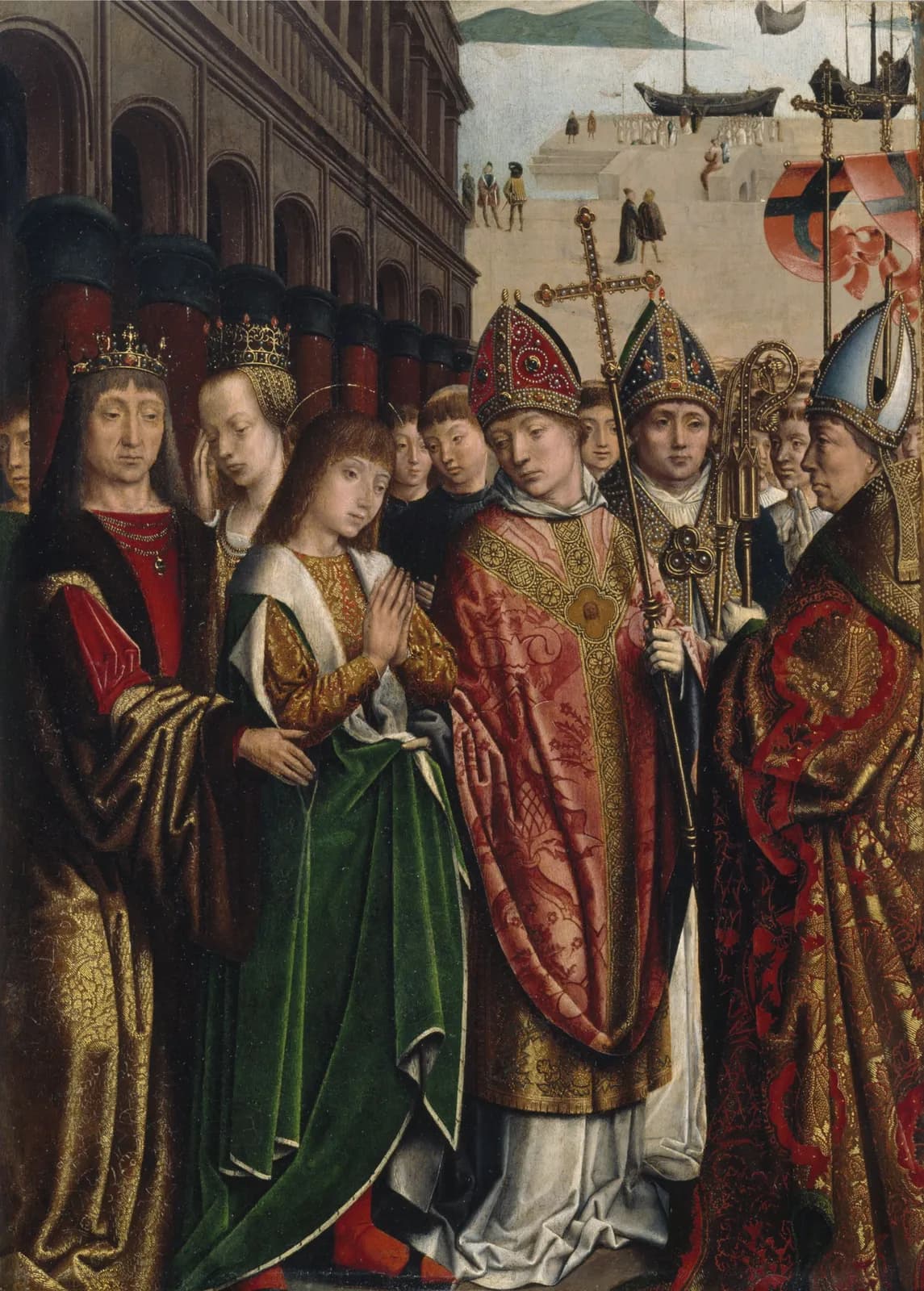
The painting at the top of this page belongs to the Irish version. It dates from around 1490 and shows a young prince with a halo taking leave of a crowned king and a weeping queen, with bishops waiting and ships at the quay behind them. It is a picture of the tradition, not a record.
A missionary bishop in Brabant
Butler's account of his life is short and mostly praise. Rumold renounced the world in his youth and "embraced a state of voluntary poverty," and was "the most declared enemy to voluptuousness." 3 After serving God for many years in his own country he set out to preach to the pagans of Lower Germany, went first to Rome "to receive his mission from the chief pastor," and with the pope's blessing went into Brabant, where he converted much of the country around Mechelen. 3
He was ordained, Butler says, "a regionary or missionary bishop without any fixed see," and he kept breaking off his work to retire into solitude. 3 The Roman Martyrology remembers him in exactly those two terms: at Mechelen in Brabant, Saint Rumold, venerated as hermit and martyr. 2 He was not alone in the region. The Catholic Church in Norway's biography of Saint Gummarus says Gummarus, the hermit around whose cell the town of Lier grew up, was a close friend of Rumold, and that the two are counted together as founders of the monastery there. 7
His death
It was in one of those retreats that he was killed. Butler gives the date as June 24, 775, and the killers as "two sons of Belial, one of whom he had reproved for adultery." 3 They threw his body into a river. It was "miraculously discovered," Butler says, and buried with honor by his friend and protector, Count Ado. 3 The encyclopedia says only that he was martyred at Mechelen and died about 775. 1
Whether a man killed for rebuking another's adultery died for the faith is a fair question, and the Church's answer is in the Martyrology, which calls him a martyr. 2
The shrine
His grave became the center of the town. A great church was built at Mechelen to receive his relics, Butler writes, and it bears his name. 3 The cathedral's own history says the present building was begun in the thirteenth century in his honor and was designed from the start to impress; when the Archdiocese of Mechelen was created in 1559 it became the cathedral, and its fifteenth-century tower by the Keldermans family became the landmark of the city. 9 Kempeneer gives the tower's height as 318 feet. 1
Early in the thirteenth century, perhaps in 1227, his remains were dug up and moved into the collegiate church of St. Rumbold. 4 By the early fourteenth century there were two processions a year through the town with his shrine. 4 In 1366 the town council, acting without the canons, put up gold and silver for a worthier shrine, finished in 1369. 4 That one did not survive the wars of religion: in 1578 it was requisitioned for the city's defense and sold at Antwerp, though the inner chest with the relics was kept. 4
A new shrine was consecrated in 1624, remade in 1631, and kept inside a great painted wooden chest whose keys were held by the town magistrates, the relics' secular guardians. 4 In 1666 the shrine was set into the new high altar. In 1794 the city had to strip off its silver to pay war costs imposed by the French Republic, and the bare wooden frame was covered in red velvet and gold brocade cut from an old chasuble; it can still be seen in the cathedral. 4 The present shrine, designed by the Antwerp architect Albert Jacobs and made by J. F. Van Deuren of Mechelen, dates from 1825 and was paid for by the clergy, the townspeople and gifts from the whole diocese. 4
Bearers from Den Bosch, and a thousandth anniversary
The cathedral tells how, when the bishop of Liège besieged Mechelen in 1268, men from 's-Hertogenbosch came to the rescue, and won in return the right to carry Saint Rumbold's body through the town every year at the Mechelen fair. 6 For three centuries a deputation from Den Bosch walked in the great procession on the first Sunday of July, until 1565, or 1541 by other accounts, on the eve of the iconoclasm. 6 The custom came back in 1935, and a confraternity from Den Bosch still attends each year. 6
In 1775 the town marked the thousandth anniversary of his death with great feasts, and bishops and abbots from across the country gave seventeen large paintings of scenes from his life to the church, with an eighteenth showing its interior. 8 Four have since been lost, two sold in 1811 to pay for repairs and two destroyed in the bombardment of 1914; the fourteen that remain are protected as Flemish masterpieces. 8
What is Saint Rumbold the patron saint of?
Saint Rumbold is the patron saint of Mechelen. The encyclopedia says he "became the city's patron saint, and subsequently the patron of the whole diocese." 1 Butler says Mechelen honors him "as its patron and apostle." 3 Before the Reformation, Butler adds, his feast was kept as a double feast with an office of nine lessons throughout the province of Dublin, and in 1741 it was extended to the whole of Ireland. 3
Saint Rumbold's feast day
Saint Rumbold's feast day is July 1 in Mechelen, where the cathedral calls it his feast and the patronal feast of the church; the bell that bears his name was blessed on July 1, 1861, which the cathedral notes was his feast day. 56 Butler also places him under July 1, while giving June 24 as the day he died. 3 The Roman Martyrology enters him on June 24. 2 Today the cathedral's Saint Rumbold celebration is held on the last Sunday before July 1. 6
Praying with Saint Rumbold
The facts are few: a preacher who came from somewhere across the sea, who would not settle in one see, and who kept leaving his work to be alone with God. 123 Butler reads those retreats as the secret of the rest. It was from the spirit of prayer, he writes in his reflection on this saint, "that the saints derived all their lights and all their strength." 3
His death has nothing glamorous about it. He told a man that his adultery was wrong, and the man and an accomplice killed him and threw him in a river. 3 That is a smaller and more ordinary kind of courage than crossing the sea to preach, and probably the kind more often asked of anyone.
What followed is the town's side of the story. For centuries Mechelen carried him through its streets, rebuilt his shrine every time it was stripped, and paid for the newest one out of its own pockets. 46 The relics are still in the cathedral, above the high altar, where anyone can see them. 4
Saint Rumbold of Mechelen, pray for us.
Sources
- 1.Albert Kempeneer, "Mechlin," The Catholic Encyclopedia, Vol. 10 (New York: Robert Appleton Company, 1911).
- 2.Roman Martyrology, entry for June 24, "San Rumoldo, eremita e martire," as printed in "Santo del giorno," Conferenza Episcopale Italiana (in Italian).
- 3.Alban Butler, "Saint Rumold, B. M., Patron of Mechlin," July 1, The Lives of the Fathers, Martyrs, and Other Principal Saints, Vol. 7 (New York: P. J. Kenedy, 1908), via Project Gutenberg.
- 4."Het reliekschrijn van Sint-Rumoldus," Sint-Romboutskathedraal, Mechelen (in Dutch).
- 5."Rumoldus," De luidklokken, Sint-Romboutskathedraal, Mechelen (in Dutch).
- 6."Hulp uit 's Hertogenbosch," Sint-Romboutskathedraal, Mechelen (in Dutch).
- 7."Den hellige Gummarus av Lier (~717-~775)," Helgener, salige og andre, katolsk.no, the Catholic Church in Norway (in Norwegian).
- 8."Schilderijenreeks erkend als Vlaams Topstuk," Sint-Romboutskathedraal, Mechelen (in Dutch).
- 9."Geschiedenis," Sint-Romboutskathedraal, Mechelen (in Dutch).
Saints to turn to next
Others in this collection who are turned to for some of the same things.