Saints Rufina and Secunda
Died 257, or 287
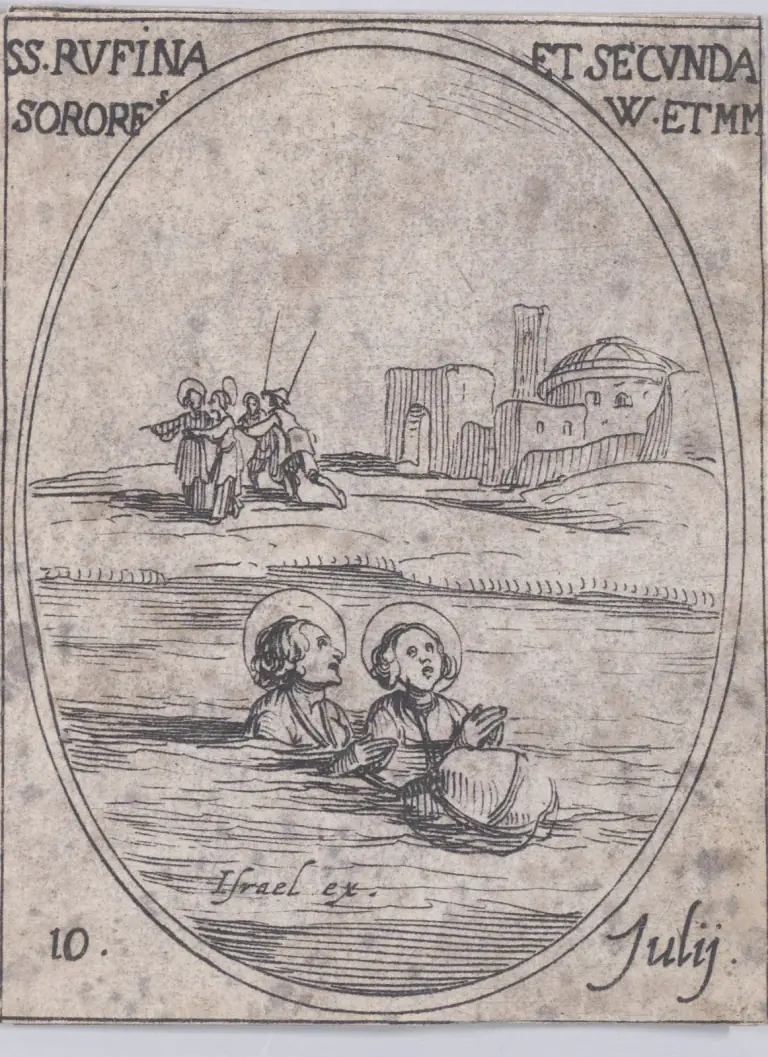
- Died
- In 257 under Valerian and Gallienus, say Butler and katolsk.no 23; about 260, says Vatican News 5; in 287, says the Catholic Encyclopedia from their Acts 1
- Church and see
- A basilica over their grave became the seat of the bishops of Silva Candida, or Santa Rufina, united with Porto in the twelfth century 17
- Not to be confused with
- Saint Rufina of Seville, martyred with Saint Justa 1
Saints Rufina and Secunda were two sisters martyred outside Rome in the third century and buried beside the Via Cornelia, where a church rose over their grave and a bishopric grew up around it. 127 Their names are in the oldest Roman calendar of martyrs and in the pilgrim guides of the seventh century. 1 The story of their arrest, after the men they were to marry abandoned the faith, comes from a Passio that katolsk.no calls legendary. 28 Their feast is July 10. 4
What the old records show
J.P. Kirsch, writing in the 1912 Catholic Encyclopedia, starts from the evidence. The Berne manuscript of the Hieronymian Martyrology places their burial at the ninth milestone of the Via Cornelia, and the itineraries of the seventh century, the guidebooks pilgrims used to find the martyrs' graves, record them on that road. 1 Pope Damasus, he says, built a church over the grave. 1 The current Roman Martyrology keeps them at the same spot, at the ninth mile of the Via Cornelia. 4
The Bollandists, who printed their Passio in the Acta Sanctorum, collected the old calendar entries. The Hieronymian lists, they note, wrongly counted the two sisters among the Seven Brothers, the sons of Saint Felicity, who share their day. 8 katolsk.no adds that a legend soon grew up making them the brothers' sisters. 2
The Passio
The Passio makes them the daughters of a Roman of rank named Asterius and his wife Aurelia, betrothed to two Christians, Armentarius and Verinus. 8 When persecution broke out under the emperors Valerian and Gallienus, the two young men gave up the faith and tried to persuade the sisters to do the same. 38 The sisters left Rome for a family property in Tuscany. 8 Here the sources part. Alban Butler says only that the young men apostatized; the Passio and Vatican News have them denounce the sisters to the authorities. 358
A count named Archesilaus overtook them with horsemen and brought them before Junius Donatus, prefect of the city. 8 The prefect had Rufina scourged in front of her sister, hoping to frighten Secunda, and Secunda protested that he was honoring her sister and dishonoring her: they were both Christians, and they should be beaten together. 28
There follow the trials such stories carry: a dark cell filled with smoke that smelled like incense, a scalding bath that cooled, and the river. 8 The prefect had them thrown into the Tiber with one stone tied to both their necks, and they came up, the Passio says, in dry clothes. 8 Handed back to Archesilaus, they were taken to a wood on the Via Cornelia at the tenth mile, on an estate called Buxo, where one was beheaded and the other beaten, and their bodies were left for the wolves. 8 A woman named Plautilla, who owned the land, saw them in a vision, found the bodies and buried them. 8
Writers have judged the Passio differently. katolsk.no says plainly that it is legendary. 2 The Bollandists printed it but marked passages they thought added later, and doubted that a text so full of speeches could be free of an interpolator's hand. 8 They also noted that a list of the city prefects does name a Junius Donatus in 257, under Valerian and Gallienus. 8
When, where, and how
Butler and katolsk.no put their death in 257, Vatican News about 260. 235 Kirsch, summarizing the Acts, gives 287 "during the Aurelian persecution." 1
The place moves too. The Martyrology and Kirsch say the ninth mile of the Via Cornelia, the Passio and katolsk.no the tenth, at Buxo, which katolsk.no identifies with modern Boccea. 1248 Butler puts the execution twelve miles out, "in a forest on the Aurelian Way." 3 Benigni, in the encyclopedia's article on the diocese, puts the basilica on the Via Aurelia, fourteen miles from Rome. 7
So does the manner of death. katolsk.no follows the Passio: Rufina beheaded, Secunda beaten to death. 2 The 1897 English Martyrology has "the one having her head split open, the other being decapitated." 6 Butler has both condemned "to lose their heads." 3
Silva Candida
Butler tells the story of the name. The wood where they died was called the Black Forest, Silva Nigra, and after them it became Silva Candida, the White Forest. 3 A town grew up around their church, also called Santa Rufina, and became a bishopric; Benigni dates the first notice of its bishop to the fifth century. 37
One of those bishops appears in the Liber Pontificalis. Valentinus, "bishop of Saints Rufina and Secunda," was sent back to Rome in the 540s to guard the Lateran while Pope Vigilius was away; Loomis adds from Procopius that the Gothic king Totila captured him and cut off both his hands. 9 Loomis's note also gives the tradition that Julius I laid the foundation of the basilica and Damasus finished it, and Benigni says the same. 79 Kirsch credits Damasus alone; katolsk.no says it was possibly Julius. 12
The town was destroyed by the Saracens in the ninth century, Benigni says, and could not be saved. 7 Pope Calixtus II, who reigned from 1119 to 1124, united the see to Porto, and the diocese that resulted is called Porto and Santa Rufina. 7 Benigni, writing in 1911, says remnants of the ancient basilica and a chapel remained; katolsk.no says the church decayed and vanished, so that its exact site is no longer known. 27
The relics
Their bodies were taken to the Lateran. Butler dates the translation to 1120, at the union of the sees; katolsk.no to 1154. 23 The Bollandists quote a Lateran canon who says the bodies were found by Anastasius IV before he became pope, and placed beneath an altar he consecrated with his own hands in an oratory behind the basilica. 8 The 1897 Martyrology says they were "kept with due honors in the Lateran Basilica, near the baptistery." 6
Not the Rufina of Seville
Several saints called Rufina are in the Martyrology, and Kirsch lists them together. 1 The best known besides these sisters is Rufina of Seville, a martyr of the Spanish Church honored with Saint Justa, whom Kirsch lists under 19 July. 1 Butler gives the Seville pair their own entry later in the month. 3 The Rufina of July 10 is the Roman one, always paired with her sister. 14
What are Saints Rufina and Secunda the patron saints of?
Saints Rufina and Secunda's feast day
Saints Rufina and Secunda's feast day is July 10. 14 The current Roman Martyrology, as the Italian bishops print it, commemorates them on that day as martyrs at Rome, at the ninth mile of the Via Cornelia. 4 Vatican News lists them on July 10, and katolsk.no gives the same day. 25 The 1897 English Martyrology entered them on July 10 as well, after the Seven Brothers. 6 The Passio dates their death to that day. 8
Praying with Saints Rufina and Secunda
The two things the sources agree on are a grave and a pair of names. 14 Two sisters died for Christ near Rome and were buried on the road west of the city, and the pilgrims' guides of the seventh century still led there. 1
The Passio fills in what nobody knew. 28 It makes the sisters' trial begin with the men they were to marry, who gave up the faith when it became dangerous and expected the women to follow them. 38 In its best-remembered scene Secunda asks to be beaten with her sister rather than spared. 8
The church over their grave gave its name to a town, then to a see, and the see lasted after the town was gone. 7 The 1897 Martyrology could still say where their bodies were: at the Lateran, near the baptistery. 6
Saints Rufina and Secunda, pray for us.
Sources
- 1.Johann Peter Kirsch, "Sts. Rufina," The Catholic Encyclopedia, vol. 13 (New York: Robert Appleton Company, 1912).
- 2."De hellige Rufina og Secunda av Roma," Den katolske kirke, the saints database of the Catholic Church in Norway, katolsk.no (in Norwegian).
- 3.Alban Butler, "Saints Rufina and Secunda, Virgins, MM.," July 10, in The Lives of the Fathers, Martyrs, and Other Principal Saints, Vol. VII (New York: P. J. Kenedy, 1908), via Project Gutenberg.
- 4.Roman Martyrology, entry for July 10, "Sante Rufina e Seconda, martiri," Santo del giorno, Conferenza Episcopale Italiana (in Italian).
- 5."Sante Rufina e Seconda, martiri sulla via Cornelia," Santo del giorno, 10 luglio, Vatican News (in Italian).
- 6.The Roman Martyrology, July 10 (Baltimore: John Murphy Company, 1897), Internet Archive.
- 7.Umberto Benigni, "Diocese of Porto and Santa-Rufina," The Catholic Encyclopedia, vol. 12 (New York: Robert Appleton Company, 1911).
- 8."De SS. Rufina et Secunda VV. MM." and "Passio SS. Rufinae et Secundae virginum et martyrum," July 10, Acta Sanctorum, Iulii tomus III (Antwerp, 1723; reprinted Paris and Rome: Victor Palmé, 1867), Internet Archive (in Latin).
- 9.The Book of the Popes (Liber Pontificalis), vol. 1, "LXI. Vigilius," translated with notes by Louise Ropes Loomis (New York: Columbia University Press, 1916), Internet Archive.
Saints to turn to next
Others in this collection who are turned to for some of the same things.
- Saint Adelaide931 - December 16, 999Marriage and familyCourage
- Saint Adrian of Nicomediad. c. 304-306CourageMarriage and family
- Saints Chrysanthus and Dariad. about 283CourageMarriage and family
- Saint EustaceMartyred at Rome, in 118 by tradition; other accounts give 140 or 188CourageMarriage and family