Saint Romuald
c. 950 - June 19, 1027
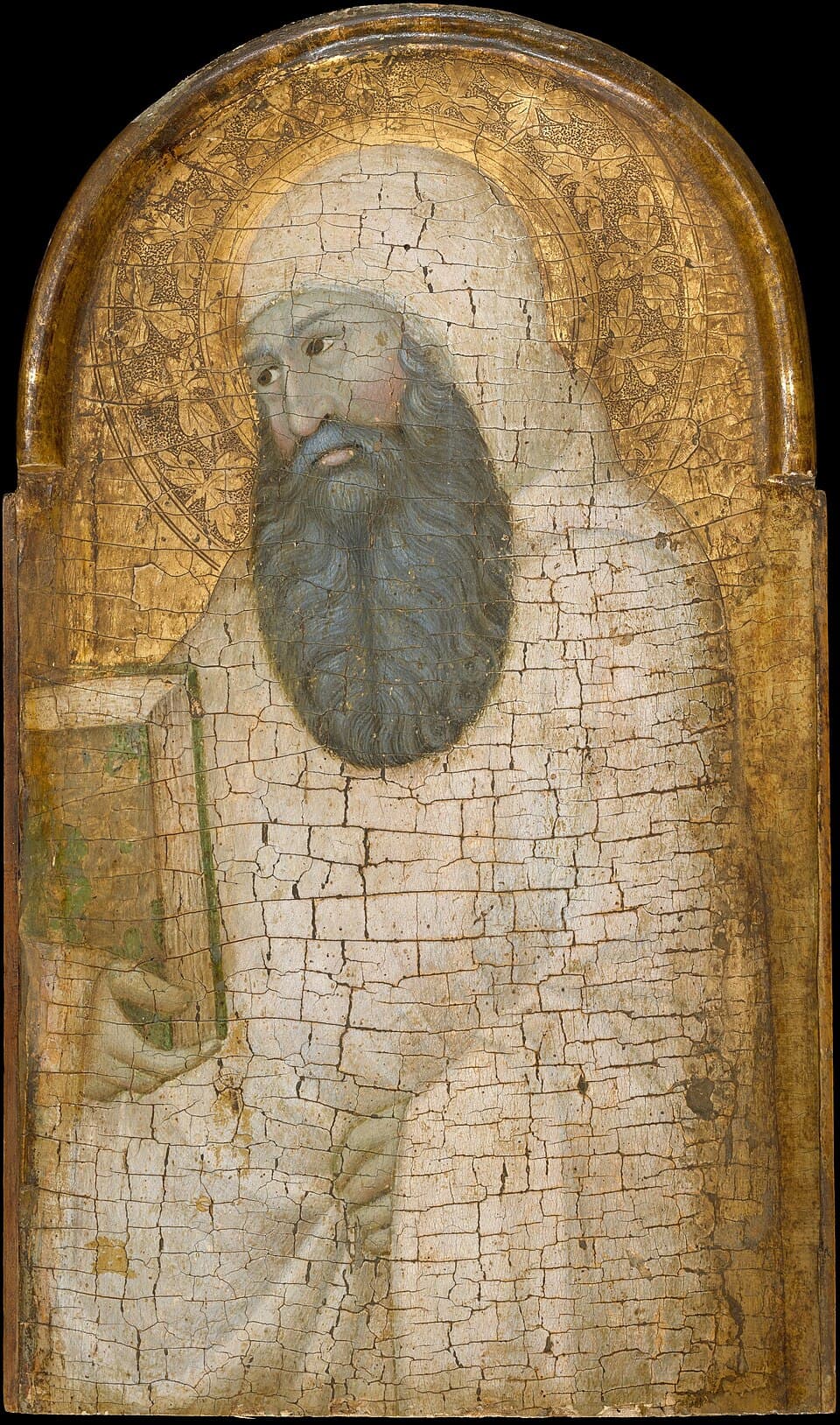
- Feast day
- June 19, the day he died. Clement VIII had fixed it on 7 February; it was moved in 1969 1
- Born
- Ravenna, probably about 950 - not 907, as his first biographer had it 1
- Eased out of his first monastery
- For correcting the other monks. Franciscan Media: they "found him to be uncomfortably holy" 12
- Excommunicated
- On a false accusation, and bore it in silence for six months 2
Saint Romuald was a young Italian nobleman living, in his encyclopedia's phrase, "the usual thoughtless and even vicious life of the tenth-century noble" when he watched his father kill a man in a duel. 12 He fled to a monastery, was eased out of it for being too strict, and spent the next fifty years founding hermitages up and down Italy. 12 He was also excommunicated on a charge he had not earned, and said nothing about it for six months. 2
A correction before the biography starts
Toke's article opens with a piece of housekeeping worth reading before anything else, because it shows how a mistake can outlive everyone who could have caught it.
"St. Peter Damian, his first biographer, and almost all the Camaldolese writers assert that St. Romuald's age at his death was one hundred and twenty, and that therefore he was born about 907. This is disputed by most modern writers. Such a date not only results in a series of improbabilities with regard to events in the saint's life, but is also irreconcilable with known dates, and probably was determined from some mistaken inference by St. Peter Damian." 1
Peter Damian is himself a Doctor of the Church, and he was writing within living memory. He got it wrong by about forty years, and Romuald's own order repeated the error for nine hundred. Toke puts the birth "probably about 950." 1
The duel
Toke is unsparing about the young man: "In his youth Romuald indulged in the usual thoughtless and even vicious life of the tenth-century noble, yet felt greatly drawn to the eremetical life." 1 Both halves at once - the dissipation and the pull toward solitude.
At about twenty it broke. "Struck with horror because his father had killed an enemy in a duel, he fled to the Abbey of San Apollinare-in-Classe and after some hesitation entered religion." 1 Franciscan Media makes it worse and closer to home: "Saint Romuald watched his father kill a relative in a duel over property. In horror he fled to a monastery near Ravenna." 2 An enemy or a kinsman; the sources differ and both are recorded.
He watched it happen.
The monastery did not hold him, and the reason is one of the more human things in this library. San Apollinare had been reformed recently but "still was not strict enough in its observance to satisfy Romuald. His injudicious correction of the less zealous aroused such enmity against him that he applied for, and was readily granted, permission to retire to Venice." 1
Franciscan Media puts it more bluntly: "After three years, some of the monks found him to be uncomfortably holy and eased him out." 2 Note Toke's word - injudicious. The encyclopedia thinks he handled it badly. He was a new convert telling long-professed monks how to keep their rule, and they got rid of him.
Fifty years of moving
At Venice he put himself under a hermit named Marinus and lived "a life of extraordinary severity." 1 The two of them, with an abbot from Catalonia, then talked the Doge of Venice into abdicating.
Pietro Orseolo I "had obtained his office by acquiescence in the murder of his predecessor" and began to suffer for it. On their advice "he abandoned his office and relations, and fled to Cuxa, where he took the habit of St. Benedict, while Romuald and Marinus erected a hermitage close to the monastery." 1 A reigning doge walked away from Venice and became a monk in the Pyrenees.
Then his father. Sergius had himself become a monk and "was tormented with doubts as to his vocation", so Romuald "returned in haste to Italy, subjected Sergius to severe discipline, and so resolved his doubts." 1 Franciscan Media describes the same episode very differently: his father "wavered, and was kept faithful by the encouragement of his son." 2 Severe discipline or encouragement. The two accounts of how a man helped his own father are worth setting side by side.
"For the next thirty years St. Romuald seems to have wandered about Italy, founding many monasteries and hermitages." 1 Toke can give little more than an itinerary: Pereum, Val-di-Castro in 1005, Vallombrosa in 1012, Monte-Sitria in 1013, Bifolco in 1021.
He wanted to be martyred. Franciscan Media: "He longed to give his life to Christ in martyrdom, and got the pope's permission to preach the gospel in Hungary. But he was struck with illness as soon as he arrived, and the illness recurred as often as he tried to proceed." 2 Toke: he "attempted to go to Hungary, but was prevented by persistent illness." 1 Every time he set out he got sick, and every time he turned back he recovered.
The six months
Two episodes from Franciscan Media belong together, because they are the interior of the life the itinerary conceals.
The first: "During another period of his life, Saint Romuald suffered great spiritual dryness. One day as he was praying Psalm 31 ('I will give you understanding and I will instruct you'), he was given an extraordinary light and spirit which never left him." 2
The second is harder. "At the next monastery where he stayed, Saint Romuald was accused of a scandalous crime by a young nobleman he had rebuked for a dissolute life. Amazingly, his fellow monks believed the accusation. He was given a severe penance, forbidden from offering Mass, and excommunicated - an unjust sentence that he endured in silence for six months." 2
A man he had corrected accused him of something disgraceful, and the community he lived in took the young man's word. He was barred from the altar and put outside the Church for half a year, and he did not defend himself.
Camaldoli
The foundation he is remembered for came late and, Toke says carefully, "according to the legend": a man named Maldolus, "who had seen a vision of monks in white garments ascending into Heaven, gave him some land, afterwards known as the Campus Maldoli, or Camaldoli." 1
He built five cells for hermits there, and a monastery at Fontebuono two years afterward. Together they "became the famous mother-house of the Camaldolese Order." 1 Franciscan Media names what was new about it: "the Order of the Camaldolese Benedictines, uniting the monastic and eremitical lives." 2 Hermits in their own cells and monks in community, under one roof - the two forms of religious life that had been alternatives, put together.
In 1005 he had left Val-di-Castro "prophesying that he would return to die there alone and unaided." 1 In 1026 he went back, and "died, as he had prophesied, alone in his cell" on 19 June 1027. 1
His body was found incorrupt in 1466 and moved to Fabriano in 1481. 1 Toke adds how he is recognized: "He is represented in art pointing to a ladder on which are monks ascending to Heaven." 1
What is Saint Romuald the patron saint of?
Neither Toke nor Franciscan Media assigns Saint Romuald a patronage. 12 He is invoked by hermits and contemplatives, and by the Camaldolese who still keep his rule.
He is also a good patron for two less obvious groups. The first is people who have been falsely accused by someone they were right to correct, and disbelieved by their own community. 2 The second is converts whose zeal makes them tactless - Toke calls his corrections of the other monks injudicious, and it cost him his place. 1 He is a saint who was difficult, and the encyclopedia does not hide it.
Saint Romuald's feast day
The feast of Saint Romuald is June 19, the day he died alone at Val-di-Castro in 1027.
It has not always been. Toke records the older arrangement: "In 1595 Clement VIII fixed his feast on 7 Feb., the day of the translation of his relics, and extended its celebration to the whole Church." 1 For nearly four centuries he was kept in February, on the anniversary of a reburial rather than of a death.
New Advent has appended a note to the article recording the change: "By the Apostolic Constitution Calendarium Romanum, promulgated in 1969, the feast of St. Romuald was assigned, as an 'Optional Memorial,' to 19 June, the day of his death." 1 This is the second entry in this library where the publisher has had to annotate the 1913 text because the calendar moved under it - Matthias is the other.
Praying with Saint Romuald
He is not a comfortable saint and the sources do not pretend he was. He was thrown out of his first monastery for telling the other monks how to behave, and Toke's word for his manner is injudicious. 1 Franciscan Media's phrase - the monks "found him to be uncomfortably holy" - is kinder, and the outcome was the same. 2 Zeal that is right about the facts and wrong about the person is still wrong.
The six months of excommunication are the part to sit with. He had rebuked a young man for the way he was living; the young man accused him of something shameful; his brothers believed it; and he was cut off from the Mass and the Church and said nothing. 2 He had no way to prove a negative and he did not try. Whatever else that is, it is the same man who could not keep his mouth shut at San Apollinare, thirty years later, choosing silence.
The Hungarian mission is quietly instructive. He wanted martyrdom, got permission for it, and was turned back every single time by illness. 12 A desire can be sincere, sanctioned by a pope, and still not be the thing you are for. He founded Camaldoli instead, which has lasted a thousand years.
And the correction at the top of his entry is a lesson of its own. His first biographer was a saint and a Doctor of the Church who thought he had died at a hundred and twenty, and his order believed it for centuries. 1 Reverence is not accuracy. Toke checked the dates against what else was known, found they did not fit, and said so - which is the only kind of respect a historical person can actually be shown.
Saint Romuald, pray for us.
Sources
Saints to turn to next
Others in this collection who are turned to for some of the same things.