Saint Romaric
c. 570 - 653
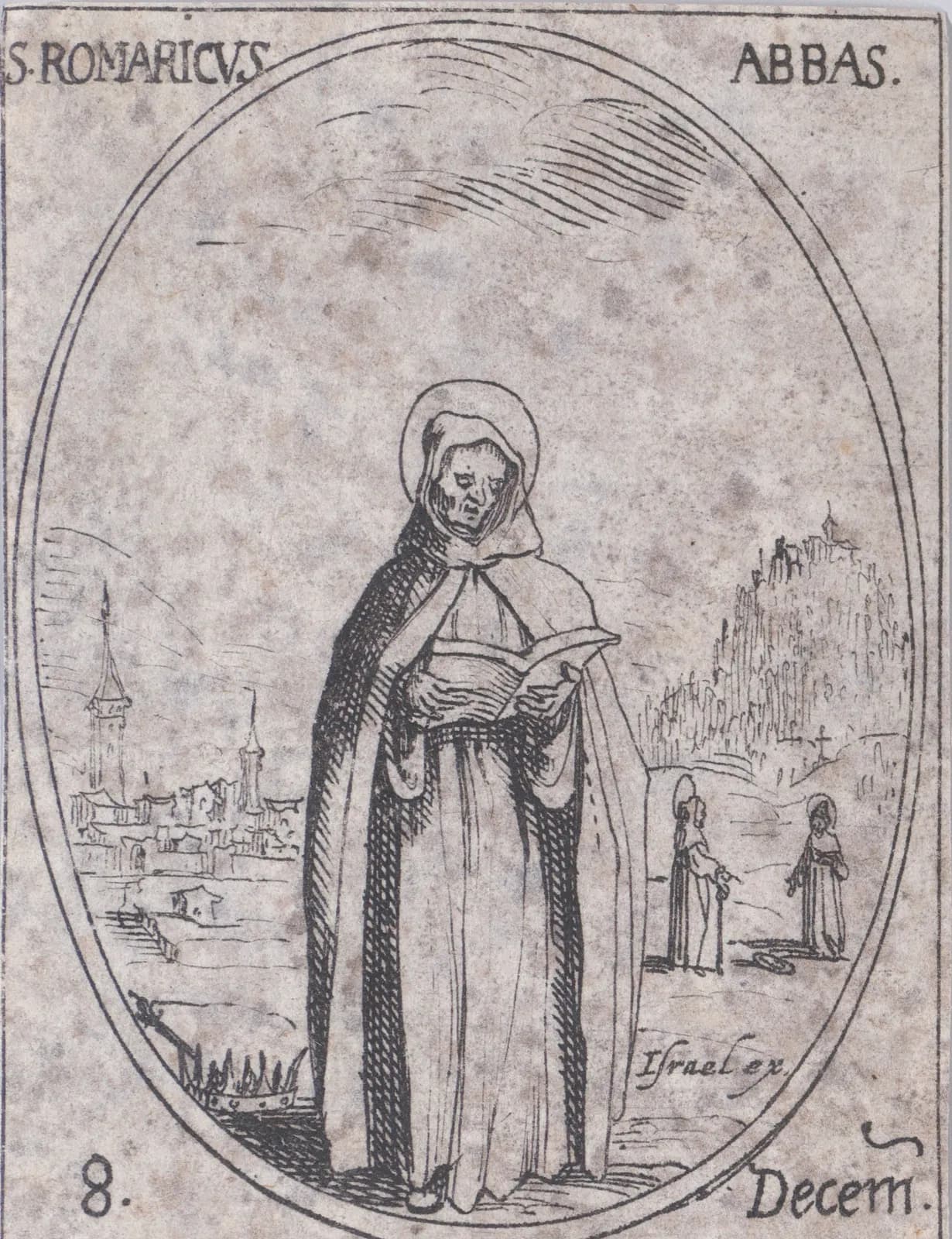
Saint Romaric was a Frankish noble of the court of Metz who became a monk of Luxeuil and, about 620, gave the estate he had kept for himself to found a double monastery in the Vosges mountains. 135 The house was named for him, Romarici Mons, and the town that grew up below it is Remiremont. 15 He governed it as abbot for some twenty-five years and died there on December 8, 653. 13
A courtier who lost everything
Romaric was born about 570 into a family related to the Merovingian royal house. 12 The Norwegian bishops' saints database (katolsk.no) says that kinship did not protect his father, whose death was ordered by Queen Brunhild, and that the family lands were confiscated, so that the young man was driven from the Vosges and wandered for years without a home. 1 Nominis, the French bishops' saints site, likewise says his goods were seized by the partisans of the cruel Queen Brunhild. 3
He rebuilt his fortunes. katolsk.no says he was married for a time and had three daughters, and that by the end of the sixth century he held office at the courts of Theodebert II and Clothaire II and owned a great many serfs. 1 Nominis calls him a father of a family and a "leude" of the court of Metz, a man bound to the court by a personal tie of service. 3 The Roman Martyrology, as the Italian bishops print it, remembers him as a counselor of King Theodebert. 4
Among his friends at court was Arnulf, later bishop of Metz. Francis Schaefer, in the 1907 Catholic Encyclopedia, says Arnulf's thoughts "dwelled often on monasteries," and that with "his friend Romaricus, likewise an officer of the court," he planned a pilgrimage to the abbey of Lérins, evidently to give his life to God. 6 The pilgrimage never happened, because Arnulf was made bishop of Metz about 611. 6
Amatus and Luxeuil
The turn came through a monk of Luxeuil named Amatus. katolsk.no says Abbot Eustace of Luxeuil sent Amatus out to preach because he had a gift for it, and that on one of these missions, which some historians date to 615, he came to the court at Metz and met Romaric. 2 The Romaric entry puts the meeting about 600. 1 Both entries say it was Amatus who converted him. 12 Nominis adds that Romaric had come out of his reverses convinced of the instability of human things. 3 The French text of the Martyrology says he withdrew to Luxeuil after the murder of Theodebert. 3
He entered Luxeuil, the monastery founded by the Irish abbot Columban, and became a monk there. 134 katolsk.no says that when he received the tonsure he set all his serfs free, and that several of them loved him so much that they asked the abbot to take them too and followed him into the monastery. 1 Its entry on Amatus says Romaric gave half his fortune to the poor and half to Luxeuil, keeping only a villa near the ruins of an old fort called Habendum. 2
The monastery on the mountain
King Clothaire II valued Romaric and called him back as an adviser, and in 620, katolsk.no says, gave him land in the Vosges beside the villa he had kept. 12 There, on a height above the Moselle, Romaric and Amatus founded a monastery. 12 Joseph Dedieu-Barthe, in the 1911 Catholic Encyclopedia, gives the same year and says it was founded "on hills above the site where the town now stands, whence the name Romarici Mons, Remiremont." 5 katolsk.no says it began as a convent of nuns, unusual at the time, and soon became a double monastery for men and women. 12 Nominis says the monks lived at the foot of the mountain and the nuns at the top, and that two of Romaric's daughters were among them. 3 katolsk.no adds that two grandchildren later entered as well. 1
Amatus was the first abbot, but he soon withdrew to a hermit's cell and came to the community only on Sundays and feast days to preach. 12 Romaric carried the daily government. 1 The nuns kept the perpetual praise, laus perennis, which Amatus brought from the abbey of Saint-Maurice at Agaune: seven choirs taking turns so that the office was sung day and night without a break. 123 The sources disagree about the numbers. katolsk.no's Romaric entry speaks of six hundred nuns besides the monks; its Amatus entry estimates more than eighty-four. 12
The early years were not untroubled. katolsk.no tells, from Jonas of Bobbio, how a monk named Agrestius, expelled from Luxeuil for siding with a schism, came to the mountain and won the two founders over, so that they grew cold toward Eustace when he rebuked them. 2 A run of misfortunes followed, which Romaric and Amatus took as a warning, and about 628, after Agrestius was dead, they asked Eustace's forgiveness and restored order. 2
Old friends came. katolsk.no says Arnulf gave up his see about 629 and came to end his days in a hermitage near the monastery. 12 Schaefer dates it about 626 and says Arnulf "and his friend Romaricus withdrew to a solitary place in the mountains of the Vosges." 6 When Arnulf died, his remains were "interred by Romaricus" before the bishop of Metz moved them to the city. 6
Abbot, and a last journey to Metz
Amatus died on September 13, 629, according to the history of the saints of Saint-Dié that Nominis quotes; katolsk.no says about 630. 23 Romaric, by then a priest, succeeded him as abbot of both communities, and katolsk.no says he governed alone for twenty-five years. 123 The French text of the Martyrology calls him the second abbot of the house he had founded on his own land. 3
Near the end of his life he was troubled by news from Metz. katolsk.no says he learned that Grimoald, the son of his old friend Pepin of Landen, was scheming to put the young prince Dagobert off the throne of Austrasia. 1 Old and ill, the abbot traveled to Metz, protested to Grimoald and warned the nobles who supported him. 1 They heard him in silence, treated him courteously and sent him back to his monastery. 1 Three days later he died there, on December 8, 653. 13 katolsk.no adds that Dagobert was sent away to Ireland and recovered his throne some twenty years later. 1 Nominis notes that he died on a Sunday. 3
Remiremont after Romaric
The founders were buried on the mountain, and katolsk.no says their relics were honored there for nearly two hundred years. 2 Then the nuns moved down to the valley and built a new house, taking the relics with them. katolsk.no dates the move to 870; Dedieu-Barthe says it was in 910, "as the Huns were wasting the country," and that that the town of Remiremont rose around that convent. 25 The monks stayed on the height until the French Revolution. 15
Pope Leo IX, himself from Lorraine, enshrined the relics of Romaric, Amatus and their successor Adelphus, which at that date was the equivalent of a canonization. 123 katolsk.no gives the year as 1051 in one entry and December 3, 1049, in the other; Nominis gives November 13, 1049. 123 Dedieu-Barthe traces the later history of the convent: a fire in 1057, a gradual loosening of the rule, the abbess made a princess of the empire in 1290, and the nuns declaring themselves canonesses who admitted only women of noble birth. 5 Convent and monastery were both suppressed in the Revolution. 5
What is Saint Romaric the patron saint of?
None of the sources consulted names a patronage for Saint Romaric. 135 He is remembered at Remiremont, which bears his name, and katolsk.no says the monastery shaped the growth of monastic life in the region and produced countless notable people. 15 Nominis prints a prayer of the diocese of Saint-Dié that names him with Amatus and Adelphus as men called to a fraternal life of prayer and sharing. 3
Saint Romaric's feast day
Praying with Saint Romaric
Romaric knew what it was to lose everything and to get it back by his own effort. The sources agree that it left him with a sense of how unstable the world's goods are, and that a preacher found him ready. 13 He gave away what he had regained, freed the people who belonged to him, and found that some of them wanted to come with him. 12
He spent most of his monastic life as the second man in a house he had paid for. Amatus was abbot and Romaric did the governing, and when the two of them went wrong over Agrestius, they went back together and asked pardon. 12
His last act was a journey he did not need to make. An old abbot rode to Metz to tell powerful men, the son of a friend among them, that what they were doing was wrong; they were polite, and he went home and died. 1 The sources do not say that he changed anything.
Saint Romaric, pray for us.
Sources
- 1."Den hellige Romarik av Remiremont," Den katolske kirke (katolsk.no), Catholic Diocese of Oslo (in Norwegian).
- 2."Den hellige Amatus av Remiremont (~567-~630)," Den katolske kirke (katolsk.no), Catholic Diocese of Oslo (in Norwegian).
- 3."Saint Romaric," Nominis, Conférence des évêques de France, quoting the history of the saints of the Diocese of Saint-Dié and the Roman Martyrology (in French).
- 4.Roman Martyrology, entry for December 8, "San Romarico, abate," as printed in "Santo del giorno," Conferenza Episcopale Italiana (in Italian).
- 5.Joseph Dedieu-Barthe, "Remiremont," The Catholic Encyclopedia, Vol. 12 (New York: Robert Appleton Company, 1911).
- 6.Francis Schaefer, "St. Arnulf of Metz," The Catholic Encyclopedia, Vol. 1 (New York: Robert Appleton Company, 1907).
Saints to turn to next
Others in this collection who are turned to for some of the same things.
- Saint Andrew Avellino1521 - November 10, 1608ConversionWork and vocationPrayer
- Saint Anthony Zaccaria1502 - July 5, 1539Work and vocationConversionPrayer
- Saint Bernardine of SienaSeptember 8, 1380 - May 20, 1444ConversionWork and vocationPrayer
- Saint John EudesNovember 14, 1601 - August 19, 1680PrayerWork and vocationConversion