Saint Robert of Newminster
Died June 1159
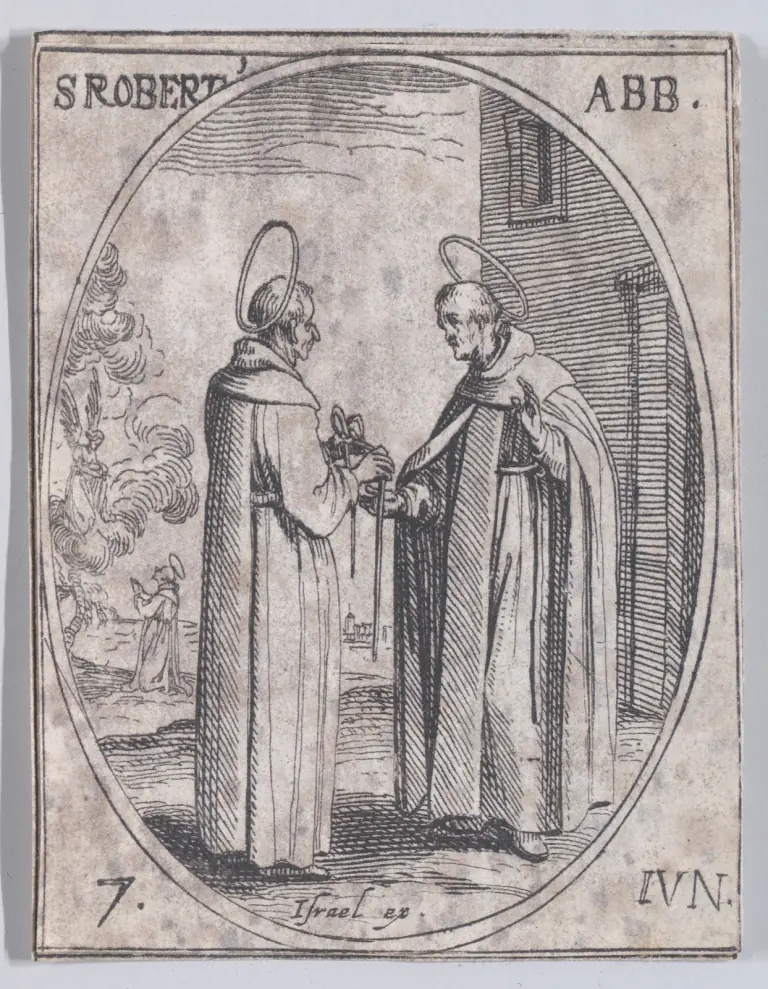
- Before Fountains
- Parish priest at Gargrave, then a Benedictine monk: at Whitby according to the encyclopedia and santiebeati, at Our Lady's in York according to Butler 123
- Abbot of
- Newminster, near Morpeth in Northumberland, founded from Fountains in 1137 or about 1138 123
Saint Robert of Newminster was a Yorkshire parish priest who became a monk, joined the community that founded Fountains Abbey, and about 1138 led its first colony north to found the Cistercian abbey of Newminster, near Morpeth in Northumberland. 123 Within ten years Newminster had sent out monks to found three more abbeys, and Robert was remembered for his prayer, his austerity and his friendship with Saint Bernard and with the hermit Godric. 123 He died in 1159, and his feast is June 7. 14
A priest from Craven
Robert was born in the district of Craven in Yorkshire, probably at the village of Gargrave, toward the end of the eleventh century. 13 Butler says that even as a child he cared nothing for the usual games, "loving only prayer, serious reading, and useful and pious employments." 2
He studied at the University of Paris, where the Catholic Encyclopedia says he "is said to have composed a commentary on the Psalms." 1 Back in England he was ordained and given the parish of Gargrave, his birthplace. 13 Butler describes him serving a parish in the diocese of York "with great assiduity and zeal" for some time before resigning it. 2
He wanted a more contemplative life and became a Benedictine. Where he did so is the first point on which the sources part. The encyclopedia and santiebeati say he entered the abbey of Whitby. 13 Butler says he took the habit in the Benedictine monastery of Our Lady at York. 2
Fountains
Butler tells the story of Fountains from its beginning. Richard, the prior of Our Lady's at York, and twelve others wanted to live the Rule of Saint Benedict as it had first been kept, and left the monastery with the abbot's leave. 2 They struggled with "incredible hardships" until Thurstan, the archbishop of York, gave them a deserted valley, and there, in the middle of winter and in extreme poverty, they founded the abbey that took its name from the springs of the place, in 1132. 2
The new community asked to be received into the Cistercian Order, and Saint Bernard accepted it. 2 Butler, drawing on Bernard's letters, describes a house where the monks lived by their own labor, sang the office without tiring, "never yielded to rest till fatigued with labour; and always came hungry from their slender table." 2
Robert joined them, with his abbot's permission according to the encyclopedia, having heard of their holiness according to santiebeati. 13 Among them, Butler says, he "seemed so far to eclipse the rest of this holy company by the lustre of his piety, that they all had their eyes on him." 2
Newminster
A few years after the foundation of Fountains, Ralph de Merlay, baron of Morpeth, visited the abbey and was so struck by the monks that he asked the abbot for some of them and built them a monastery near his castle at Morpeth in Northumberland. 12 It was called Newminster. Butler dates it to 1137, the encyclopedia to about 1138, and Lentini, writing on santiebeati, to 1138. 123 The current Roman Martyrology says Robert founded it with twelve companions. 4
Robert was made its first abbot. 123 Butler says he believed his new office obliged him not only to walk ahead of his brethren but to go beyond them in every observance, and that he prayed for those in his care "with many tears" night and day. 2 santiebeati says he kept the house in the simplicity he believed in and fasted on bread and water through the whole of Lent. 3
The community grew quickly. In the next ten years Newminster sent out three colonies, which founded the abbeys of Pipewell in 1143, Roche in 1147 and Sawley in 1148. 13 Butler mentions a single foundation, at "Pipinelle or Rivebelle in Northamptonshire." 2 The Martyrology speaks of three families of monks that sprang from Newminster in a short time. 4
The shipwreck, and an accusation
Butler says Robert was "favoured with the gift of prophecy and miracles." 2 santiebeati gives one example. During Mass he became aware that a ship had been wrecked near Whitby, though no news had come, and he sent his monks to help and to bury the dead. 3
A harder story concerns a charge brought against him. santiebeati says he was falsely accused of paying attention to a woman who lived near the abbey and went to Saint Bernard to clear himself, but found it unnecessary, because Bernard had already been given a revelation of his innocence. 3 The two became close friends, and Bernard gave Robert his belt, which was kept at Newminster and through which many of the sick were said to be healed. 3
The Catholic Encyclopedia is more cautious. It says the story that his own monks accused him of misconduct, and that he went abroad in 1147 and 1148 to defend himself before Bernard, comes from Capgrave's Life, and that doubt has been cast on it: it "may have arisen from a desire to associate the English saint personally with the greatest of the Cistercians." 1 Butler mentions only "the strictest union of holy friendship" with Bernard. 2
santiebeati adds that Robert met Pope Eugene III in France in 1147, who received him with honor and commended him to the bishop of Durham, in whose diocese Newminster lay; the bishop gave the abbey the district of Wolsingham. 3
Godric, and the end
Butler names a second friend, Saint Godric, a hermit of the north, "illiterate as to secular learning, but a most spiritual man." 2 santiebeati says they had known each other since Whitby, and that in 1159, sensing that his end was near, Robert went to say goodbye to him. 3
He fell ill in May. 3 He died in 1159, and santiebeati says he died surrounded by his monks, having received the sacraments. 123 The encyclopedia and Butler give the day as June 7; santiebeati gives June 6. 123 He was buried in a marble tomb in the abbey church. 3
Butler says miracles attested his holiness. 2 His tomb at Newminster became a place of pilgrimage. 13
What is Saint Robert of Newminster the patron saint of?
Saint Robert of Newminster's feast day
Saint Robert of Newminster's feast day is June 7. The current Roman Martyrology, as the Italian bishops print it, enters him on that day as an abbot of the Cistercian Order who, "desiring poverty and prayer," founded Newminster with twelve companions. 4 The Catholic Encyclopedia says his feast is kept on June 7, Butler places him on June 7 and says he is named in the Roman Martyrology, and santiebeati gives the same day. 123
Praying with Saint Robert of Newminster
Robert left a settled parish for a monastery, and then an old and settled monastery for a new community that had begun in a winter valley with almost nothing. 12 The Martyrology sums up what drew him in two words, poverty and prayer. 4
Butler's picture of him as abbot is of a man who prayed for his monks with tears and thought that being in charge meant going further than anyone else. 2
He was also accused of a sin, and one tradition says the accusers were his own monks. 13 The sources do not settle whether that story is true, and this page does not either.
The friendships are what the sources remember best: with Bernard, whom the encyclopedia calls the greatest of the Cistercians, and with Godric, a hermit with no secular learning, whom he went to see one last time when he knew he was dying. 123
Saint Robert of Newminster, pray for us.
Sources
- 1.Douglas Raymund Webster, "St. Robert of Newminster," The Catholic Encyclopedia, Vol. 13 (New York: Robert Appleton Company, 1912).
- 2.Alban Butler, "Saint Robert, Abbot of Newminster in England, of the Cistercian Order," June 7, in The Lives of the Fathers, Martyrs, and Other Principal Saints, Vol. VI (1812 edition).
- 3.Antonio Borrelli and Mariella Lentini, "San Roberto di Newminster," Santi, beati e testimoni, santiebeati.it (in Italian).
- 4.Roman Martyrology, entries for June 7, Santo del giorno, Conferenza Episcopale Italiana (in Italian).
Saints to turn to next
Others in this collection who are turned to for some of the same things.
- Saint Agnes of Bohemiac. 1200-1205 - March 1281 or 1282Poverty and simplicityPrayer
- Saint Aidan of Lindisfarnec. 590 - August 31, 651Poverty and simplicityPrayer
- Saint Alexius of RomeFifth century, by traditionPoverty and simplicityPrayer
- Saint Alonso de OrozcoOctober 17, 1500 - September 19, 1591PrayerPoverty and simplicity