Saint Richard of Wessex
Died at Lucca, c. 720-722
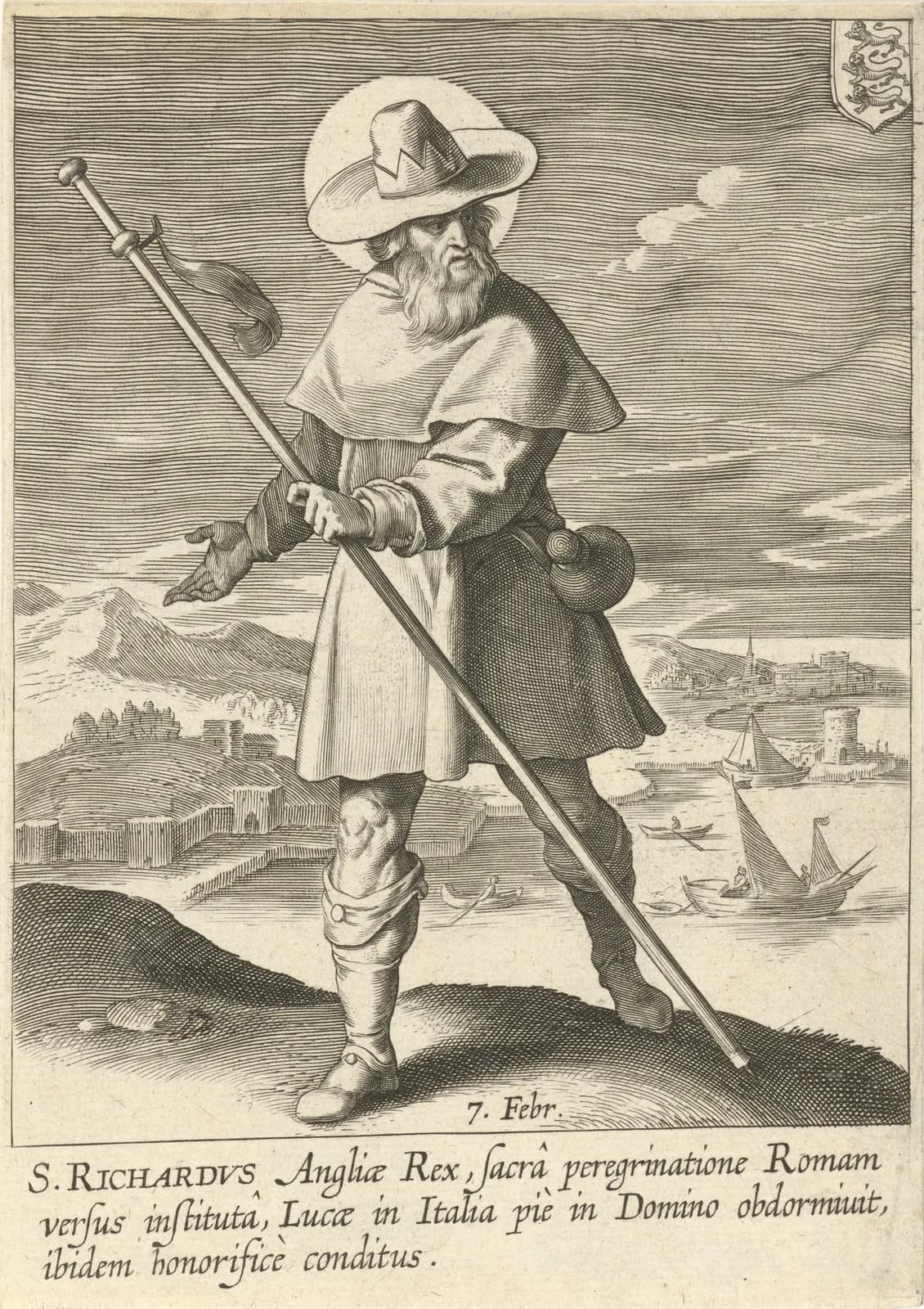
Saint Richard was a man of Wessex, the father of Saints Willibald, Wynnebald and Walburga, who set out with his two sons on pilgrimage to Rome and died on the way at Lucca, in Tuscany. 123 His son's biographer never gives his name, and several of the sources say that "Richard" and the title of king were added by later centuries. 127 The Roman Martyrology keeps him on February 7, as a father who died on the road while making a pilgrimage with his children. 3
A father without a name
Nearly everything known about him comes from the Hodoeporicon, the account of Willibald's travels that Huneberc, a nun of Heidenheim, wrote down from the bishop's own telling. 17 In it he is only "his father." 1 The Norwegian bishops' saints database (katolsk.no) says plainly that his name is not known, and that he and his wife Wunna are first named in the eleventh century. 2 C. H. Talbot, translating the Hodoeporicon, points in a note to "the legend created by Reginald of Eichstatt about St. Richard." 1
The title of king has the same history. The 1912 Catholic Encyclopedia calls him "St. Richard, commonly called the King," and in its article on Walburga makes him "one of the under-kings of the West Saxons." 56 Alban Butler, more carefully, calls him an English prince who was "perhaps deprived of his inheritance by some revolution in the state," or gave it up for the sake of Christian perfection. 4 katolsk.no says he is wrongly called an English king, and notes that some think he was a duke from Swabia. 2
A Spanish entry on Catholic.net goes furthest. It says the people of Lucca and Eichstätt, who venerated him, gave him a name, a life and a rank, "king of the English," though England had no King Richard before the Lionheart; and that the older Roman Martyrology listed him as "sanctus Richardus rex Anglorum," a description the present one has dropped. 7 All that can be said of his position, it concludes, is that he was well enough off to pay for long journeys. 7
The child at the cross
Huneberc gives one scene from his life at home. When Willibald was three, he fell so ill that his parents thought he would die. 1 They carried him, she writes, not into a church but to the foot of a cross, "for on the estates of the nobles and good men of the Saxon race it is a custom to have a cross, which is dedicated to our Lord and held in great reverence, erected on some prominent spot." 1 There they vowed that if the child lived they would have him tonsured and give him to the monastic life, and he recovered. 1
Butler tells the same story with the father alone at the center: Richard "obtained by his prayers the recovery of his younger son Willibald," laying him at the foot of a great crucifix "when the child's life was despaired of." 4 In Huneberc it is both parents who pray and both who keep the vow. 1 At five the boy was taken to the monastery of Waldheim, Bishops Waltham in Hampshire, and handed over to Abbot Egwald. 15
Persuaded to go
The pilgrimage was not his idea. Huneberc says that when Willibald, now a grown monk, resolved to travel abroad, he went to his father and begged him to come too, to leave the world and its "false prosperity of wealth" and visit the shrine of Saint Peter. 1 His father refused at first, "on the plea that he could not leave his wife and small children. It would be cruel, and unchristian, he said, to deprive them of his protection." 1 Willibald kept at him, by turns with "fearful threats of damnation" and "bland promises of eternal life," until he and Willibald's brother Wynnebald gave their word. 1
One of those small children was Walburga. Gertrude Casanova, in the encyclopedia, says that when the father set out with his two sons he left his daughter, then eleven, with the abbess of Wimborne. 6 Casanova says the journey was to the Holy Land; Huneberc names Rome as the goal, and Catholic.net says Rome and the Holy Land. 167
They left, in Huneberc's telling, toward the end of summer, with money for the road and a band of friends, and took ship at Hamblemouth near the port of Hamwih. 1 They landed on the Seine and camped near Rouen, then went on by stages, praying at the shrines of the saints along the way. 1 katolsk.no puts the departure in 720, and Catholic.net in the spring of that year. 27
Death at Lucca
At Lucca the father was "struck down almost at once by a severe bodily sickness," Huneberc writes, and after a few days it was clear he was dying. 1 "As the sickness increased, his weary limbs grew cold and stiff, and in this way he breathed his last." 1 His sons wrapped his body in a fine shroud and buried it in the Church of Saint Frigidian at Lucca, "where it still rests." 1 Then they went on over the Apennines to Rome. 1
The sources differ on the year. katolsk.no gives February 7, 720, or possibly 722. 2 Butler says he "died suddenly, about the year 722," and the encyclopedia dates the pilgrimage to Rome to 722. 45 Catholic.net gives 720. 7 Casanova adds that the news of his death reached Walburga at Wimborne scarcely a year after she arrived. 6
King Richard of Lucca
The cult grew at his grave. Butler says his relics were still venerated at Saint Frigidian's, his festival kept at Lucca "with singular devotion," and that many had felt the power of his intercession there. 4 Catholic.net also mentions miracles at the tomb. 7 katolsk.no says the relics were enshrined in 1150 and that part of them went in 1154 to Eichstätt in Bavaria, where his son Willibald had been bishop, so that he was honored in both cities. 2
katolsk.no adds that he is named in none of the old martyrologies, but that his feast was kept on February 7, above all at Lucca, where he is honored as "King Richard." 2 It also records a legend: on the way to Rome, father and sons stopped at an inn where a man lay dying, and when Richard went in and spoke with him, the man was healed. 2
His children are better known than he is. Willibald became the first bishop of Eichstätt and Wynnebald abbot of Heidenheim, where the brothers founded a double monastery, and Walburga governed its nuns. 56
What is Saint Richard of Wessex the patron saint of?
Saint Richard of Wessex's feast day
Saint Richard's feast day is February 7. 234 The current Roman Martyrology records on that day his deposition at Lucca, as the father of Saints Willibald and Walburga, who died on the road while on pilgrimage with his children from England to Rome. 3 Butler gives the same day for both the Martyrology and the feast at Lucca, and katolsk.no says it was kept above all in that city. 24
Praying with Saint Richard of Wessex
The one speech the Hodoeporicon gives him is a refusal, and a reasonable one: he had a wife and small children, and thought it would be cruel to leave them. 1 His son kept arguing until he gave way. 1
He did not see Rome. He got as far as Lucca and died there after a few days' illness, and his sons buried him and went on. 1 Whatever he had hoped to find at the shrine of Saint Peter, he did not reach it. 1
Later centuries gave him a name and a crown and set him among the kings. 27 The oldest account gives him something smaller: a father who carried a dying child to a wayside cross, and who, when the child grew up and asked him to leave everything, eventually went. 1
Saint Richard of Wessex, pray for us.
Sources
- 1.Huneberc of Heidenheim, "The Hodoeporicon of St. Willibald," in C. H. Talbot, trans., The Anglo-Saxon Missionaries in Germany (London and New York: Sheed and Ward, 1954), with Talbot's notes, Internet Medieval Sourcebook, Fordham University.
- 2."Den hellige Richard av Wessex," Den katolske kirke (katolsk.no), Catholic Diocese of Oslo (in Norwegian).
- 3.Roman Martyrology, entry for February 7, "San Riccardo," as printed in "Santo del giorno," Conferenza Episcopale Italiana (in Italian).
- 4.Alban Butler, "St. Richard, King and C.," February 7, in The Lives of the Fathers, Martyrs, and Other Principal Saints, Vol. I (New York, 1895), Project Gutenberg eBook #20450.
- 5.Francis Mershman, "Sts. Willibald and Winnebald," The Catholic Encyclopedia, Vol. 15 (New York: Robert Appleton Company, 1912).
- 6.Gertrude Casanova, "St. Walburga," The Catholic Encyclopedia, Vol. 15 (New York: Robert Appleton Company, 1912).
- 7."Ricardo, Santo," February 7, Catholic.net, after Alban Butler's Vidas de los santos (in Spanish).
Saints to turn to next
Others in this collection who are turned to for some of the same things.