Saint Emmelia
c. 300 - 372
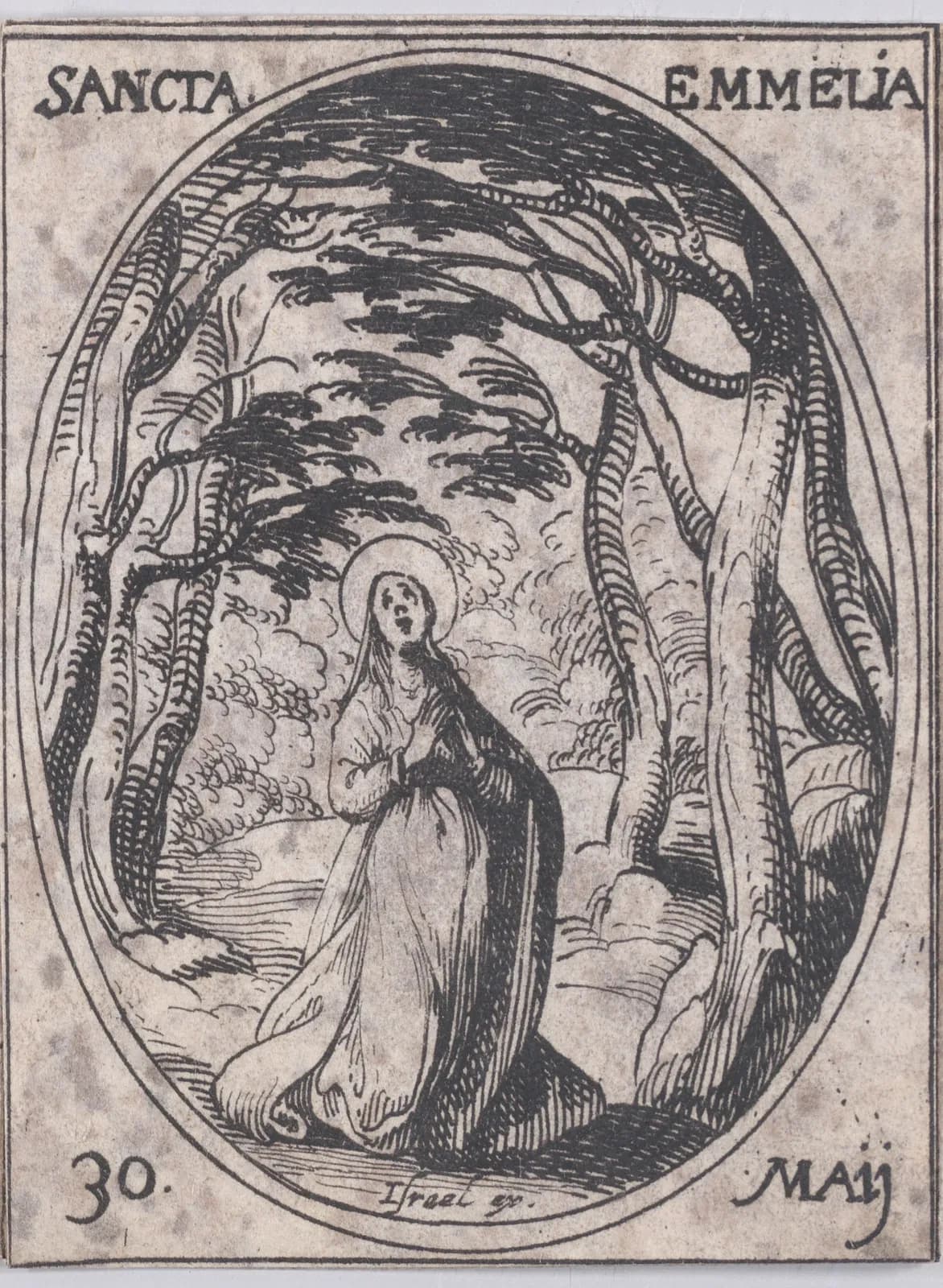
- Born
- About 300, at Caesarea in Cappadocia, says katolsk.no 1
- Children
- Ten, among them Macrina the Younger, Basil the Great, Gregory of Nyssa and Peter of Sebaste 126
- Died
- 372, says katolsk.no, and was buried at Annesi beside her husband 1
Saint Emmelia was the mother of four saints, among them Basil the Great and Gregory of Nyssa, and in old age she became a nun in the community her daughter Macrina led on the family's land in Pontus. 128 Almost everything known of her comes from her children and their friends. Gregory of Nazianzus, preaching at Basil's funeral, asked, "Who has not known Emmelia," and gave the credit for the whole family to the parents who brought them up. 3
A martyr's daughter in Cappadocia
Emmelia was born about the year 300 at Caesarea in Cappadocia, according to the Norwegian bishops' saints database (katolsk.no), which also gives her name as Eumelia or Emilia. 1 The Catholic Encyclopedia says twice that she was the daughter of a martyr, in its articles on Basil and on Gregory of Nyssa. 67 Meg Hunter-Kilmer, writing for Aleteia, counts that martyred father among the family's saints. 9
Gregory of Nazianzus, who knew the family well, describes her side of it in his funeral oration on Basil. "What family," he asks, "owns more numerous, or more illustrious generals and governors, or court officials, or again, men of wealth, and lofty thrones, and public honours, and oratorical renown?" 3 He says he will not dwell on it, because Basil himself held that each man's nobility should be judged by his own worth. 3
katolsk.no says that as a girl she wanted to enter a monastery, but that the early death of her parents led her to marry instead. 1 It dates the marriage to 315. 1 Her husband, Basil the Elder, came from a Christian family that had suffered in the persecutions. 16 The Catholic Encyclopedia describes him as a teacher in Caesarea with a considerable reputation; katolsk.no calls him a rich lawyer and a well-known rhetorician. 16
Ten children
Basil and Emmelia had ten children. 169 katolsk.no says five were sons and five daughters, and that nine survived. 1 The eldest was Macrina and the youngest Peter; Basil was born about 330. 18 Joseph McSorley's encyclopedia article counts three of them as saints, Macrina, Basil and Gregory, and notes that three sons, Basil, Gregory and Peter, became bishops. 6 katolsk.no counts four saints honored in both East and West, adding Peter, and a fifth, the deaconess Theosebia, honored by the Orthodox. 1
Gregory of Nazianzus thought the children were the parents' best claim to fame. The marriage, he says, was notable for "generosity to the poor, for hospitality, for purity of soul as the result of self-discipline," and for dedicating part of their property to God, but its "greatest claim to distinction is the excellence of their children." 3 One gifted child might be put down to nature, he argues, "but when all are eminent, the honour is clearly due to those who brought them up." 3
Then he names her. "Who has not known Emmelia, whose name was a forecast of what she became, or else whose life was an exemplification of her name? For she had a right to the name which implies gracefulness, and occupied, to speak concisely, the same place among women, as her husband among men." 3
Basil credits her with his faith. Defending his orthodoxy in a letter, he wrote: "The teaching about God which I had received as a boy from my blessed mother and my grandmother Macrina, I have ever held with increased conviction." 4 katolsk.no says she taught all her children to pray and to give their lives to the service of the Church, and calls her the mother of the saints; Hunter-Kilmer says she would come to be known as "mother of saints." 19
Widowhood and the house on the Iris
Basil the Elder died while his son Basil was still young. 6 katolsk.no puts his death about 340, when Peter was still an infant, and says Macrina stayed at home to help raise the youngest children. 1 Where the family went next, and when, the sources tell differently. J. P. Kirsch, in the encyclopedia's article on Macrina, says that on their father's death Basil took his sister and mother to a family estate on the River Iris in Pontus. 8 Hunter-Kilmer says that the widow and children moved to the estate of the elder Macrina. 9 katolsk.no places the move later, after Naucratius's death. 1
That death was the hardest blow. Naucratius, the encyclopedia says, was a lawyer drawn to the ascetic life who "died too young to realize his desires." 7 katolsk.no says he died suddenly about 358, at twenty-seven. 1 Hunter-Kilmer writes that Emmelia was heartbroken and that Macrina told her, "it is not right for a Christian to mourn as one who has no hope." 9 katolsk.no gives the same counsel from Saint Paul's letter to the Thessalonians, and says that Macrina then persuaded her mother to leave the world. 1
Emmelia divided the family property among her children, freed her slaves and kept only what she needed, katolsk.no says, and retired with Macrina to the estate on the Iris, near Amaseia. 1 Several of the freed women chose to join them, and the house became a convent where they lived, ate, worked and prayed together. 1 Hunter-Kilmer says it was Emmelia who started the community, at Macrina's prompting, and that many of the nuns were former slaves. 9 Kirsch names strict asceticism, meditation on the truths of the faith, and prayer as the chief concerns of the community. 8
Basil settled as a hermit across the river. 1 In the letter that credits her teaching, he also recalled the days he and a friend had spent "in the opposite village, at my mother's," talking together night and day. 4
Her death
katolsk.no says Emmelia lived this way for many years and reached a great age. 1 In her last illness her youngest son Peter came to her, and he and Macrina nursed her until she died in 372. 1 She was buried, as she had asked, beside her husband in the chapel on the estate at Annesi, where Naucratius also lay. 1 After her death Macrina became head of the community. 8
Basil wrote to his friend Eusebius of Samosata: "Now, for my sins, I have lost my Mother, the only comfort I had in life. Do not smile, if, old as I am, I lament my orphanhood." 5 He added that he could not bear the separation from a soul with whom he could compare nothing in the life still before him. 5
What is Saint Emmelia the patron saint of?
None of the sources consulted names a patronage for Saint Emmelia. She is remembered as a mother, and katolsk.no gives her the title of mother of the saints. 1 Gregory of Nazianzus's judgment is the oldest and the plainest: when every child of a family turns out well, the honor belongs to those who raised them. 3
Saint Emmelia's feast day
Saint Emmelia's feast day is May 30. 12 The current Roman Martyrology keeps her that day together with her husband, as the parents of Basil, Gregory of Nyssa, Peter of Sebaste and Macrina, who were driven from their home under Galerius Maximian, lived in the wilds of Pontus and, once the persecution was over, died in peace. 2 Gregory of Nazianzus tells the flight into the mountains of Pontus as the story of Basil's paternal ancestors in the persecution of Maximinus. 3 Hunter-Kilmer gives May 30 as the feast of Emmelia and Macrina the Elder. 9 katolsk.no adds that churches of the Russian tradition remember her on January 1, with her son Basil. 1
Praying with Saint Emmelia
Emmelia left no writings, and nobody wrote her life on its own. She is known through her children and their friends: two of Basil's letters, and the sermon Gregory of Nazianzus preached at Basil's funeral. 345
What they remembered was specific. Basil remembered the teaching he took from her as a boy and never changed. 4 Gregory of Nazianzus remembered a household known for its hospitality and its care for the poor. 3 Basil, as an old man, remembered the days at his mother's house across the river, and wrote of losing her as the loss of the one comfort he had. 45
She also learned from her own daughter. When Naucratius died, it was Macrina who reminded her of the Christian hope, and Macrina who drew her into a life of prayer in which the freed slaves of the household became her sisters. 19 katolsk.no says Macrina gave her mother the courage to hope in the resurrection. 1
Saint Emmelia, pray for us.
Sources
- 1."De hellige Basilios den Eldre og Emmelia (270-340/~300-372)," Den katolske kirke (katolsk.no), Catholic Diocese of Oslo (in Norwegian).
- 2.Roman Martyrology, entry for May 30, "Santi Basilio e Emmelia, sposi," as printed in "Santo del giorno," Conferenza Episcopale Italiana (in Italian).
- 3.Saint Gregory of Nazianzus, Oration 43, Funeral Oration on the Great S. Basil, trans. Charles Gordon Browne and James Edward Swallow (Nicene and Post-Nicene Fathers, Second Series, vol. 7), New Advent.
- 4.Saint Basil the Great, Letter 223, trans. Blomfield Jackson (Nicene and Post-Nicene Fathers, Second Series, vol. 8), New Advent.
- 5.Saint Basil the Great, Letter 30, To Eusebius of Samosata, trans. Blomfield Jackson (Nicene and Post-Nicene Fathers, Second Series, vol. 8), New Advent.
- 6.Joseph McSorley, "St. Basil the Great," The Catholic Encyclopedia, Vol. 2 (New York: Robert Appleton Company, 1907).
- 7.Henri Leclercq, "St. Gregory of Nyssa," The Catholic Encyclopedia, Vol. 7 (New York: Robert Appleton Company, 1910).
- 8.Johann Peter Kirsch, "St. Macrina the Younger," The Catholic Encyclopedia, Vol. 9 (New York: Robert Appleton Company, 1910).
- 9.Meg Hunter-Kilmer, "A family and their friends with at least a dozen saints," Aleteia, May 25, 2017.
Saints to turn to next
Others in this collection who are turned to for some of the same things.
- Saint AnneFirst century BC to first century ADParentingMarriage and family
- Saint Clotildec. 474 - June 3, 545Marriage and familyParenting
- Saint Elizabeth Ann SetonAugust 28, 1774 - January 4, 1821ParentingMarriage and family
- Saint Gianna Beretta MollaOctober 4, 1922 - April 28, 1962Marriage and familyParenting