Saint Richard of Chichester
c. 1197 - April 3, 1253
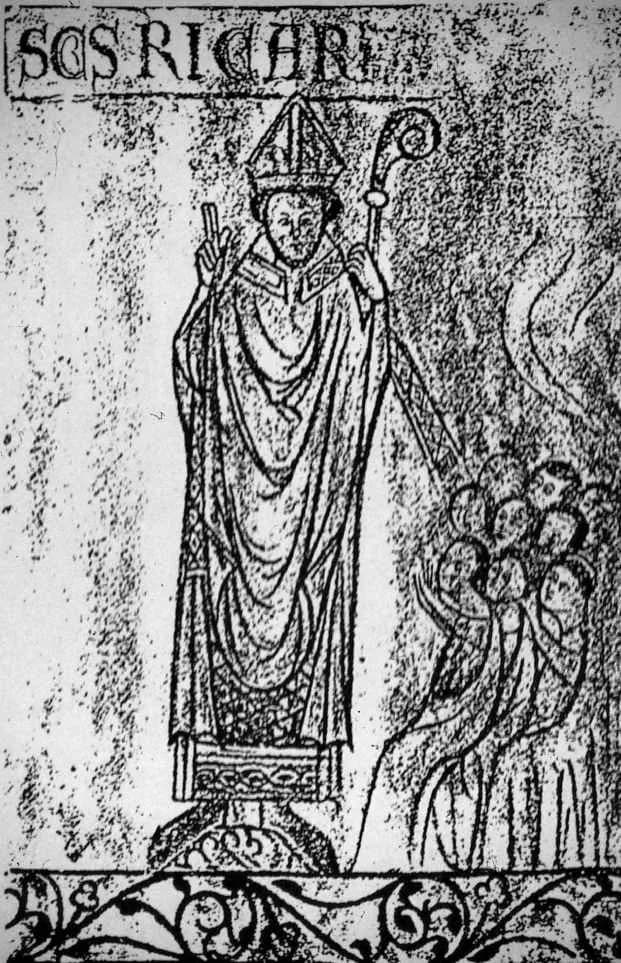
- Patron saint of
- Coachmen; Sussex; the city and diocese of Chichester, according to Catholic Culture 4
- Feast day
- April 3 134; kept on June 16, the anniversary of the translation of his relics, in the national calendar for England 12
- Consecrated bishop
- By Pope Innocent IV in person, at Lyons, March 5, 1245 1
Saint Richard of Chichester was elected bishop in 1244, consecrated by the pope himself, and then kept out of his own diocese by Henry III, who would not hand over its lands or its income. 1 For about two years he lived on the charity of his clergy, sharing a parish priest's house and visiting his parishes on foot. 12 When the king gave way, Richard spent his revenues on the poor and wrote the statutes that reformed his diocese. 12 His feast is April 3, the day he died at Dover in 1253. 134
Droitwich, a farm, and one gown among three
He was born about 1197 at Droitwich in Worcestershire, the town that gave him his surname, de Wyche, and he was the second son of Richard and Alice de Wyche. 1 His father died while he was young, and Gilbert Huddleston, writing in the 1912 Catholic Encyclopedia, says the family property "fell into a state of great delapidation." 1 Richard took over the management of it and brought it back into good order. His elder brother then offered to give him the inheritance, and he refused. 1
The sources tell this part differently. Catholic Culture has both brothers orphaned young and the farms belonging to the brother, and says Richard turned down not only the estate but "the opportunity of a brilliant marriage, since he desired to give himself to God's service." 4 The Liturgy Office of England and Wales says simply that as a boy he worked on his father's farm. 2 Every version agrees that he left the land to study.
At Oxford he and two companions were so poor that, Huddleston writes, "they had only one tunic and hooded gown between them, in which they attended lectures by turns." 1 He went on to Paris, came back to take his Master of Arts, and studied canon law at Bologna, where he made a name for himself. 14 Oxford elected him its chancellor. 1
Chancellor to Saint Edmund
His reputation reached two bishops at once. Edmund Rich, Archbishop of Canterbury, and Robert Grosseteste, Bishop of Lincoln, both offered him the chancellorship of their dioceses. 1 He took Canterbury, and from then on, Huddleston says, he was Edmund's "intimate friend and follower." 1
Edmund was already in conflict with the king over sees left vacant, and Richard backed him. 1 He went with the archbishop into exile at Pontigny, was with him at Soissy when he died, and afterward supplied the chronicler Matthew Paris with material for a life of Edmund. 1
After Edmund's death he went to the Dominican house at Orléans, studied theology and was ordained priest. 14 The Liturgy Office notes he was forty-five by then. 2 He founded a chapel in Edmund's honor, came home to be vicar of Deal and rector of Charing, and was soon persuaded by Edmund's successor, Boniface of Savoy, to take up the chancellorship again. 1
Elected against the king's man
Ralph Neville, Bishop of Chichester, died in 1244. The cathedral chapter elected Robert Passelewe, the archdeacon of Chichester, and Archbishop Boniface quashed the election at a synod of his bishops on June 3, 1244. 1 On his recommendation the chapter then chose Richard, and the archbishop confirmed it at once. 1 Catholic Culture says the archbishop had declared the king's candidate unqualified. 4
Henry III was indignant. Passelewe, in Huddleston's words, "was a favourite," and the king refused to surrender the temporalities of the see to the new bishop: the lands, the houses and the income that came with it. 1 Richard took his case to Innocent IV, who consecrated him in person at Lyons on March 5, 1245, and sent him back to England. 1 "But Henry was immovable." 1
Homeless in his own diocese
So the Bishop of Chichester came home to a diocese where he owned nothing. Huddleston: "Thus homeless in his own diocese, Richard was dependent on the charity of his clergy, one of whom, Simon of Tarring, shared with him the little he possessed." 1 The Liturgy Office says he lived in a priest's house, went round the parishes on foot, and looked after an orchard. 2 Catholic Culture says he suffered "many hardships and persecutions for two years, repaying with favors those who persecuted him." 4
How long it lasted depends on the source. Huddleston says that in 1246 the king was "induced by the threats of the pope to deliver up the temporalities." 1 The Liturgy Office says Richard could not take over the see until 1247, and Catholic Culture says his revenues were restored after two years. 24
Bishop of Chichester
Once he had his income, he gave most of it away. Huddleston says he "lived in great austerity, giving away most of his revenues as alms." 1 The Liturgy Office remembers him for "his generosity to the poor, the mercy he showed to sinners, and the reform of the liturgical life of his diocese." 2 Vatican News credits his ministry with work for the reform of the clergy, for the sacraments to be given free of charge, for Mass to be celebrated in dignified conditions, and with care for the poor and the sick. 3
The reform had a document behind it. He compiled statutes regulating in detail the lives of the clergy, the celebration of divine service and the administration of the sacraments, and every priest in the diocese had to get a copy and bring it to the diocesan synod. 1 By that means, Huddleston says, "the standard of life among the clergy was raised considerably." 1 He set up a yearly collection in every parish, at Easter or Whitsunday, for the upkeep of the cathedral, and he gave particular encouragement to the friars, the Dominicans above all. 1
The crusade and Dover
In 1250 the pope named him one of the collectors of the subsidy for the crusade, and two years later the king who had once kept him out of his see appointed him to preach the crusade in London. 1 He worked hard at it across the dioceses of Chichester and Canterbury. 1
On the way to Dover, where he was to consecrate a new church dedicated to Saint Edmund, he fell ill. 1 He lodged at a hospital there called the Maison Dieu, consecrated the church on April 2, and died the next morning, April 3, 1253. 1 Catholic Culture says he foretold his death and gives his age as fifty-six. 4
His body was carried back to Chichester and buried in the cathedral, before an altar he had put up himself, Catholic Culture says, and it adds that miraculous cures occurred at the tomb. 14 Urban IV canonized him in 1262 in the Franciscan church at Viterbo. 14
His relics were moved to a new shrine behind the high altar on June 16, 1276, by Archbishop Kilwardby with Edward I present. 1 At the Reformation the shrine was rifled and destroyed; Catholic Culture dates the plundering to 1538, by order of Thomas Cromwell. 14 Huddleston adds that the much-restored tomb in the south transept now pointed out as Richard's "has no evidence to support its claim, and no relics are known to exist." 1
What is Saint Richard of Chichester the patron saint of?
Catholic Culture lists Saint Richard as patron of coachmen, of Sussex in southern England, and of the city and diocese of Chichester. 4 The encyclopedia, the Liturgy Office and Vatican News assign him no patronage. 123 Catholic Culture adds that since 2007 the date of his translation, June 16, has been kept in the county as Sussex Day. 4
He is also remembered for a prayer. Catholic Culture prints a prayer of thanksgiving to Christ, attributed to him and associated with his deathbed, and notes that the hymn "Day by Day" takes its lyrics from it. 4 This page does not reproduce it.
In pictures he is shown as a bishop with a chalice lying on its side at his feet. Catholic Culture explains the emblem by a story that he once dropped the chalice at Mass and nothing spilled from it. 4 None of the other sources tells the story.
Saint Richard of Chichester's feast day
The feast of Saint Richard of Chichester is April 3, the day he died at Dover in 1253. "The feast is celebrated on 3 April," the encyclopedia says, and Vatican News and Catholic Culture both list him on that day. 134
In England the national calendar keeps him on June 16 instead, under the title of bishop. 2 That is the anniversary of the translation of his relics to the new shrine at Chichester in 1276. 1
Praying with Saint Richard of Chichester
For most of two years he was a bishop the king would not let have a bishopric. He had been elected, confirmed by his archbishop and consecrated by the pope, and none of it gave him a roof. 1 What the sources record of that time is small and practical: a priest named Simon of Tarring sharing what little he had, a bishop walking from parish to parish, an orchard to look after. 12 It is a picture of authority without any of its comforts, and of a man who used it anyway.
His life also turns on a friendship. He followed Edmund into exile, was with him when he died, and kept his memory for years afterward, down to a last journey to Dover to consecrate a church in Edmund's name. 1 He died the morning after he had done it. 1
The reform he carried out was unglamorous work. Statutes every priest had to own and bring to synod, a collection in every parish for the cathedral, the sacraments without a fee, Mass celebrated with some dignity. 13 The Liturgy Office sums up what Chichester remembered: generosity to the poor, mercy to sinners, and the liturgy put in order. 2
There is no reconciliation scene with the king in any of the sources. Henry gave up the temporalities under papal pressure, and a few years later sent Richard to preach his crusade. 1 Richard went, and was still on the road when he fell ill.
Saint Richard of Chichester, pray for us.
Sources
- 1.Gilbert Huddleston, "St. Richard de Wyche," The Catholic Encyclopedia, Vol. 13 (New York: Robert Appleton Company, 1912).
- 2."St Richard of Chichester, bishop," 16 June, National Calendar for England, Liturgy Office of England and Wales.
- 3."St. Richard, Bishop of Chichester in England," Saint of the Day, 3 April, Vatican News.
- 4."St. Richard of Chichester," Liturgical Year, April 3, Catholic Culture (biography from Rosalie Marie Levy, Heavenly Friends: A Saint for Each Day).
Saints to turn to next
Others in this collection who are turned to for some of the same things.
- Saint James the LessFirst centuryPrayerPoverty and simplicityCourage
- Saint Katharine DrexelNovember 26, 1858 - March 3, 1955Poverty and simplicityPrayerCourage
- Saint Laurence O'Toolec. 1128 - November 14, 1180CouragePrayerPoverty and simplicity
- Saint Louis de MontfortJanuary 31, 1673 - April 28, 1716PrayerPoverty and simplicityCourage