Saint Raymond of Penyafort
1175 - January 6, 1275
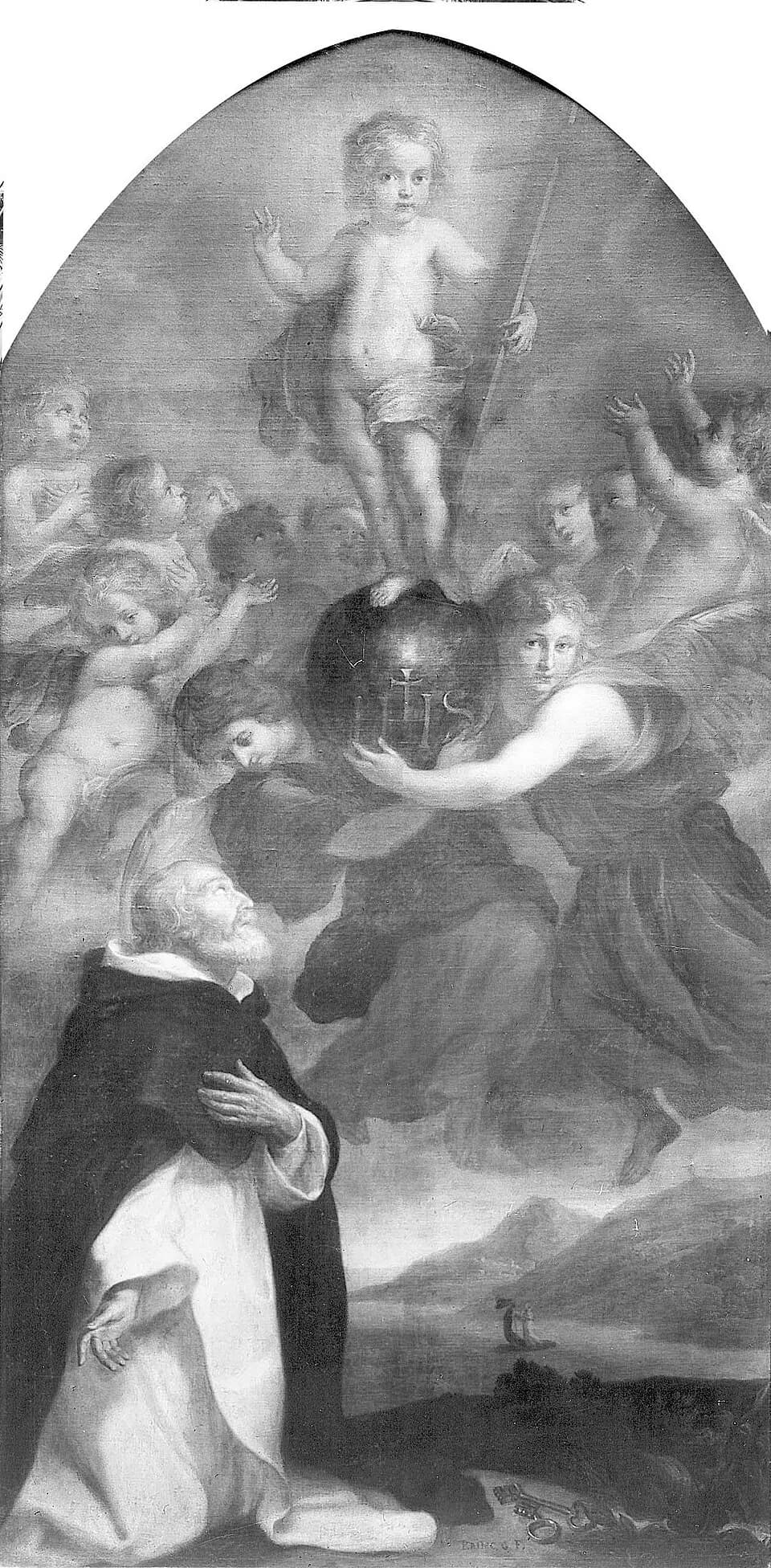
- Patron saint of
- Lawyers, according to Franciscan Media 4; Vatican News says he is "invoked as protector of jurists" 3. Catholic Culture lists attorneys, barristers, canon lawyers, lawyers, medical record librarians, and Barcelona, Navarre and Majorca 7
- Born
- 1175, at Villafranca de Benadis near Barcelona according to the 1911 Catholic Encyclopedia 1, at Peñafort in Catalonia according to Vatican News 2
- Master General
- Elected 1238; resigned two years later 1
Saint Raymond of Penyafort was a Catalan Dominican and canon lawyer who, at the request of Pope Gregory IX, gathered centuries of scattered papal decrees into the collection known as the Decretals. 14 Franciscan Media says it was regarded as one of the best organized collections of Church law until the Code of 1917. 4 He also wrote a handbook of cases for confessors, served for two years as Master General of his order, and died at Barcelona in 1275, by most accounts in his hundredth year. 124
A lawyer from Catalonia
The sources agree on 1175 and on Catalonia, and on little else about his birth. Michael O'Kane, writing in the 1911 Catholic Encyclopedia, gives Villafranca de Benadis, near Barcelona. 1 Vatican News gives Peñafort, and says the family was wealthy and noble. 2 Galway Cathedral's profile names Villafranca del Penedès and gives the day as January 6. 6 An older life of him, reprinted by Catholic Culture, says only that he was born at Barcelona, "of the noble family of Peñafort." 7
He was a teacher young. Franciscan Media says he was teaching philosophy by the age of twenty. 4 O'Kane says he became professor of canon law in 1195 and taught for fifteen years, then left for Bologna in 1210 to complete his studies, held a chair of canon law there for three years, and wrote a treatise on Church legislation that the encyclopedia says still survived in the Vatican Library. 1 Franciscan Media has him earning a doctorate in both canon and civil law in his early thirties. 4
What brought him back to Spain is told two ways. Vatican News says Berenguer IV, Count of Barcelona, met him on a journey to Italy and asked him to teach at a seminary he meant to found. 2 The older life says it was Berengarius, Bishop of Barcelona, who called at Bologna on his way home from Rome and, "after most earnest entreaties," took Raymond with him, and that he became a canon and provost of the cathedral. 7
A Dominican, and the Mercedarians
O'Kane says he was drawn to the Dominicans by the preaching of Blessed Reginald, prior of the Dominicans at Bologna, and received the habit at Barcelona in 1222, after returning from Italy. 1 Vatican News gives the same year. 2 Franciscan Media puts his age at the time at forty-one, the older life at "about forty-five." 47
Around the same time he was involved in founding the Order of Our Lady of Mercy, the Mercedarians, whose work was ransoming Christians held captive. 57 The sources weigh his part differently. O'Kane calls him co-founder with Saint Peter Nolasco. 1 Vatican News says he founded the order "with the help of" Nolasco, a year after joining the Dominicans. 2 Pope Leo XIV, in his 2025 exhortation Dilexi te, says the order was "founded by Saint Peter Nolasco with the support of the Dominican Saint Raymond of Peñafort." 5 The older life adds that the Virgin appeared to Nolasco, to Raymond and to King James I of Aragon, and that Raymond drew up the order's rule. 7
He also wrote, at his superiors' request, the Summa Casuum, a book of cases for confessors that O'Kane says went through several editions in the sixteenth and seventeenth centuries. 1 Franciscan Media describes it as more than a list of sins and penances: it discussed the doctrines and laws bearing on each case a confessor might meet. 4
The Decretals
In 1229 he became theologian and penitentiary to Cardinal John of Abbeville, and in 1230 Gregory IX summoned him to Rome and made him his chaplain and grand penitentiary. 1 Franciscan Media adds that he was the pope's confessor. 4
The pope then gave him the work he is remembered for. The decrees of popes and councils had been piling up for centuries in some twelve or fourteen collections. 1 O'Kane cites a bull of Gregory IX complaining that many of them repeated earlier decrees, many contradicted them, many were so long they caused "endless confusion," and others had never been collected at all and were "of uncertain authority." 1 Raymond had to rewrite and condense the lot. 1 Franciscan Media describes the task as gathering everything decreed in the eighty years since Gratian's collection, and says the result filled five books. 4
According to O'Kane, the pope announced the new collection in a bull to the doctors and students of Paris and Bologna, and ordered that Raymond's work alone was to be considered authoritative and used in the schools. 1 Galway Cathedral says it remained the standard for seven hundred years. 6 Vatican News suggests that "perhaps he would have done without it, but one cannot refuse the Pope." 2
Most sources say that when the work was done, the pope offered him the archbishopric of Tarragona and he declined it. 127 Franciscan Media tells it differently: he was appointed archbishop at sixty, "didn't like the honor at all," fell ill and resigned after two years. 4
Master General, and the last thirty-five years
Back in Spain, he was not left alone for long. In 1238 the Dominicans elected him Master General, and he resigned two years later. 1 Vatican News counts him the third to hold the office, after Dominic and Jordan of Saxony, and says he visited the order's houses across Europe on foot. 2 In those two years he published a revised edition of the Dominican Constitutions. 1 Franciscan Media says he got a provision into them allowing a master general to resign, and resigned once they were accepted. 4
He then turned to training the friars who would preach outside the faith. O'Kane says he founded institutes at Barcelona and Tunis for the study of oriental languages, "to convert the Moors and Jews." 1 Vatican News says he set up a school of Hebrew at Murcia and one of Arabic at Tunis, because he was convinced that preachers needed to know the culture of the people they hoped to reach. 2 O'Kane and Franciscan Media both say it was at his request that Thomas Aquinas wrote the Summa Contra Gentiles. 14
The older life says he persuaded King James of Aragon to establish the Inquisition in his lands. 7 Galway Cathedral says he was often consulted on its practice there and brought "a sense of justice and compassion" to it. 6 Neither source says more, and this page does not either.
He died at Barcelona on January 6, 1275. 12 Vatican News gives his age as one hundred, says that "it is said" many miracles took place at his funeral, and notes that his remains lie in Barcelona's cathedral. 2 Clement VIII canonized him in 1601. 12
The cloak on the sea
The best-known story about him is not in the encyclopedia, Vatican News or Franciscan Media. It comes from the older tradition of his life. In Galway Cathedral's telling, Raymond was the confessor of King James of Aragon, who took a mistress with him to Majorca. When Raymond could not persuade the king to send her away, he tried to leave the island, and the king threatened any captain who took him on board. Raymond, it says, "made a boat out of his cloak, using his staff as a mast," and sailed the 160 miles to Barcelona in six hours, after which "King James mended his ways." 6
The older life reprinted by Catholic Culture counts it among his miracles: he "spread his cloak upon the sea, and sailed upon it, in the space of six hours, the distance of a hundred and sixty miles," and on arrival entered his convent "through the closed doors." 7 This page reports it as those sources give it.
What is Saint Raymond of Penyafort the patron saint of?
Franciscan Media lists him as patron saint of lawyers. 4 Vatican News says that because he was "a great canon lawyer" he "is invoked as protector of jurists." 3 Catholic Culture gives a longer list: attorneys, barristers, canon lawyers, lawyers and medical record librarians, and the places Barcelona, Navarre and Majorca. 7
Saint Raymond of Penyafort's feast day
Praying with Saint Raymond
Most of what is recorded of him is work: lectures, a handbook for confessors, a revised constitution, and years spent reducing a heap of contradictory decrees to something the schools could use. 14 Franciscan Media's reflection treats that as worth taking seriously, warning against legalism but also against "seeing law as useless," and calling law at its best a means of "serving the common good." 4
Much of that work was for confessors. He wrote a handbook of cases for them, his office in Rome was that of grand penitentiary, and Franciscan Media says the handbook went beyond lists of sins and penances to the doctrine and law behind each case. 14 The Decretals themselves answered a pope's complaint that the old collections led to "endless confusion." 1
Twice, by the sources' account, he was given high office and set it down: the archbishopric of Tarragona, refused or resigned depending on the source, and the generalship of his order, left after two years under a provision he had written into its constitutions. 124 Vatican News says what drew him afterward was prayer and study, and the training of younger friars. 2
He lived, by most accounts, nearly a hundred years and spent the last thirty-five of them in Spain, preparing preachers to speak with people who did not share his faith. 24
Saint Raymond of Penyafort, pray for us.
Sources
- 1.Michael O'Kane, "St. Raymond of Peñafort," The Catholic Encyclopedia, Vol. 12 (New York: Robert Appleton Company, 1911).
- 2."St. Raymond of Penyafort, Dominican, Co-founder of the Mercedarians," Saint of the Day, Vatican News.
- 3."7 January," Saint of the Day, Vatican News.
- 4."Saint Raymond of Peñafort," Saint of the Day, Franciscan Media.
- 5.Pope Leo XIV, Apostolic Exhortation Dilexi te, on love for the poor, no. 60, October 4, 2025.
- 6."Saint of the Month: St Raymond of Penyafort," Galway Cathedral.
- 7."Tuesday after Epiphany; Opt. Mem. of St. Raymond of Penyafort, Priest," Liturgical Year, January 7, 2025, Catholic Culture.
Saints to turn to next
Others in this collection who are turned to for some of the same things.
- Saint Albert the Greatc. 1206 - November 15, 1280Study and teachingWork and vocation
- Saint Angela MericiMarch 21, 1474 - January 27, 1540Study and teachingWork and vocation
- Saint Brigid of Kildare451 or 452 - February 1, 525Work and vocationStudy and teaching
- Saint Charles BorromeoOctober 2, 1538 - November 3, 1584Work and vocationStudy and teaching