Saint Raphael the Archangel
Archangel
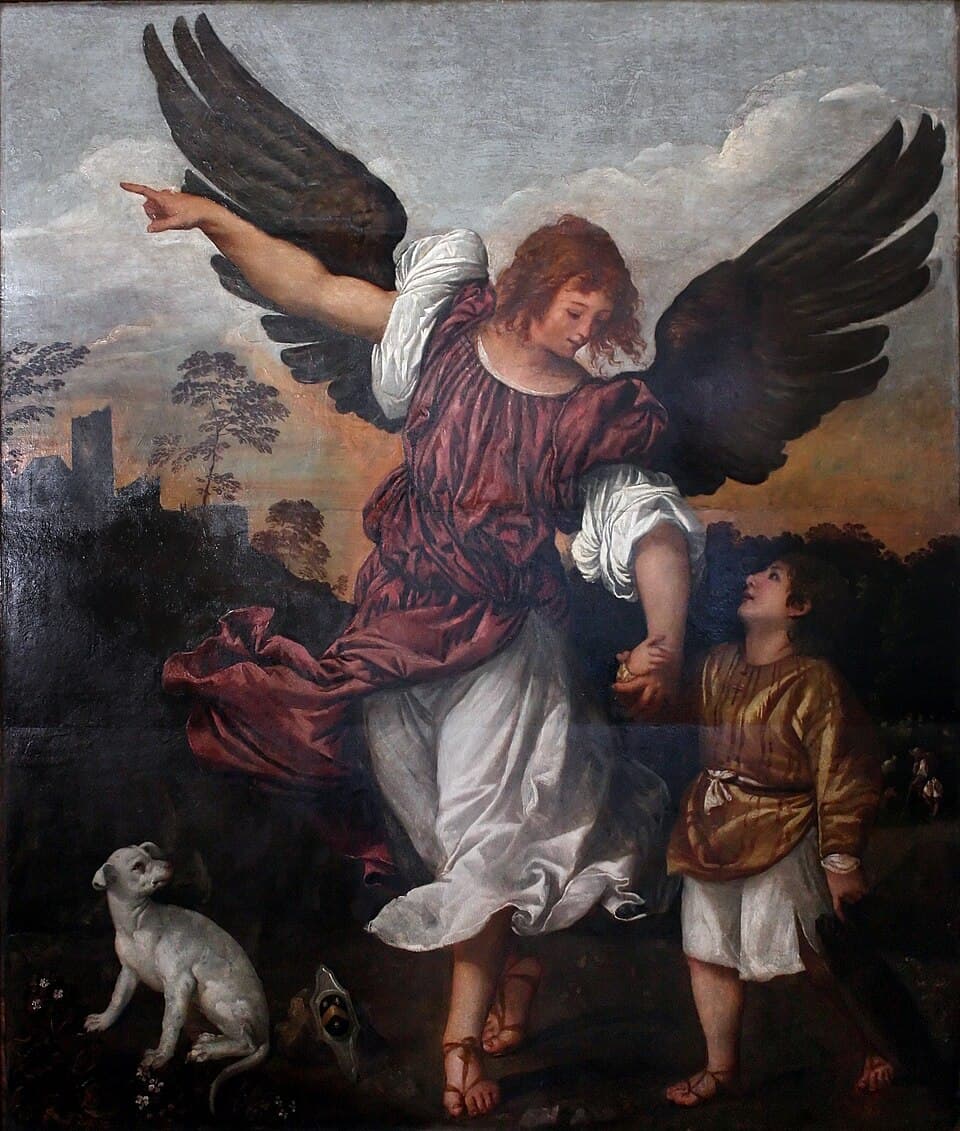
- Patron saint of
- The blind and travelers 2
- Feast day
- September 29, with Michael and Gabriel; the 1911 Catholic Encyclopedia records his older separate feast on October 24 123
- Name
- Hebrew; "God has healed" in the Catholic Encyclopedia, "medicine of El [God]" in Vatican News 14
- Calls himself
- "One of the seven angels who enter and serve before the Glory of the Lord" (Tobit 12:15) 9
- Disguise
- Azariah, son of Hananiah the elder, a kinsman of Tobit 5
Saint Raphael the Archangel spends almost his whole time in Scripture pretending to be someone else. In the Book of Tobit he hires on as a guide for a young man's journey into Media, gives a false name and family, settles his wages, and only at the end reveals that he is "one of the seven angels who enter and serve before the Glory of the Lord." 9 His name means "God has healed" 1, and the story he walks through is about exactly that: a blind father, a frightened son, and a bride no one dared marry.
A name that means healing
Raphael is a Hebrew name. The Catholic Encyclopedia renders it "God has healed" 1; Vatican News gives "medicine of El [God]," and points out that it is the opposite of the name of the demon in his story, Asmodeus, "he who causes to perish." 4 Either way, the name says what he is for.
He is one of only three angels named in the canonical Scriptures, alongside Michael and Gabriel. 12 The name never appears in the Hebrew Scriptures, and in the Greek Old Testament only in the Book of Tobit. 1 The Book of Enoch and other writings outside the canon name the rest of the seven, and their lists disagree. 1 In the Bible, his whole record is one book.
Tobit, the blind man who buried the dead
The story starts with Tobit, an Israelite living in exile in Assyria. Vatican News describes him as generous to a fault: he shares his goods with the poor, gives alms freely, pays his tithes, and goes so far as to bury the abandoned dead. 3 Then he loses everything, including, after one more act of charity, his sight. 3
Blind and poor, Tobit remembers a sum of money he left in trust with a kinsman, Gabael, in the distant region of Media, twenty years before. He sends his son Tobiah to recover it, and tells him to find "a trustworthy man who will make the journey with you." 5
Azariah, a kinsman who knows the roads
Tobiah walks out of the house and finds Raphael standing in front of him, "though he did not know that this was an angel of God." 5 The stranger says he is a fellow Israelite looking for work who knows all the routes to Media. 5 When Tobit insists on knowing his family, the angel gives a name: "I am Azariah, son of Hananiah the elder, one of your own kinsmen." 5 The 1911 encyclopedia, working from an older translation, spells it "Azarias the son of the great Ananias." 1
Two lines in that chapter carry more than the speakers know. Raphael greets the blind old man with "Take courage! God has healing in store for you." 5 And Tobit, sending his son off, prays that God's "angel accompany you for safety," then comforts his weeping wife with the assurance that "a good angel will go with him." 5 The NAB's note points out that Tobit has no idea the hired man is that angel. 5
The boy leaves with his guide, and the family dog follows them out the door. 6
The fish in the Tigris
On the first night they camp beside the Tigris. Tobiah goes down to wash his feet and a large fish leaps out of the water and tries to swallow his foot. 6 Raphael tells him to haul it ashore, cut it open and keep the gall, the heart and the liver, because they "make useful medicines." 6
It is easy to read as the quaint part of the story. In the book it is the hinge. Later on the road the angel explains what the organs are for: smoke from the heart and liver will drive off a demon, and the gall, rubbed on eyes with cataracts, will restore sight. 6 Both of the book's healings are already in Tobiah's bag before he knows he will need either one.
Sarah and the demon
Near Ecbatana, Raphael tells Tobiah they will stay with Raguel, a relative, whose only child is a daughter named Sarah, and that Tobiah has the right to marry her. 6 Tobiah has heard about her. She has been married seven times, and each husband died in the bridal chamber on the wedding night, killed by a demon. 6 Vatican News adds that Sarah had been close to taking her own life over it, and held back only so as not to grieve her parents further. 3
Tobiah is afraid, and says so: he is an only son, and his death would bring his parents to the grave in sorrow. 6 Raphael tells him to marry her anyway, to put the fish's heart and liver on the embers of the incense, and then for the two of them to rise and pray before anything else. 6 They do. The demon, repelled by the smell, flees into Upper Egypt, where Raphael pursues him and binds him hand and foot, then comes straight back. 7 The newlyweds get out of bed and pray together. 7
The healing of Tobit
On the way home Raphael and Tobiah go on ahead of the wedding party, and the angel tells him to have the gall ready in his hand. 8 Tobit comes stumbling out through the courtyard gate. Tobiah holds him, blows into his eyes, smears on the medicine and peels away the cataracts with both hands, and the old man sees his son. 8 "Blessed be God," Tobit says, "and blessed be all his holy angels." 8 He walks to the gate of Nineveh to meet his daughter-in-law with no one leading him, and the city is amazed. 8
Franciscan Media sums up the book as "a threefold happy ending": the marriage, the healing of Tobit's blindness, and the restoration of the family fortune. 2
"I am Raphael"
Tobiah lists what the man has done: led him back safe, cured his wife, recovered the money, cured his father. The family agrees to give him half of everything. 9 Raphael takes the two men aside and tells them instead to thank God, to give alms, and to make known what God has done. 9
Then he tells them who he is. When Tobit and Sarah prayed, he was the one who presented the record of their prayers before the Lord; he did the same when Tobit buried the dead; God sent him to heal them both. 9 "I am Raphael, one of the seven angels who enter and serve before the Glory of the Lord." 9 The two men fall to the ground. He tells them not to be afraid, that he came "not out of any favor on my part, but because it was God's will," and that the eating and drinking they watched him do was a vision. 9 He tells them to write it all down, and ascends. 9
The angel at the pool of Bethesda
The New Testament does not name Raphael. But many commentators, the encyclopedia reports, identify him with the "angel of the Lord" in John 5, who came down at certain times to stir the water of the pool where the sick lay waiting, so that the first one in was healed. 1 The identification rests on his name and on the healing he does in Tobit. 1 The encyclopedia calls it a conjecture, and adds that the liturgy of its day took it up: the Gospel at Mass on his feast was that passage. 1
What is Saint Raphael the patron saint of?
Saint Raphael is the patron saint of the blind and of travelers. 2 Both come straight out of Tobit: the one patronage from the old man whose cataracts came away in his son's hands, the other from the guide who knew every road into Media. Franciscan Media also lists patronages Raphael shares with Michael and Gabriel, including death, grocers, police officers and first responders, and radiologists. 2
The travel patronage once had a very concrete form. Vatican News records a medieval custom: a young person leaving home for the first time carried a small picture of himself in the place of Tobiah, walking beside the archangel. 3
Saint Raphael's feast day
Saint Raphael is honored on September 29, together with the archangels Michael and Gabriel. 24 Vatican News traces the cult of Raphael back to the eleventh century. 4 The 1911 Catholic Encyclopedia records his own feast on October 24 1; that was the observance when it was written, and his feast is now kept with the other two archangels.
Praying with Saint Raphael
For nearly the whole of his story nobody knows who Raphael is. He is a hired man who knows the roads, and the family questions him about his relatives and settles his daily pay. 5 Tobit prays that an angel will go with his son and never suspects that the prayer is already answered, sitting in his own house. 5
The healing in Tobit takes time and goes by road. The medicine is picked up on the first night, beside a river, in the middle of a fright, and is not used until the journey home. 68 Raphael tells a blind man to take courage because God has healing in store, and Tobit is left with no idea how it will come. 5
Sarah's part of the story should not be smoothed over. Seven husbands dead on their wedding nights, and a despair deep enough that she thought about ending her life. 36 What changes it is not explained away: a frightened young man marries her anyway, and the two of them get up in the night and pray before anything else. 7
When it is over Raphael refuses the thanks. He sends the gratitude past himself to God, says he came because it was God's will rather than as a favor of his own, and tells them to write the whole thing down. 9 He also says something easy to miss: he had been carrying Tobit's prayers before God the whole time, during the years when Tobit was burying the dead and going blind and hearing nothing back. 9
Saint Raphael the Archangel, pray for us.
Sources
- 1.James F. Driscoll, "St. Raphael," The Catholic Encyclopedia, Vol. 12 (New York: Robert Appleton Company, 1911).
- 2."Saints Michael, Gabriel, and Raphael," Saint of the Day, Franciscan Media.
- 3."St. Raphael, Archangel," Saint of the Day, Vatican News.
- 4."Saint of the Day: 29 September," Vatican News.
- 5.Tobit 5, New American Bible (Libreria Editrice Vaticana).
- 6.Tobit 6, New American Bible (Libreria Editrice Vaticana).
- 7.Tobit 8, New American Bible (Libreria Editrice Vaticana).
- 8.Tobit 11, New American Bible (Libreria Editrice Vaticana).
- 9.Tobit 12, New American Bible (Libreria Editrice Vaticana).
Saints to turn to next
Others in this collection who are turned to for some of the same things.