Saint Radegund
c. 518 - August 13, 587
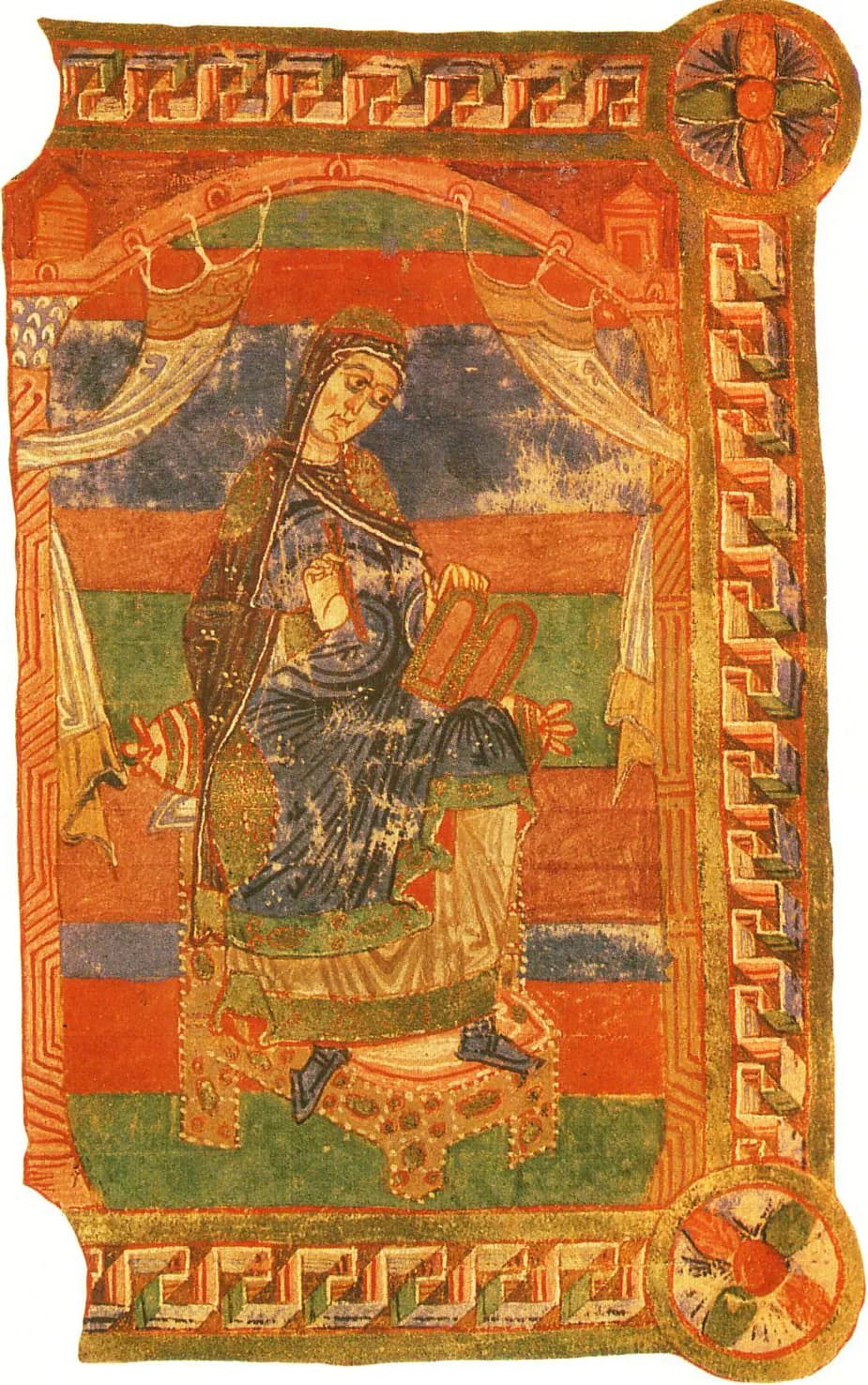
- Patron saint of
- Difficult marriages, potters and weavers, and Poitiers; invoked against drowning, fever, leprosy, scabies, ulcers and the death of parents 6
- Born
- Thuringia, in 518 according to Catholic Culture 6
- Died
- August 13, 587 1
- Father
- Berthar, a Thuringian king 5
- Buried
- In the crypt of the church of Saint Radegund, Poitiers 3
Saint Radegund was a Thuringian princess carried off as a child by the Frankish king Clothar I, and then made his wife against her will; he later had her brother killed. 15 She left him, took the veil, and founded the monastery of the Holy Cross at Poitiers, where the relic of the Cross she obtained from the emperor was the occasion of the hymn "Vexilla Regis." 12 She died on August 13, 587, and is remembered on that day. 167
Who wrote her life
Radegund is unusually well documented for a sixth-century woman, because two of the people who wrote about her knew her well. The poet Venantius Fortunatus lived at Poitiers from about 567 until her death, called her his mother, and wrote her life; after Fortunatus died, Baudonivia, a nun of her own monastery, added a second book. 1 Gregory, bishop of Tours, knew her too, and mentions her several times in his History of the Franks. 5
This page draws on Gregory directly, on what the 1913 Catholic Encyclopedia says about her across several articles, and on the Catholic Culture liturgical calendar. Where they disagree, both readings are given.
A captive, then a queen
She was the daughter of Berthar, a king of Thuringia. 5 According to the encyclopedia, her father was killed by his own brother, Hermanfried. 1 In 531 the Franks under Theodoric and Clothar conquered Thuringia, 15 and Gregory describes a river so full of the dead that the Franks crossed it "upon them as if on a bridge." 5 Then, he writes, "Clothar went back, taking with him as a captive Radegunda, daughter of king Berthar," and married her. 5
Catholic Culture fills in the years between. She was twelve when she was taken, and lived on a royal estate at Athies until she was eighteen, when Clothar brought her to Vitry and married her. 6 It calls him "a man of shocking character." 6 The encyclopedia puts it plainly: "She became, against her will the wife of Clotaire." 1 As queen she spent her time on the poor and on captives, and she ministered to lepers and founded a hospital for them. 6
Her brother
Gregory writes that "her brother he afterwards killed unjustly by the hands of wicked men." 5 The encyclopedia says only that he was "put to death by the Franks." 1 Catholic Culture says she had been married to him for six years when it happened. 6 None of the sources consulted gives his name or the reason.
This was the point at which she left. Catholic Culture says that, "unable to bear his cruelties any longer," she became a nun, "with his permission." 6 The encyclopedia says she "sought refuge" with Saint Medard, bishop of Vermandois, "who caused her to take the veil." 1 Gregory puts the whole turn in one sentence: "She also turned to God, changing her garments, and built a monastery for herself in the city of Poitiers." 5
Clothar did not let go easily. According to Catholic Culture, he later decided to bring her back to court, and Saint Germanus, bishop of Paris, intervened for her; the king, now repentant, sent Germanus back to ask her forgiveness and her prayers. 6
The Holy Cross at Poitiers
Her monastery at Poitiers grew very large, about two hundred religious by the encyclopedia's count. 1 Catholic Culture describes it as a double monastery. 6 At first the nuns had no fixed rule; around 567 she adopted the rule of Saint Caesarius of Arles, and had her adopted daughter Agnes consecrated as abbess. 1 The abbess was Agnes, not Radegund. Gregory says she was "remarkable for prayer, fasting and charity," and that "she attained such fame that she was considered great by the people." 5
Gregory also records a scene from inside the house. A young nun, after a vision, asked to be walled into a cell as a recluse, and the community led her to it singing psalms by lamplight, "the blessed Radegunda holding her hand." 5 The encyclopedia notes, in an article on altar bread, that Radegund was known for the reverence with which she prepared hosts for her monastery and for many surrounding churches. 4
The relic and the "Vexilla Regis"
Radegund asked the emperor Justin II in Constantinople for a relic of the True Cross, and he sent one. 2 The encyclopedia's article on Fortunatus places this "about 568"; its article on the hymn dates the procession that brought the relic from Tours to the monastery to November 19, 569. 12 The Fortunatus article describes the monastery as already dedicated to the Cross, and Catholic Culture gives its name as Holy Cross. 16
Fortunatus was asked to thank the emperor and empress, and wrote a series of poems for the occasion. 1 Two of them, the "Vexilla Regis Prodeunt" and the "Pange Lingua," were taken into the Church's liturgy. 1 The "Vexilla Regis" was first sung in that procession, and the encyclopedia records it in the Roman Breviary at Vespers in the two weeks before Easter and on feasts of the Holy Cross, and in the Missal on Good Friday. 2 Catholic Culture connects the "Crux Fidelis" to the same gift. 6
She did not forget her family. A cousin, Amalafried, had found refuge in the East in the emperor's service, and through Fortunatus she wrote him a long elegy on what had happened to her country and her family. 1 The encyclopedia calls it one of the poet's best works. 1
Her death, and after
She died on August 13, 587. 1 Catholic Culture passes on a description that her face after death shone "with a brightness surpassing the beauty of lilies and roses." 6
Peace did not outlast her long. Gregory devotes the end of his ninth book and part of his tenth to a revolt in her monastery, led by two royal nuns, Chrodield and Basina, against their abbess. 5 Men were killed "at the holy Radegunda's tomb," Gregory writes, "before the very chest that contained the relics of the holy cross." 5 A council at Poitiers in 590 excommunicated Chrodield. 3 Her own way of running the house survives in the bishops' findings, which Gregory copied out. Answering the rebels, the abbess said that a new bath had been opened to the servants because "lady Radegunda had given orders" for it until the smell of the fresh limestone was gone; that she had played games "when lady Radegunda was alive and it was not regarded as a sin"; and that in offering the blessed bread to orthodox Christians she had only done "as had been done under lady Radegunda." 5 Her tomb is still in the crypt of the church of Saint Radegund at Poitiers, which the encyclopedia calls a place of pilgrimage, and the diocese counts her as its great saint. 3
What is Saint Radegund the patron saint of?
The Catholic Culture calendar lists her as patron of difficult marriages, of potters and weavers, and of the city of Poitiers, and invokes her against drowning, fever, leprosy, scabies, ulcers and the death of parents. 6 The patronage of difficult marriages fits the record plainly: she was married as a captive to the king whose army had conquered her country, and who later had her brother killed. 15 No other source consulted names a patronage.
Saint Radegund's feast day
Her feast is August 13, the day of her death. 16 Catholic Culture lists her among the saints of the Roman Martyrology for that day, and the National Catholic Register gives the same date, noting that her friend Saint Junian died on the same day. 67 The encyclopedia also lists Junian as her director, dying in 587. 3
Praying with Saint Radegund
She did not choose her marriage, and none of the sources pretend she did. 1 She was a child taken in war and later married to the king who took her. 56 What the record shows is what she did inside that: the poor, the captives and the lepers, for years, as queen. 6
Then her brother was killed, and she left. 15 The sources do not agree on how, and the page does not smooth that over. Every version ends in the same place, with Radegund in a nun's veil. 156
At Poitiers she did not rule her community; she put Agnes in charge and lived under a rule herself. 1 Gregory remembered her leading a young nun by the hand to a walled cell. 5 Fortunatus wrote to thank an emperor on her behalf, and out of that came a hymn the Breviary gave to the last weeks of Lent. 12
Her loss did not go away. Years into her religious life she was still grieving, through Fortunatus, for her country and her family, and writing to a cousin in exile. 1
Saint Radegund, pray for us.
Sources
- 1.Paul Lejay, "Fortunatus," The Catholic Encyclopedia, Vol. 6 (New York: Robert Appleton Company, 1909).
- 2.Hugh Henry, "Vexilla Regis Prodeunt," The Catholic Encyclopedia, Vol. 15 (New York: Robert Appleton Company, 1912).
- 3.Georges Goyau, "Poitiers," The Catholic Encyclopedia, Vol. 12 (New York: Robert Appleton Company, 1911).
- 4.Henri Leclercq, "Host," The Catholic Encyclopedia, Vol. 7 (New York: Robert Appleton Company, 1910).
- 5.Gregory of Tours, History of the Franks, Books III, VI, IX and X, translated by Ernest Brehaut (New York: Columbia University Press, 1916), Internet Medieval Sourcebook, Fordham University.
- 6."St. Radegunde, Queen," Liturgical Year, August 13, 2024, Catholic Culture.
- 7.Angelo Stagnaro, "Queen St. Radegundes, Ora Pro Nobis," National Catholic Register, August 13, 2020.
Saints to turn to next
Others in this collection who are turned to for some of the same things.
- Saint Elizabeth of Portugal1271 - July 4, 1336Marriage and familySuffering and illnessPrayer
- Saint Bridget of Swedenc. 1303 - July 23, 1373PrayerMarriage and familySuffering and illness
- Saint Frances of Rome1384 - March 9, 1440Marriage and familyPrayerSuffering and illness
- Saint Germaine Cousin1579 - 1601Suffering and illnessMarriage and familyPrayer