Saints Quiricus and Julitta
d. c. 304
- Quiricus
- Three months old, according to the encyclopedia 2; three years old, according to katolsk.no and Catholic.net 14
- Historical record
- Named in the Martyrologium Hieronymianum 2; their Acts were listed as apocryphal in the sixth century 14
Saints Quiricus and Julitta are a mother and her small son, martyred at Tarsus in Asia Minor in the persecution under Diocletian. 12 In the legend Julitta, a widow fleeing persecution with her child, is arrested and tortured, and when the boy struggles in the governor's lap and claws his face, the governor throws him down the steps of the tribunal and kills him. 14 Their names are in the Martyrologium Hieronymianum and their cult spread across the whole Church, but the Acts that tell the story were condemned as apocryphal as early as the sixth century. 21
What is known
The Catholic Encyclopedia of 1911 starts with the evidence for the cult: "The names of these two martyrs, who in the early Church enjoyed a widespread veneration, are found in the 'Martyrologium Hieronymianum' (ed. De Rossi-Duchesne, 79) and also in the calendars and menologies of the Greek and other Oriental Churches." 2 Their story, it adds, comes from Acts "which appeared later, and a letter of the sixth century." 2
The Norwegian bishops' saints database (katolsk.no) is blunter. In reality, it says, we know nothing about them. 1 The legends survive in several versions, and as early as the sixth century the Acts of Julitta and Quiricus were included in a list of apocryphal documents, the decree once attributed to Pope Gelasius I and now called pseudo-Gelasian. 14 katolsk.no adds that Bede left them out of his martyrology, either because he did not have their Acts or because he thought them apocryphal. 1
Its best guess is that Quiricus was a real martyr, perhaps a child martyr, at Antioch, as the Martyrologium Hieronymianum has it, and that the legends gathered around him over time. 1 Catholic.net reports that Father Delehaye favored the same view, and notes that Quiricus appears alone, without his mother, in many inscriptions and church dedications across Europe and the Near East. 4
The flight to Tarsus
In the best-known version, Julitta is a devout Christian noblewoman of Iconium in Lycaonia, modern Konya in Turkey, widowed during Diocletian's persecution. 14 A brutal enemy of the Christians named Domitian is at work in the city, and she leaves her large fortune behind and escapes with her son Quiricus and two maids to Seleucia. 14 There the governor, Alexander, is persecuting Christians even more harshly, and the four go on to Tarsus, the capital of Cilicia and the birthplace of Saint Paul. 14 They are recognized, and by bad luck Alexander is visiting Tarsus at that very moment. 14
The encyclopedia tells the route differently: Julitta "fled with her three-months-old child, Quiricus, from Lycaonia, when the Maximinian persecution broke out there, to Isauria and thence to Tarsus in Cilicia." 2 katolsk.no and Catholic.net make the boy three years old, and katolsk.no mentions the Lycaonia and Isauria version as a variant. 14
The tribunal
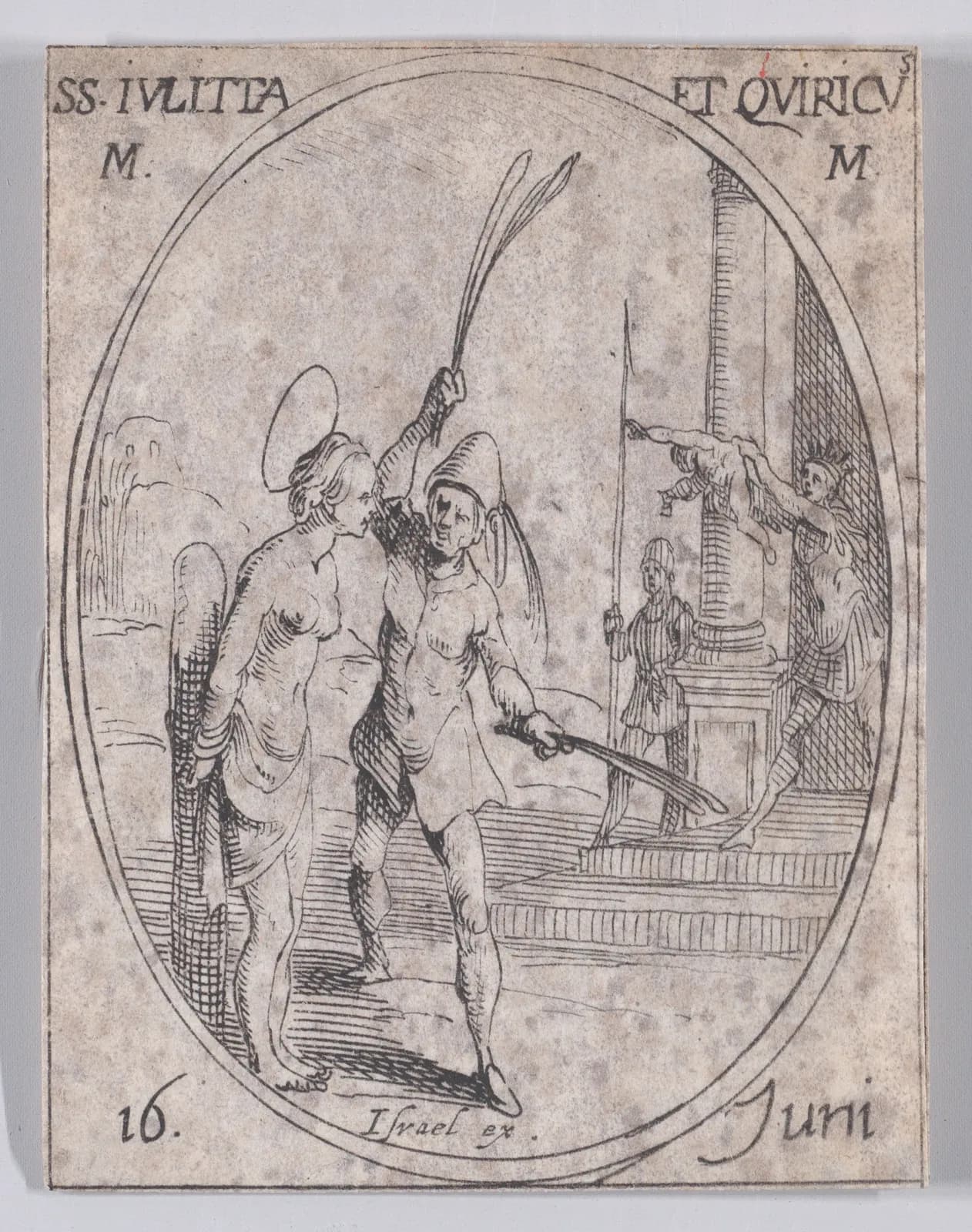
Brought to trial, Julitta takes her son with her into the courtroom. She refuses to answer any question about her name, her rank or her home, saying only that she is a Christian. 14 She is sentenced to the rack and the whip, and the guards take the child from her. He begins to cry. 1
Alexander, trying to quiet him, takes the boy on his knee. The child wants only his mother, and in one version he bites the governor on the shoulder and scratches his face; in another, seeing his mother being tortured, he cries out that he is a Christian too. 1 Catholic.net tells both: the child echoes his mother's cry, then kicks and scratches to get free. 4 The governor stands up in a rage, takes the boy by the foot and throws him down the steps of the tribunal, and his skull is broken on the stone. 14
Catholic.net continues the story. Julitta, watching from where she is bound, gives thanks to God that her son has received the crown of martyrdom. Alexander has her sides torn with hooks and has her beheaded, and the two bodies are thrown out with those of criminals. Her two maids recover them and bury them in a nearby field, and after Constantine gives peace to the Church, one of them reveals the place. 4 The encyclopedia keeps to one line: she "suffered martyrdom in the last-named city after her child had first been killed before her eyes." 2
Saint Cyr and his churches
The cult grew enormously, and mostly around the child. The encyclopedia says "the veneration of the two martyrs was common in the West at an early date, as is proved by the chapel dedicated to them in the Church of Santa Maria Antiqua at Rome, as well as by testimony from Gaul." 2 katolsk.no dates the frescoes of Quiricus in Santa Maria Antiqua, the oldest known images of him, to the eighth century. 1 The encyclopedia says their relics are said to have been brought to the monastery of Saint-Amand in the Diocese of Tournai. 2
In France he became Saint Cyr. katolsk.no counts forty-two French place names from him, and notes that the military academy of Saint-Cyr took its name from a place that was once a Benedictine monastery. 1 Saint Amator, bishop of Auxerre, is said to have brought relics from Antioch, which spread his cult; Catholic.net adds that there is no real proof connecting the historical martyrs with Antioch at all. 14 A story retold in the Golden Legend has Charlemagne dreaming that a naked child saved him from a wild boar in return for clothes, which the bishop of Nevers read as a request to repair the roof of his cathedral, dedicated to Saint Cyr; hence the child riding a boar in some images. 1
In Italy, katolsk.no counts more than two hundred churches, monasteries and places with signs of a cult of one or both, among them San Quirico d'Orcia in the Val d'Orcia and Santa Giuletta near Pavia. 1 In Spain a Saint Quiricus is honored as San Quirce, though the Bollandists were unsure whether he is the same saint. 1
What are Saints Quiricus and Julitta the patron saints of?
Saint Quiricus is the patron saint of Nevers in France. 1 katolsk.no names among the Italian towns that keep the two as patrons Borgo San Martino near Alessandria, Cavaria near Varese, Cisternino near Brindisi, Collesalvetti near Livorno and Trofarello near Turin. 1 In the East they are counted among the holy physicians. 1 No source read here gives them a patronage beyond these places.
Saints Quiricus and Julitta's feast day
The feast of Saints Quiricus and Julitta is June 16. The Roman Martyrology commemorates them on that day in Asia Minor, and the encyclopedia gives the same date. 32 The Spanish text of the Martyrology on Catholic.net places them in the Roman province of Asia Minor. 4 katolsk.no notes that most martyrologies have June 16 without explaining it; the Orthodox keep them on July 15, which the encyclopedia says is the date in the Synaxarium of Constantinople, and Catholic.net suggests July 15 may have been the actual day. 124
Praying with Saints Quiricus and Julitta
This is a hard story, and it does not get easier for being legend. A mother runs from city to city with a small child to keep him safe, and fails. 14 In the plainest version the boy is killed not for anything he says but because he wanted his mother and fought the man holding him. 1
Medieval Christians loved the story anyway, and it is not hard to see why. 14 It is about the bond between a parent and a child, and about a death that comes in the middle of an ordinary fit of crying. Catholic.net has Julitta thanking God at the sight. 4 Many readers will find that harder to accept than the governor's rage, and they need not pretend otherwise.
Whatever happened at Tarsus, the Church in East and West went on naming churches and towns for the child, more often than for his mother. 14 The legend does give her the larger part: she is the one who ran, who refused to answer, and who had to watch. 14
Saints Quiricus and Julitta, pray for us.
Sources
- 1."De hellige Julitta og Quiricus av Tarsus (d. 304)," Den katolske kirke (katolsk.no), Catholic Diocese of Oslo (in Norwegian).
- 2.Johann Peter Kirsch, "Sts. Quiricus and Julitta," The Catholic Encyclopedia, Vol. 12 (New York: Robert Appleton Company, 1911).
- 3.Roman Martyrology, entry for June 16, "Santi Quirico e Giulitta, martiri," as printed in "Santo del giorno," Conferenza Episcopale Italiana (in Italian).
- 4."Ciro (Ciriaco) y Julita, Santos," with the Roman Martyrology entry for June 16, Catholic.net (in Spanish).
Saints to turn to next
Others in this collection who are turned to for some of the same things.
- Saint Gianna Beretta MollaOctober 4, 1922 - April 28, 1962ParentingCourageSuffering and illness
- Saints Perpetua and FelicityMartyred at Carthage, March 7, 203CourageParentingSuffering and illness
- Saint Agathac. 230 - c. 251CourageSuffering and illness
- Saint AgnesDied in the third or early fourth centuryCourageSuffering and illness