Saint Quentin
d. c. 287
- Died
- Beheaded on October 31, 287, by the traditional date, at Augusta Veromanduorum, now Saint-Quentin 12
Saint Quentin was a Roman, by tradition a senator's son, who preached the Gospel at Amiens in northern Gaul and was tortured and beheaded under the emperor Maximian at the town on the Somme that now carries his name. 125 His acts date his death to October 31, 287, and October 31 is his feast. 12 Almost everything else told about him comes from a passion written later, and the sources that repeat it say as much. 14
A martyr and his acts
The Roman Martyrology gives him one sentence. In the town later honored with his name, in what is now France, it commemorates Saint Quentin, martyr, a senator who suffered for Christ under the emperor Maximian. 5 Katolsk.no, the website of the Catholic Church in Norway, is nearly as short about what can be known: he may have been born in Rome, or perhaps in France, and he died at an unknown date, probably in Maximian's persecution. 4
The detail comes from his acts, and Alban Butler, retelling them in the eighteenth century, was careful about what they are worth. He judged them "written in a good style, before St. Eligius's time, but later than Nestorius." 1 Their author claimed to work from a history by someone present when the relics were first moved, fifty-five years after the martyr died. But he had also, Butler warns, "added certain circumstances from popular traditions," and those "are not of equal authority." 1
Katolsk.no goes further. It calls the narrative later legend, describes the prefect who condemns Quentin as mythical and probably fictitious, and says nobody is now sure that his companion Lucian existed. 4 What follows is the tradition as its tellers give it.
From Rome to Amiens
Butler begins: "St. Quintin was a Roman, descended of a senatorial family, and is called by his historian the son of Zeno." 1 He left Rome, giving up "all prospects of preferment," and made his way to Gaul with Saint Lucian of Beauvais. The two preached together as far as Amiens and parted there, Lucian going on to Beauvais and to his own martyrdom. 1 The French life by Paul Guerin that CatholicCulture.org excerpts gives him eleven companions sent from Rome, who separated to cover the regions of Gaul. 2 The Diocese of Soissons, Laon and Saint-Quentin sets him beside Saints Crispin and Crispinian as one of the young Romans who came to preach in Gaul. 3
Amiens became the center of his work. 123 Guerin has him healing as he preached: "He gave sight to the blind, vigor to paralytics, hearing to the deaf, and agility to the infirm, in the name of Our Lord, simply by the sign of the Cross." 2 The diocese's page adds that the wonders stirred admiration in some people and hatred in others. 3 Butler is more reserved. He says only that Quentin's preaching was "strongly recommended by great numbers of miracles" and by "a most holy and mortified life." 1
Before Rictiovarus
Diocletian took Maximian as his partner in the empire in 286, and Maximian, Butler says, made a man named Rictius Varus prefect, one "whose hatred of the Christian religion has stored the Martyrology with lists of many illustrious martyrs." 1 He is the same governor Rictiovarus who tortures Crispin and Crispinian at Soissons in the Catholic Encyclopedia's account, where he is "a most cruel persecutor of the Christians." 8 Hearing how far the faith had spread at Amiens, he went there and had Quentin seized, chained and jailed. 1
The next day came the hearing. 1 In Guerin's version the prefect asks how a man "of such high nobility" has given himself to "so superstitious a religion," and Quentin answers: "It is sovereign nobility to adore the Creator of heaven and earth, and to obey willingly His divine commandments." 2 In the diocese's version he is asked his name and says first that he is called a Christian, and only then that his father is a Roman senator and his own name Quentin. 3
He was flogged, racked and shut in a dungeon where no Christian could reach him. 12 Butler writes that he "preserved a perfect tranquillity of mind in the midst of such torments as filled the spectators with horror." 1 The later tellings add marvels here. The men beating him fall over backward, an angel lets him out of the locked prison at night, and his guards find him preaching in the city and are converted. 2 The diocese's page has him freed twice and baptizing six hundred people. 3 None of that is in Butler. 1
The town on the Somme
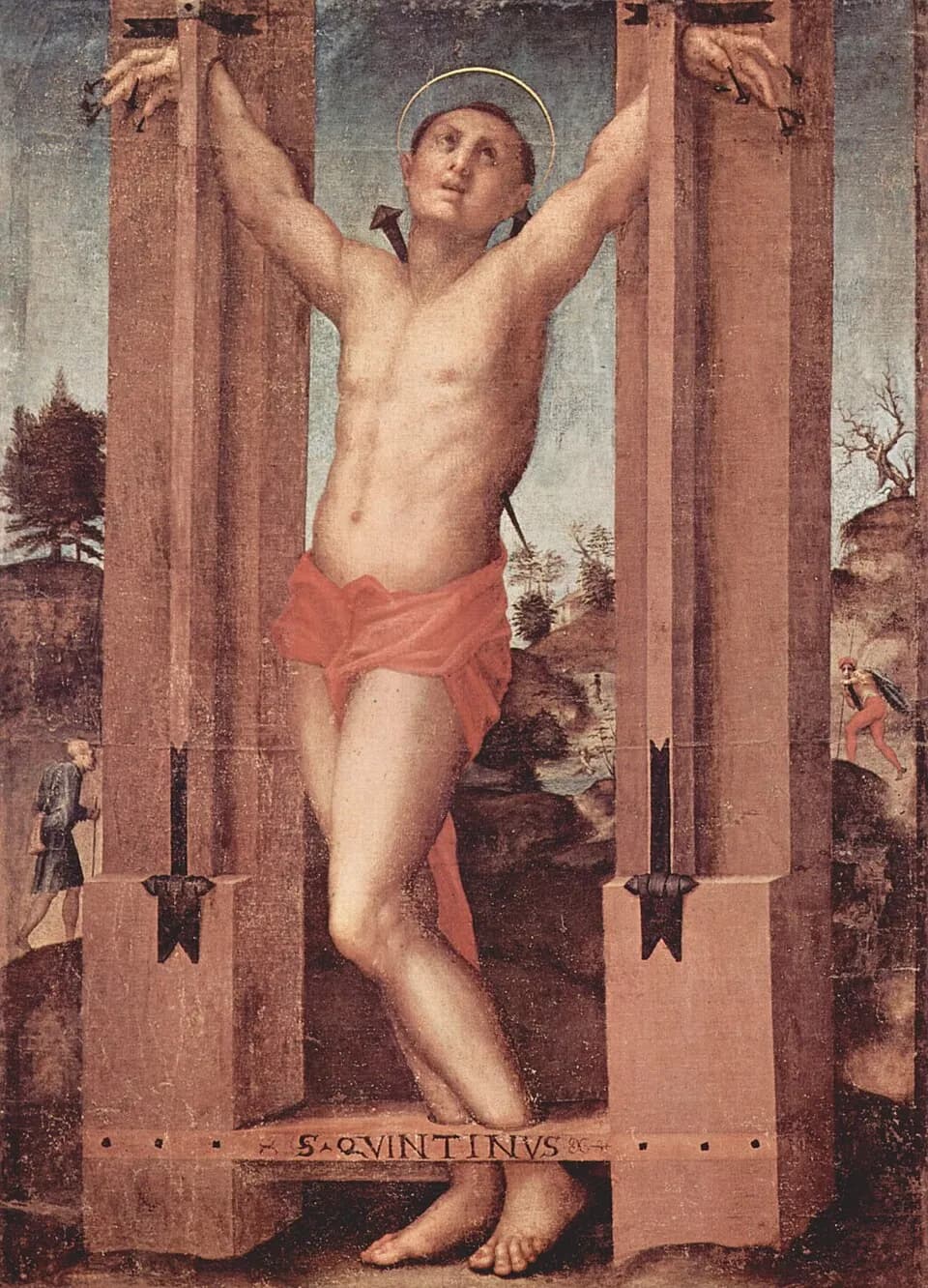
When the prefect left Amiens he had his prisoner brought along to the country of the Veromandui and its capital, Augusta Veromanduorum. 1 There he "caused his body to be pierced with two iron wires from the neck to the thighs, and iron nails to be struck under his nails, and in his flesh in many places, particularly into his skull; and, lastly, his head to be cut off." 1 Guerin runs the wires from the shoulders. 2 Both date the death to October 31, 287. 12 The encyclopedia, in a passing line, puts the martyrdom under Diocletian. 6 The diocese adds that bystanders saw his soul rise to heaven as a white dove. 3
About the body the sources part ways. In Butler, soldiers guarded it until dark and threw it into the Somme; Christians recovered it some days later and buried it on a mountain near the town; and fifty-five years after that it was found again by "Eusebia, a devout lady," when a blind woman recovered her sight at the relics. 1 Katolsk.no has it lie in the river for about forty years until a Christian woman found it, built a small chapel and laid the bones there. 4 Guerin, as CatholicCulture prints him, says the body was twice buried secretly and twice miraculously found, the first time in 338 "by Saint Eusebius of Rome, on a marshy island, where it had remained intact." 2
Eligius and the shrine
The grave was lost a second time, Butler says, during the persecution of Julian the Apostate, though a chapel still stood near it. 1 At the beginning of 641 Saint Eligius, bishop of Noyon and the Vermandois, had the relics searched for. They were found, "together with the great nails with which the body had been pierced." 1 Eligius sent the nails, the teeth and the hair to other churches and enclosed the rest "in a rich shrine of his own work," which he set behind the high altar. 1 Before he was a bishop Eligius had been a goldsmith, commissioned by King Clotaire II to make a throne of gold. 7 The encyclopedia adds that after finding the body he "erected in his honour a church to which was joined a monastery under the Irish rule." 7
Pilgrims kept coming. Katolsk.no says the little church had to be enlarged again and again, and that the town of Saint-Quentin, now a city of 70,000, grew up around it. 4 The encyclopedia notes that Abbot Fulrade built the church of St-Quentin in the eighth century. 6 Butler records a new church under Louis the Pious and a translation of the relics on October 25, 825, which katolsk.no dates to 835. 14 They were carried to Laon for fear of the Normans and brought home on October 30, 885. 1
In 1901 Pope Leo XIII allowed the bishops of Soissons to add Saint-Quentin to their title. 6 By then, Guerin says, more than fifty-two churches in France and as many localities bore the martyr's name, and CatholicCulture notes one far from France: the town and prison of San Quentin in California. 2
What is Saint Quentin the patron saint of?
Neither Butler nor the Martyrology names a patronage. 15 The two sources that do give long and slightly different lists. Katolsk.no calls Saint Quentin the patron of physicians, chaplains, mechanics, tailors and porters, and says he is invoked against whooping cough, colds and dropsy. 4 CatholicCulture lists bombardiers, chaplains, locksmiths, porters, tailors and surgeons, with coughs, sneezes and dropsy. 2
Saint Quentin's feast day
Saint Quentin's feast day is October 31, the traditional day of his death. 12 Butler's entry is headed with that date as his feast, and katolsk.no gives it as his memorial day, adding that it stood in the Sarum calendar and in the calendars of many medieval English monasteries. 14 The Roman Martyrology enters him on October 31, and CatholicCulture lists him for the day among the commemorations drawn from it. 25
Praying with Saint Quentin
What is certain about him fits in a line of the Martyrology: a man of rank, a martyr, a town. 5 That is not much to pray with. Butler printed his doubts about the acts in the same paragraph in which he named them. 1
The tradition did keep one thing clear, and it is the order of his answers. In the telling the Diocese of Soissons preserves, the governor asks who he is, and he gives his faith before his family and his family before his own name. 3 Guerin's Quentin makes the same point when the prefect taunts him with his birth: the nobility worth having is to adore the Creator. 2
The torments are hard to read, and the sources do not agree about them or soften them. 12 Butler's own reflection at the end of the life is plain about what he thought they meant. Martyrs, he wrote, "are witnesses, as the word imports in the original Greek," and martyrdom, "when we are called to it," is "a debt due to faith and religion." 1
Then there is the long afterlife of a body thrown in a river. A woman found it. A goldsmith bishop went looking for it again three centuries later and made the shrine with his own hands. 17 A town took the name, and people have been coming to the tomb ever since. 4 Very little about Quentin survived except that people refused to forget him.
Saint Quentin, pray for us.
Sources
- 1.Alban Butler, "St. Quintin, Martyr (A.D. 287)," from The Lives of the Fathers, Martyrs and Other Principal Saints, Vol. III, as hosted by EWTN.
- 2."St. Quentin of Vermand," Liturgical Year calendar entry for October 31, CatholicCulture.org, with an excerpt from Paul Guerin, Les Petits Bollandistes: Vies des Saints.
- 3."Saint-Quentin," Les Saints du diocese, Diocese de Soissons, Laon et Saint-Quentin (in French).
- 4.Per Einar Odden, "Den hellige Quintinus ( - ~287 (?))," Den katolske kirke (the Catholic Church in Norway) (in Norwegian).
- 5.Roman Martyrology, entry for October 31, "San Quintino, martire," as printed in "Santo del giorno," Conferenza Episcopale Italiana (in Italian).
- 6.Georges Goyau, "Soissons," The Catholic Encyclopedia, Vol. 14 (New York: Robert Appleton Company, 1912).
- 7.Leon Van der Essen, "St. Eligius," The Catholic Encyclopedia, Vol. 5 (New York: Robert Appleton Company, 1909).
- 8.Gabriel Meier, "Sts. Crispin and Crispinian," The Catholic Encyclopedia, Vol. 4 (New York: Robert Appleton Company, 1908).
Saints to turn to next
Others in this collection who are turned to for some of the same things.