Saint Proclus of Constantinople
Died 446 or 447
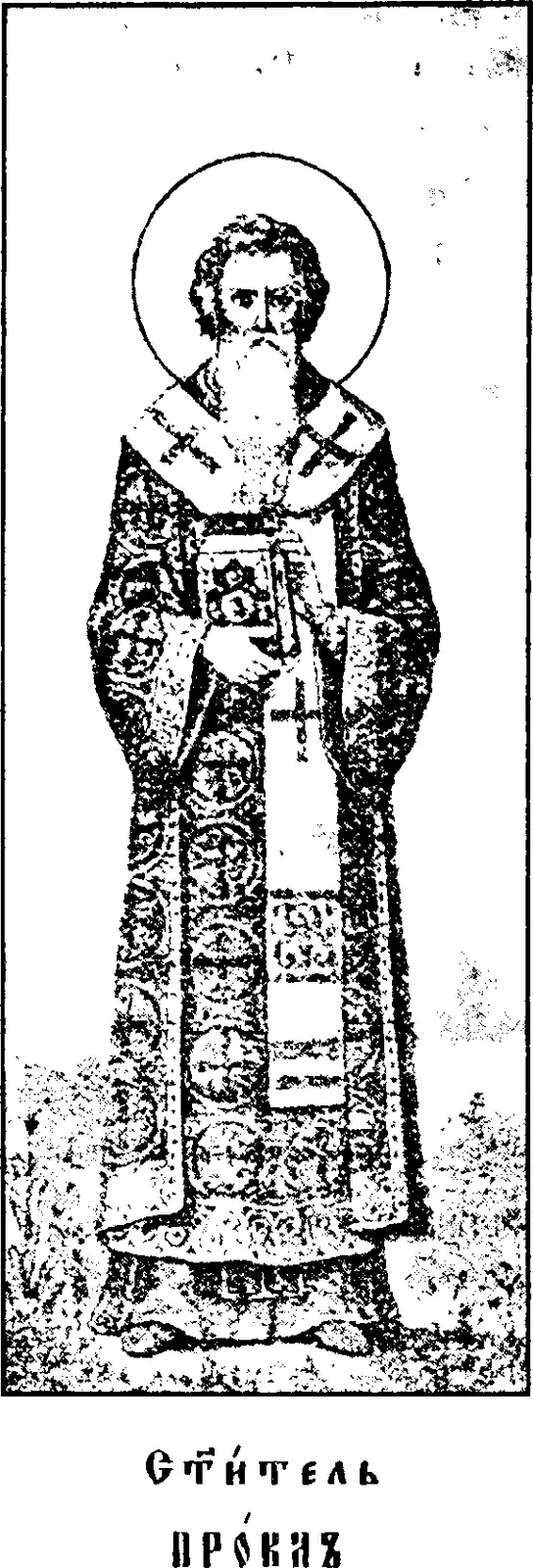
- Also called
- Proclus the Great, a title the Council of Chalcedon gave him 5
- Bishop of Cyzicus
- Named by Sisinnius, but the city elected its own bishop and he never took possession 123
- Known for
- His sermon calling Mary the Mother of God against Nestorius, and the return of Saint John Chrysostom's body to Constantinople 345
Saint Proclus was archbishop of Constantinople for the last twelve or thirteen years of his life, a city churchman who had served its bishops since boyhood and was passed over for its highest office three times before he got it. 12 As a priest he preached the sermon that called the Virgin Mary the Mother of God in front of the patriarch Nestorius, and as archbishop he brought Saint John Chrysostom's body home to Constantinople in procession. 345 The Church remembers him on October 24. 5
A reader who became a secretary
He was, Butler says, a native of Constantinople, and very young when he was made a reader of its church. 3 Socrates Scholasticus, who wrote the history of those years in the same city, describes a boy who "assiduously frequenting the schools, became devoted to the study of rhetoric." 2 On reaching manhood he was constantly in the company of Atticus, the bishop, who made him his secretary, then a deacon, then a priest. 12
Butler adds that he was for some time a disciple and secretary of Saint John Chrysostom, Atticus's predecessor but one. 3 Socrates, the nearest witness, and the Catholic Encyclopedia, which quotes him, make him Atticus's secretary and say nothing of Chrysostom. 12 Having been trained by Atticus, Socrates says, Proclus imitated all his master's virtues and outdid him in patience. 2
Passed over three times
When Atticus died in 425, one party wanted Proclus as bishop, another wanted a priest named Philip, and the people wanted Sisinnius, a priest of the suburbs famous for his care of the poor. Sisinnius was chosen. 12 He named Proclus bishop of Cyzicus, the chief city on the Hellespont, but before Proclus could leave, the people of Cyzicus elected a monk named Dalmatius instead. 23 No one forced Proclus on them. 1 He stayed in the capital without a see, and Socrates says he became famous there for his preaching. 2
Sisinnius died at the end of 427, and again many wanted Proclus. 12 This time the emperors, tired of the rivalry among the city's clergy, sent to Antioch for an outsider: Nestorius, a monk admired for his voice and his fluency. 2 When Nestorius was deposed at the Council of Ephesus in 431, Proclus was nearly chosen a third time. 1 Some influential people objected that the canons forbade moving a bishop from one see to another, and since he had been named to Cyzicus, the people believed them. 12 Socrates thought the objection was either prejudice or ignorance, and he copied out the canon to prove it. 2 The see went to Maximian, a priest who had lived an ascetic life and was, Socrates says, "rude in speech." 12
The Mother of God
At the end of 428 or early in 429, Chapman writes, Nestorius preached the first of his famous sermons against the word Theotokos, Mother of God, as a title for Mary. 4 Butler says that Proclus, then a priest without a see, maintained the truth against him "courageously," and in 429 preached a sermon to show that the Blessed Virgin ought to be called the Mother of God. 3 Nestorius was in the church and contradicted him publicly. 3
John Chapman, writing on Nestorius for the Catholic Encyclopedia, calls the sermon "flowery, but perfectly orthodox," and says that both it and the extempore reply Nestorius gave on the spot survive. 4 He counts Proclus among the critics who opposed Nestorius without any prompting from Alexandria. 4 Butler says the sermon stands first among the twenty homilies printed under his name, and that two more of them are on the Virgin Mary, "whose title of Mother of God he justly extols." 3 The current Roman Martyrology remembers him as the bishop who courageously proclaimed Mary the Mother of God. 5
Archbishop at last
Maximian died on April 12, 434, in Holy Week. 2 To prevent another fight, the Emperor Theodosius II ordered the bishops in the city to enthrone Proclus at once, before Maximian was even buried. 12 He had letters already in hand from Pope Celestine approving the choice and settling the question of the canons. 12 The new archbishop's first act was to bury his predecessor. 2
Socrates admired how he governed. Proclus was "gentle towards everybody, being convinced that kindness is far more effective than violence in advancing the cause of truth," and he resolved not to harass any heresy at all. 2 Butler says the same: his mildness even toward the most obstinate Nestorians and Arians was a distinguishing mark of his character, though he defended the Catholic faith firmly and lived in close friendship with the pope, Saint Cyril of Alexandria and John of Antioch. 3
In 436 bishops of Armenia asked his opinion of certain propositions drawn from Theodore of Mopsuestia, which the Nestorians were circulating. 13 His reply, called the Tome of Saint Proclus, condemned the propositions and set out the doctrine of the Incarnation. 13 People were ready to condemn the propositions but not the memory of Theodore, who had died in the communion of the Church, and Proclus met the difficulty by declining to attribute them to Theodore at all. 13 He also baptized Volusianus, the uncle of Saint Melania the Younger. 1
Socrates records two other episodes. When God delivered the empire from a barbarian army, Proclus preached on the prophecy of Ezekiel against Gog, and the sermon was received "with great applause." 2 And when the people of Caesarea in Cappadocia came to him for a bishop, he laid hands on Thalassius, a senator about to be named praetorian prefect of the East, and made him their bishop instead. 2
Chrysostom comes home
More than thirty years after Saint John Chrysostom was deposed, some of his followers still kept apart from the Church of Constantinople. 2 With the emperor's permission, Proclus had Chrysostom's body brought back from Comana, where it was buried, carried it in procession through the city, and laid it in the Church of the Apostles. 12 Socrates dates the procession to January 27 of the year of Theodosius's sixteenth consulate, which the Catholic Encyclopedia gives as 438, and says it brought the dissenters back into communion. 12
Socrates could not resist a comparison. Origen, he wrote, was excommunicated by Theophilus some two hundred years after his death, "while the latter was restored to communion by Proclus in the thirty-fifth year after his death! So different was Proclus from Theophilus." 2
The earthquake and the Trisagion
In the first part of 447, Butler says, earthquakes shook the East for six months. In Constantinople the people, the emperor and his court left their houses and camped in the fields, and Proclus and his clergy went with them, comforting them and praying with them. 3
Butler then reports a story with care. Theophanes and other Greek historians, he says, tell that a child was caught up into the air and heard angels singing the Trisagion: "Holy God, holy strong, holy immortal, have mercy on us." Proclus then taught it to the people. 3 What is "at least agreed," Butler writes, is that Proclus and the people used this prayer and that the earthquakes stopped. 3 He says Proclus put the hymn into the liturgy, where the Greek Church still sang it, and that the Eastern Churches credit him with the last revision of the liturgy of Constantinople. 3 The Catholic Encyclopedia refers the reader to its article on the Trisagion. 1
His death and his writings
He died the same year, on October 24, 447, according to Butler; the Catholic Encyclopedia says 446 or 447. 13 Butler collects the praise of his contemporaries. Saint Cyril called him "a man full of piety, perfectly skilled in ecclesiastical discipline, and a strict observer of the canons," Pope Sixtus III praised him in the same terms, and Pope Vigilius later called him the most learned of prelates. 3 The current Martyrology adds that the Council of Chalcedon, four years after his death, called him "the Great." 5
His homilies and letters were first printed at Rome in 1630. 13 Butler, who admired him, also thought his style concise and full of "lively witty turns, more proper to please and delight than to move the heart," and not to be compared with Saint Basil's gravity or Saint Chrysostom's sweetness. 3
What is Saint Proclus the patron saint of?
Saint Proclus's feast day
Saint Proclus's feast day is October 24. The current Roman Martyrology, as the Italian bishops print it, commemorates him at Constantinople on that day, as the bishop who courageously proclaimed the Blessed Mary as Mother of God and brought the body of Saint John Chrysostom back from exile in solemn procession, and who for this was called "the Great" at the Council of Chalcedon. 5
The 1897 English Martyrology lists him on the same day: "At Constantinople, of St. Proclus, bishop." 6 Butler gives October 24 as the day he died, and says his name stands in the Greek menologies. 3
Praying with Saint Proclus
For years Proclus was a bishop with no church. The city he was sent to would not take him, and the city where he lived passed him over three times, once on a reading of the canons that Socrates thought mistaken. 12 He spent those years preaching, and the sermon the Church remembers him for was preached by a man who held no see at all. 23
When he did take charge, he used it gently. Socrates, who had seen bishops of Constantinople persecute their opponents, marked him as the one who would not, and Butler says the gentleness did not cost him his firmness in the faith. 23
His best-known act was a reconciliation. By bringing Chrysostom's body home he ended a schism that thirty years of argument had not. 2 Butler's account of the earthquake shows the same bishop in the fields with his frightened people, praying with them until the ground was still. 3
Saint Proclus of Constantinople, pray for us.
Sources
- 1.F. J. Bacchus, "St. Proclus," The Catholic Encyclopedia, vol. 12 (New York: Robert Appleton Company, 1911).
- 2.Socrates Scholasticus, Ecclesiastical History, Book VII, chapters 26, 28, 29, 35, 36, 40, 41, 43, 45 and 48, trans. A. C. Zenos, Nicene and Post-Nicene Fathers, Second Series, vol. 2 (1890), at New Advent.
- 3.Alban Butler, "St. Proclus, Archbishop of Constantinople, Confessor," October 24, in The Lives of the Fathers, Martyrs, and Other Principal Saints, vol. X (Derby: Richardson and Son, 1842), Internet Archive.
- 4.John Chapman, "Nestorius and Nestorianism," The Catholic Encyclopedia, vol. 10 (New York: Robert Appleton Company, 1911).
- 5.Roman Martyrology, entry for October 24, "San Proclo, vescovo," Santo del giorno, Conferenza Episcopale Italiana (in Italian).
- 6.The Roman Martyrology, October 24 (Baltimore: John Murphy Company, 1897), Internet Archive.
Saints to turn to next
Others in this collection who are turned to for some of the same things.