Saint Praxedes
Era unknown; tradition says second century
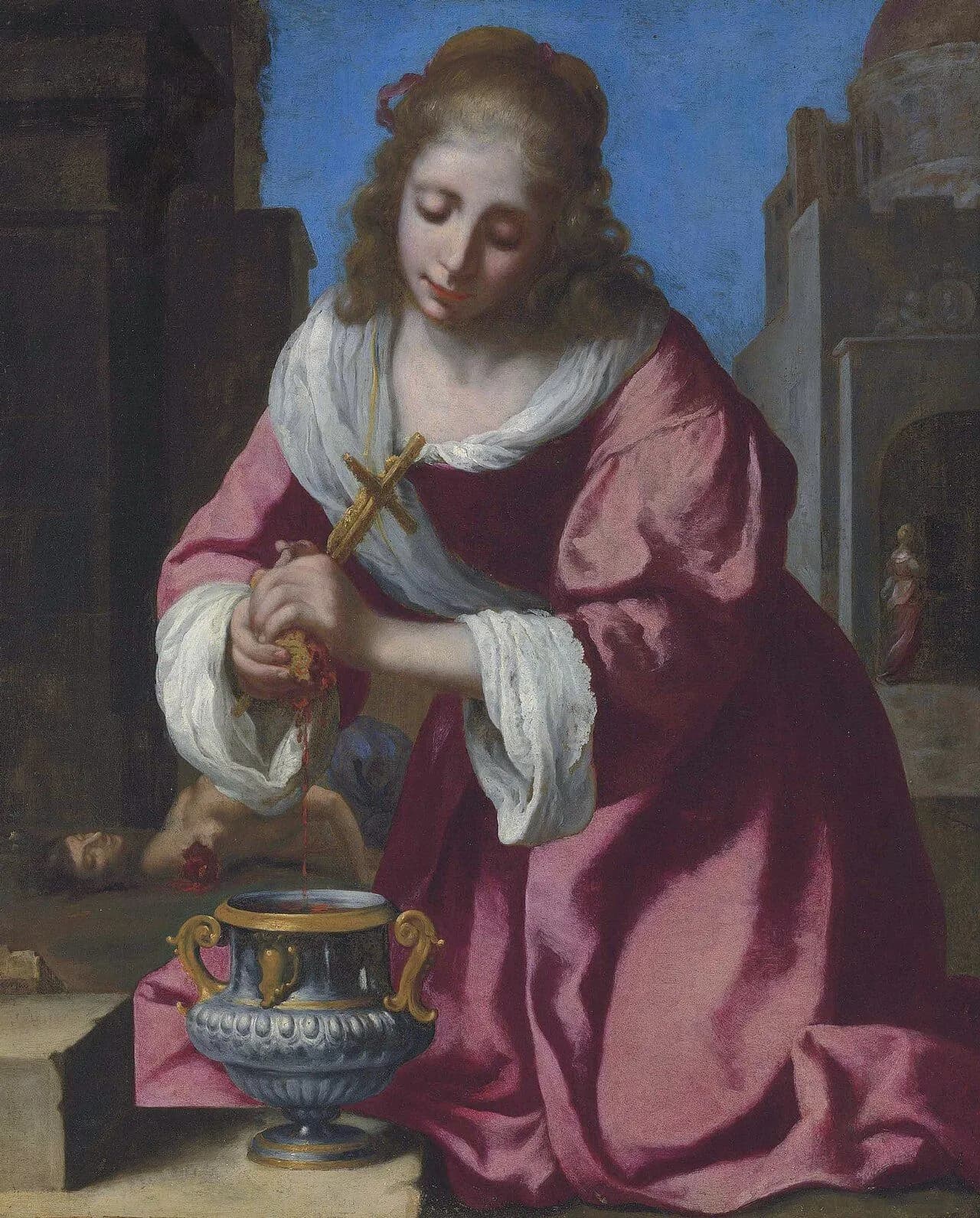
- Martyr?
- Venerated as a martyr, says the 1911 Catholic Encyclopedia 1; other accounts say she died in peace 26
- Patron saint of
- Single laywomen 6
Saint Praxedes is one of the oldest names in the Christian memory of Rome and one of the least documented. Seventh-century guides to the martyrs' graves found her in the catacomb of Priscilla, buried beside a woman called Potentiana, and the 1911 Catholic Encyclopedia says plainly that they were "martyrs of an unknown era." 1 Her story of sheltering persecuted Christians and gathering the blood of martyrs is legend. 12 Her church, rebuilt in the ninth century near Santa Maria Maggiore, still stands and still carries her name. 14
Two graves in the catacomb of Priscilla
The oldest evidence is a pair of graves. The itineraries written in the seventh century for pilgrims to the tombs of the Roman martyrs mention, in the catacomb of Priscilla, two women martyrs called Potentiana and Praxedis, in adjoining graves. 1 That is the whole of the early record. Johann Peter Kirsch, who wrote the encyclopedia entry, notes that only one manuscript of the Martyrologium Hieronymianum, the Echternach codex, names Praxedes on July 21, and that the entry "looks like a later addition." 1
The Norwegian bishops' saints database agrees that her cult is not one of Rome's oldest and that her first certain mention is in a seventh-century itinerary of the catacombs. 2 What the two sources share is a judgment: a real woman, venerated in Rome, buried in a known place, with very little else that can be established.
The legend of the house of Pudens
Later legend gave her a family. It connects Praxedes and Potentiana with the founder of one of Rome's ancient title churches, the "titulus Pudentis," makes Pudens a pupil of Saint Peter, and makes the two women his daughters. 1 In time Potentiana came to be called Pudentiana, probably, Kirsch suggests, because her church was called the "ecclesia Pudentiana." 1
katolsk.no tells the fuller legend. Praxedes is the daughter of the senator Pudens, the sister of Pudentiana and of two brothers, Novatus and Timothy, and all four are taught the faith by Peter and Paul, Peter living for a long time in their father's house. When the apostles are martyred under Nero, the sisters wipe up the martyrs' blood, and Praxedes gives everything she owns to the poor and all her strength to the martyrs, hoping one day to share their fate. 2 A still later legend makes Saint Claudia the mother of the family. 2
Other versions move her a century later. katolsk.no records legends that place her under Marcus Aurelius. 2 Pius Parsch, quoted by Catholic Culture, puts her works of mercy in the reign of the emperor Antoninus (138-161): "Some she kept in hiding in her house, others she encouraged to profess the faith heroically, and the dead she buried." 6 In his telling she finally asked God to take her from the sight of so much cruelty, and died on July 21; she was buried in the catacomb of Priscilla, in the tomb of her father and sister. 6 Catholic Culture's own summary gives her death as 164 and calls her history "rather obscure." 6
The legend even absorbed a pope. Kirsch explains, in his article on Pius I, that a later story referred the founding of both churches, the Pudentiana and the Praxedis, to the time of that second-century pope. 5 In one early source, he notes, "Pastor," the Shepherd of the book by Pius's brother Hermas, was mistaken for the name of its author. Since a Roman priest named Pastor plays an important part in the legend of the two churches, Kirsch thinks its writer may have been misled the same way, and so wove Pope Pius into the story. 5
Martyr, or not
The sources do not agree on how she died. Kirsch says Praxedes and Pudentiana "were venerated as martyrs at Rome," and the seventh-century itineraries already call them martyrs. 1 katolsk.no says Praxedes was certainly a devout virgin who helped persecuted Christians, and that she herself died a peaceful death. 2 Parsch, as above, has her die in answer to her own prayer. 6
The Church's present catalog of saints is noticeably careful. The current Roman Martyrology, as the Italian bishops print it, enters on July 21 a "commemoration" of Saint Praxedes, under whose name a church on the Esquiline Hill was dedicated to God, and gives her no title at all. 3 katolsk.no adds that Pope Benedict XIV, a serious student of the saints, declared her Acts untrustworthy when he revised the Roman Breviary in the eighteenth century, and suggests that the tradition of the two women as sisters may come only from their neighboring graves. 2
Santa Prassede
Whatever her history, she gave Rome one of its great churches. Kirsch says that a new church, the "titulus Praxedis," was built near Santa Maria Maggiore, and that from then on her veneration was attached to it. 1 katolsk.no says the parish church is first mentioned in a catacomb inscription of 491 and in the biography of Pope Symmachus, and that Pope Hadrian I repaired it. 2
The church as it stands is the work of Pope Paschal I (817-824). Kirsch's article on him says Paschal rebuilt the basilica completely, set mosaics in its apse and in the chapel of Saint Zeno, and "placed the relics of many Roman martyrs in the church of St. Praxedis where their names are still legible." 4 He translated the bones of Praxedes and Potentiana there too. 1 katolsk.no dates the rebuilding and the translation to 822 and says the relics lie in the confessio under the high altar. 2 Paschal also gave a monastery at Saint Praxedis to Greek monks fleeing iconoclasm, and he himself was buried in the church. 4
Saint Charles Borromeo held it as his titular church as a cardinal and restored it. 2 A niche holds a column said to be the one at which Christ was scourged, and a round porphyry slab in the nave marks the place where, according to tradition, Praxedes hid the bodies of martyrs in a well until they could be buried. 2 The church also gave Robert Browning a poem, "The Bishop Orders His Tomb at Saint Praxed's Church." 2
What is Saint Praxedes the patron saint of?
Catholic Culture lists Saint Praxedes as the patron saint of single laywomen, and describes her as a single laywoman who shared her wealth with the Church of Rome and lived a life of charity. 6 She is usually shown with her sister, with a sponge and a basin for collecting the blood of the martyrs; Praxedes often wears a crown or offers one to Christ. 26 Kirsch suggests that the two women offering their crowns to Christ in the apse mosaic of Santa Pudenziana are probably Potentiana and Praxedes. 1
Saint Praxedes's feast day
Praying with Saint Praxedes
What survives of Praxedes is mostly what she is remembered for doing for other people. The legends that grew around two graves in a catacomb could have made her anything. They made her the woman who hid the hunted, visited the prisoners, and went out to collect the dead so that they could be buried. 26
That is a particular kind of courage. Nobody in her story is asked to deny Christ before a magistrate. The risk is in the house: in hiding people, in visiting prisoners, in being seen burying the dead, and in going on doing it while others are being caught. 26
Parsch has her finally ask to be taken, because she could no longer bear to watch. 6 The story does not pretend that the work was easy or that it ended well. It says she did it for as long as she could, and that Rome has gone to her church for well over a thousand years to remember her for it. 24
Saint Praxedes, pray for us.
Sources
- 1.Johann Peter Kirsch, "Praxedes and Pudentiana," The Catholic Encyclopedia, Vol. 12 (New York: Robert Appleton Company, 1911).
- 2."Den hellige Praxedis av Roma (100-t)," Den katolske kirke (katolsk.no), Catholic Diocese of Oslo (in Norwegian).
- 3.Roman Martyrology, entry for July 21, "Santa Prassede," as printed in "Santo del giorno," Conferenza Episcopale Italiana (in Italian).
- 4.Johann Peter Kirsch, "Pope Paschal I," The Catholic Encyclopedia, Vol. 11 (New York: Robert Appleton Company, 1911).
- 5.Johann Peter Kirsch, "Pope St. Pius I," The Catholic Encyclopedia, Vol. 12 (New York: Robert Appleton Company, 1911).
- 6."July 21," Liturgical Year calendar, Catholic Culture (Trinity Communications), with an excerpt from Pius Parsch, The Church's Year of Grace.
Saints to turn to next
Others in this collection who are turned to for some of the same things.