Saint Porphyry of Gaza
c. 347 - 420 or 421
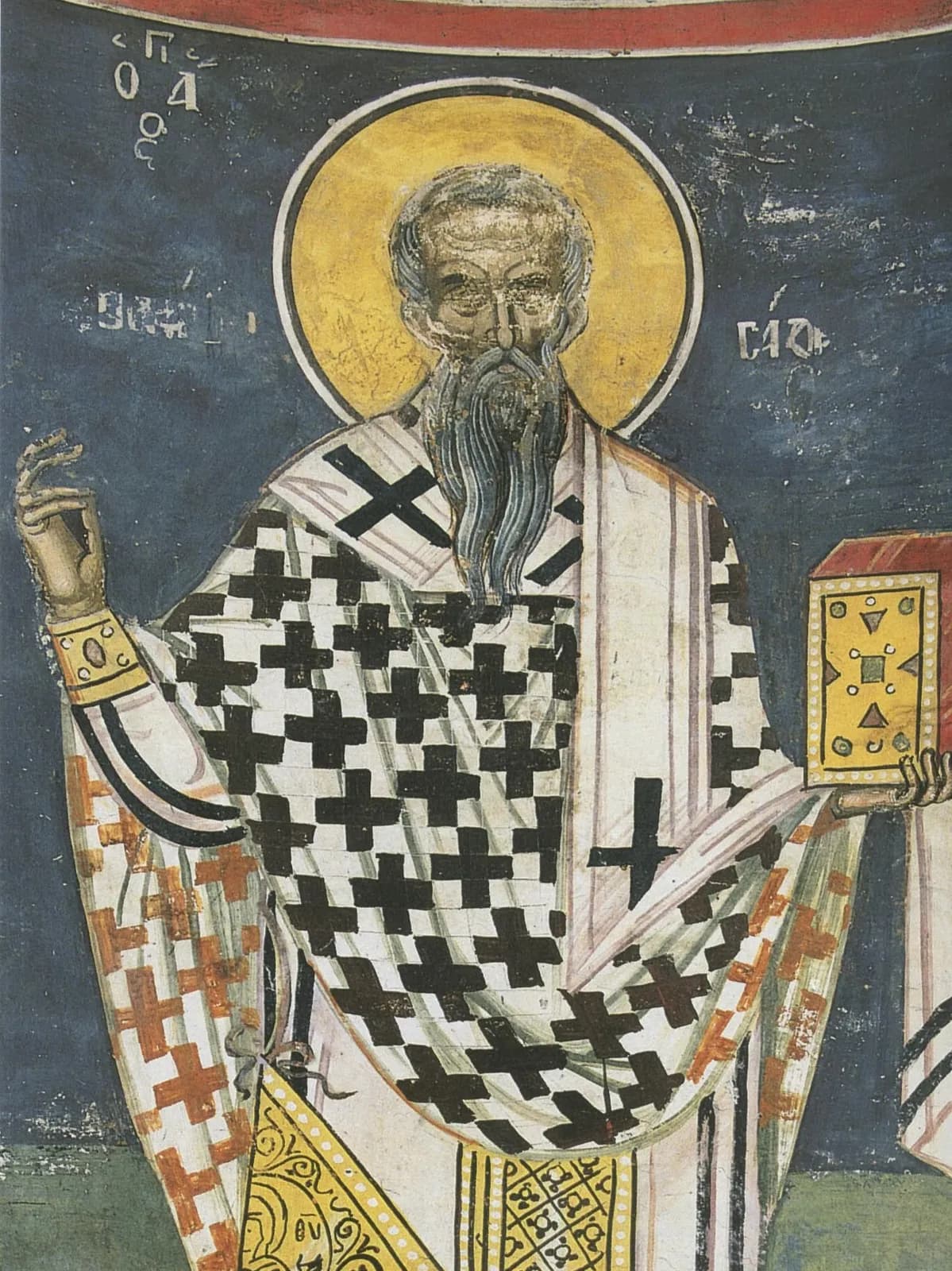
- Born
- At Thessalonica, to a wealthy Greek family, about 347 according to the 1911 Catholic Encyclopedia 2, in 353 according to katolsk.no 1
Saint Porphyry of Gaza was a rich young Greek from Thessalonica who became a hermit, gave away everything he owned, and was made bishop of Gaza, then one of the last strongholds of paganism in Palestine, against his will. 124 Over twenty-five years he brought most of the city into the Church, and with an imperial order he had its temples destroyed. 12 His deacon Mark wrote his life, which Catholic Culture calls "one of the most valuable historical sources of the fifth century." 4
Thessalonica, the desert and Jerusalem
Porphyry was born at Thessalonica in Macedonia to a well-off Greek family; the 1911 Catholic Encyclopedia says about 347, the Norwegian bishops' saints database (katolsk.no) says 353. 12 At twenty-five he left home to be a monk in the desert of Scete, in Egypt. After five years he moved to a cave by the Jordan, where he spent five more. 123 The Roman Martyrology remembers him in those years for his kindness to the poor. 3
There he fell seriously ill and was left crippled, and he decided to spend the rest of his life in Jerusalem. katolsk.no says he dragged himself to the holy places every day with a stick and refused all help, saying that he had come to ask forgiveness for his sins and nobody should make it easy for him. 1 The encyclopedia says that "in spite of his impaired health, he frequently visited the scene of the Resurrection." 2
At the Holy Sepulchre he met Mark, who would become his deacon and biographer. 12 Porphyry trusted him with selling the family property in Thessalonica. katolsk.no says Mark came back three months later with 4,500 gold pieces and found Porphyry cured: in a vision Christ had told him to carry his cross a little way, and when he woke the pain was gone. 1 The proceeds went to the poor; the encyclopedia specifies the monasteries of Egypt and the needy in and around Jerusalem. 12 Having given everything away, Porphyry learned to make shoes to support himself, and turned down Mark's offer to share his earnings by pointing to Saint Paul, who made tents. 1
Bishop against his will
His reputation got him ordained priest by the bishop of Jerusalem, who entrusted the great relic of the Holy Cross to his care. The encyclopedia dates this to 392; katolsk.no to 393, when he was forty. 12 In 395, by the encyclopedia's date, he became bishop of Gaza, a city it calls "a stronghold of paganism, with an insignificant Christian community." 2
He did not choose it. katolsk.no says he was summoned to Caesarea on the pretext that its bishop, John, wanted to consult him about passages of Scripture. A vision had warned him that Christ wanted him to marry a poor and lowly woman, pious and virtuous, and he went without knowing what it meant. At Caesarea the people of Gaza, on the bishop's order, all but kidnapped him, had him consecrated by force, and took him on a hard three-day journey to Gaza over roads the pagans had broken up and strewn with thorns. 1
Rain, and the temples of Gaza
The pagans of Gaza blamed the Christians for bringing him, saying their god Marnas had foretold disaster if he came. No rain fell for two months after he arrived. 1 The pagans prayed at the temple of Marnas; the Christians held their own fast and walked in procession to the church of Saint Timothy outside the walls, and when they came back found the gates shut against them. They prayed harder for rain, and it came. According to katolsk.no, the pagans opened the gates crying that Christ alone was God, and many conversions followed. 1
Those who remained pagan began shutting Christians out of trade and public office. 1 The encyclopedia says the bishop "appealed to the emperor for protection and pleaded repeatedly for the destruction of pagan temples," and "finally obtained an imperial rescript ordering the destruction of pagan sanctuaries at Gaza." 2 katolsk.no says the emperor Arcadius gave his consent chiefly through the intervention of Saint John Chrysostom and the empress Eudoxia, after journeys to Constantinople by Porphyry and later by Mark. 1
katolsk.no does not soften what came next. Imperial troops carried out the demolition quickly and brutally. Eight temples were burned, the temple of Marnas among them, whose beauty had once saved it; houses were searched for idols and the idols destroyed. Some pagans converted, others rioted, and the bishop's house was plundered and he nearly lost his life. 1 It adds that another early biographer seems to deny that the bishop used violent methods. 1
Where the temple of Marnas had stood, a large cross-shaped church was built. 12 Porphyry carried stones himself and helped clergy and people dig the foundations. 1 He consecrated it in 408 and called it the Eudoxiana after the empress, who had sent marble from Constantinople. 1
His last years
He spent the rest of his life at Gaza, known everywhere for his generosity to the poor, and by patient preaching brought most of the city into the Church; by his death, katolsk.no says, he had converted or driven out nearly all its pagans. 1 Catholic Culture says he ruled the see "with extraordinary energy, ability and success" and "almost completely uprooted the remnants of paganism in his diocese." 4 In 415 he attended the Council of Diospolis. 12 He died at Gaza on February 26, in 420 by the encyclopedia's reckoning and Catholic Culture's, in 421 by katolsk.no's. 124
Mark's Vita is the reason so much is known. The encyclopedia notes it was long known only in Latin until the Greek original was published in 1874. 2 katolsk.no calls it a valuable picture of the last days of paganism in the eastern Mediterranean, and a witness to the veneration paid to the relic of the Cross in Jerusalem at the end of the fourth century. 1
What is Saint Porphyry of Gaza the patron saint of?
Saint Porphyry of Gaza's feast day
Praying with Saint Porphyry
The early part of his life is easy to love. A rich young man gives away his inheritance, limps to the holy places refusing help because he has come to repent, and makes shoes to live. 1 His healing came, as katolsk.no tells it, with an invitation to carry Christ's cross a little way. 1
The later part is harder, and a page about him should say so. He asked an emperor to destroy the temples of his city, troops did it brutally, and his own house was sacked in the riot that followed. 12 The sources that admire him do not hide this, and neither should anyone praying with him. The Christians of Gaza were a small, harassed minority when he arrived, shut out of trade and office; their bishop reached for the power the empire offered. 12 It is possible to honor his holiness and still be uneasy about that, and the Church's own sources leave room for both.
What is not in doubt is the rest: the patience of his preaching, his generosity to the poor, and a bishop carrying stones for the foundations of his church. 1 He had once been carried into Gaza against his will over roads strewn with thorns, and he stayed for twenty-five years. 12
Saint Porphyry of Gaza, pray for us.
Sources
- 1."Den hellige Porfyrios av Gaza (353-421)," Den katolske kirke (katolsk.no), Catholic Diocese of Oslo (in Norwegian).
- 2.Nicholas Weber, "St. Porphyrius," The Catholic Encyclopedia, Vol. 12 (New York: Robert Appleton Company, 1911).
- 3.Roman Martyrology, entry for February 26, "San Porfirio, vescovo," as printed in "Santo del giorno," Conferenza Episcopale Italiana (in Italian).
- 4."February 26," Liturgical Year calendar, Catholic Culture (Trinity Communications), with its summary of the Roman Martyrology entry for Saint Porphyrius.
Saints to turn to next
Others in this collection who are turned to for some of the same things.