Saint Pompilio Maria Pirrotti
September 29, 1710 - July 15, 1766
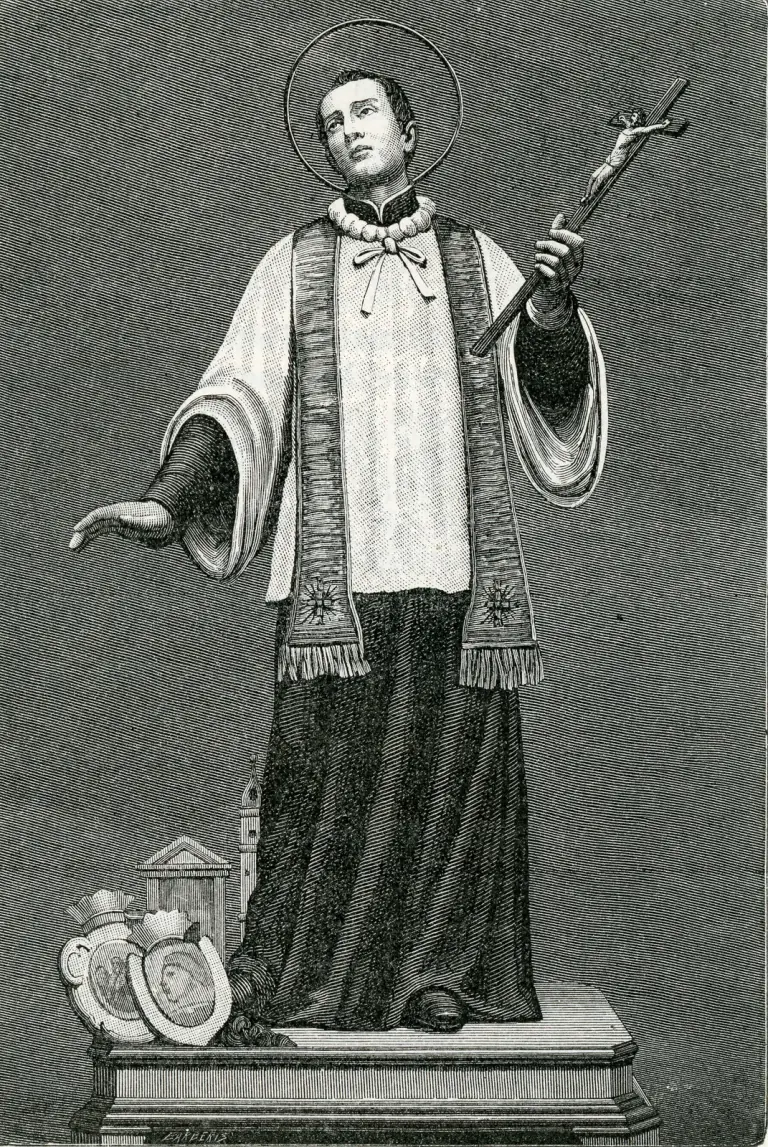
- Ordained
- March 20, 1734, by Archbishop Andrea Maddalena of Brindisi 1
Saint Pompilio Maria Pirrotti was a Piarist priest of the Kingdom of Naples who taught boys in the schools of his order for fourteen years and then gave himself to preaching and hearing confessions, until he was accused of being too lenient with penitents, suspended and expelled from the kingdom. 12 He was allowed back, and died at Campi Salentina in Apulia on July 15, 1766, which is his feast. 13 He was canonized in 1934. 12
A lawyer's son who ran away
He was born Domenico Pirrotti at Montecalvo Irpino, near Benevento, on September 29, 1710, the sixth of the eleven children of Girolamo Pirrotti, a doctor of law, and Orsola Bozzuti. 1 The family was noble; Antonio Borrelli notes that the motto over the door of their palace still reads "Virtus et honor in domo Pirrotti semper." 1
At sixteen he decided to become a Piarist, one of the sons of Saint Joseph Calasanz, whose order was founded to teach the children of the poor. 1 His parents wanted a career for him. According to the life by the Piarist Calazanz Bau, the call came during a Lenten mission preached at Montecalvo by the rector of the Piarist school at Benevento, and Domenico ran away from home to that school and asked for the habit. 2 Borrelli says he fled to Benevento after much prayer and after consulting his confessor, and then wrote his father a letter asking forgiveness and his blessing. 1 Bau adds that his father, a well-known lawyer, came after him and argued, and got nowhere. 2
He received the habit on February 2, 1727, in the novitiate of Santa Maria di Caravaggio in Naples, was dispensed from the second year of probation, and made his solemn profession on March 25, 1728, taking the name Pompilio Maria. 1 The Piarists added a fourth vow to poverty, chastity and obedience: to teach the young. 1
Fourteen years in the classroom
Illness interrupted his studies of philosophy at Chieti, and he was sent to Melfi for the climate. 1 In 1733, already known as a theologian though not yet a priest, he went to Turi near Bari to teach letters. 1 The next year he was at Francavilla Fontana, and on March 20, 1734, he was ordained by Andrea Maddalena, archbishop of Brindisi. 1 Then came Brindisi from 1736, Ortona from 1739 and Lanciano in the Abruzzi from 1742. 1
Bau counts fourteen years of teaching, the first with small children learning their letters at Turi and the rest teaching the humanities and rhetoric, with the direction of the schools and of a confraternity of the Good Death added on. 2 He tells a story from the classroom at Lanciano, as the witnesses later told it. The boys reported that Giovanni Capretti was absent. Pompilio was silent a moment and then said the boy was dying, that it would come to nothing, and that two of them should go at once. They found him unconscious on his bedroom floor, and he came round calling for Father Pompilio. 2
The order gave him leave to preach alongside his teaching, and he preached Lenten courses and retreats and catechized the villages round the schools. 12 The work earned him the title by which he was remembered, the Apostle of the Abruzzi. 12
Both sources tell of the night at Lanciano when he had the church bells rung and called the town out of bed to pray, warning that an earthquake was coming. 12 Borrelli dates it to 1746 and says he rang the bells at two in the morning, and that Lanciano was spared while other towns of the Abruzzi were badly damaged. 1 Bau puts it near midnight, and says the tremor was felt in the town and then passed off, and that he told the people their patroness, the Virgin of the Bridge, was interceding for them. 2
Confessor in Naples
In 1747 he was abruptly removed from Lanciano, after complaints about his preaching. 1 He went to Naples, where Borrelli says he spent eleven and a half years at the house of Santa Maria di Caravaggio, on what is now Piazza Dante; Bau gives twelve, from 1747 to 1759, divided between Caravaggio and the order's house called the Duchessa. 12 His superiors took him off teaching so that he could serve full time as chaplain, preacher and confessor. 2
He spent his days in the confessional and the pulpit, and in visiting the sick and the poor of the crowded quarter outside the Porta Reale. 1 He founded and directed a confraternity called the Charity of God, whose members were to receive the sacraments often, practice the Christian virtues and pray for the dead. 12 Against the rigorism of the time, he encouraged frequent and even daily communion, which Borrelli notes was then the privilege of a few. 1 He was devoted to the Sacred Heart, and in 1765 he wrote a novena to the Sacred Heart of Jesus that spread through the kingdom. 1 His constant prayer was the name of Mary, whom he called "Mamma bella." 12
Bau gathers stories from the process of canonization. A mother came to the church in tears because her small son had fallen down a well; he went with her and made the sign of the cross, and the witnesses said the water rose until the child could be lifted out unhurt. 2 On November 17, 1756, he stopped in the middle of a sermon, stood silent for some minutes, and asked the congregation for a requiem for his mother, who, he said, had just died. 2
Suspended and expelled
The trouble came from his confessional. Borrelli says a group of priests known as the Cappelloni, after their broad upturned hats, accused him of absolving too easily and imposing penances that were too light, and of being turbulent, restless and stubborn. 1 Cardinal Sersale, the archbishop of Naples, believed them and suspended him from hearing confessions and preaching, and King Charles III, through his courts, ordered him expelled from the Kingdom of Naples. 1 Bau dates the orders, from the royal palace and from the archbishop's chancery, to early 1759, and weighs the possible causes: royal hostility to the Church, a quarrel between provinces of the order, or, as he thinks most likely, the Jansenist party among the clergy, who disliked his mercy toward penitents. 2
The two sources tell the exile differently. Borrelli says it lasted six years, during which he was moved from house to house of the order, to Chieti, to Ancona three times, to Lugo in Romagna and to Manfredonia, before he was allowed back into the kingdom, and then only under supervision with periodic reports on his conduct. 1 Bau calls it a stage of four years at Lugo and Ancona, followed by a return to Naples that he calls triumphant, the rectorship at Manfredonia, work in his home town and finally Campi Salentina. 2
Borrelli adds that he was denounced again to the Holy Office and suspended again, and that through it all he did not complain: in his words and his letters there was only the wish to do God's will and to suffer with joy, while the illnesses he had carried for years grew worse. 1 Bau writes that he accepted every obedience with resignation and humility. 2
Campi Salentina
On April 15, 1765, he set out from Ancona for Campi Salentina, near Lecce, at the far end of the peninsula, and arrived on July 12, passing through towns where he had preached and saying goodbye to the people of Montecalvo with the words "Addio in Paradiso." 1 At Campi, where Joseph Calasanz had opened a school for poor children in 1631, he repaired the house, restored order to a troubled community and reorganized the schools. 1 Bau writes that he was rector and master of novices there, and even took charge of the smallest children's class himself for a while. 2
A famine struck in 1765, and Borrelli credits his intervention with bringing the town through it; every year on his feast blessed bread is still distributed in Campi in memory of it. 1
On Sunday, July 13, 1766, after saying Mass, he went into the confessional as usual and was taken ill there. 1 He was carried to his room and died on July 15, at fifty-six, as the bells were announcing first Vespers of Our Lady of Mount Carmel, lying on a chest. 12 He is buried in the Piarist church at Campi Salentina. 1
The diocesan process on his virtues opened at Lecce in 1835. 1 Leo XIII beatified him on January 26, 1890, and Pius XI canonized him on March 19, 1934, together with Saint Joseph Benedict Cottolengo. 12
What is Saint Pompilio Maria Pirrotti the patron saint of?
Saint Pompilio Maria Pirrotti's feast day
Saint Pompilio Maria Pirrotti's feast day is July 15, the day he died in 1766. 12 The current Roman Martyrology, as the Italian bishops publish it, remembers him on that day at Campi Salentina, a priest of the Clerks Regular of the Pious Schools, "insigne per austerità di vita," distinguished for the austerity of his life. 3
Praying with Saint Pompilio
He was a teacher first. For fourteen years the work was a classroom of boys, some of them learning to read, in the schools his order kept for children whose families could not pay. 12 Whatever else he became, he finished at Campi Salentina reorganizing a school. 12
The charge that ended his work in Naples was that he was too gentle with sinners. 12 He encouraged people to receive communion often at a time when many were kept from it, and he spent his days in the confessional. 1 The Church that later canonized him first suspended him, and an archbishop and a king believed his accusers. 1
He did not answer them. The sources say he spent the years of exile going where he was sent, without complaint, and they do not pretend the years were short or that his health survived them. 12
He was taken ill in the confessional, after Mass, and died two days later. 1 The bread that is still given out at Campi on his feast remembers a famine and a town that came through it. 1
Saint Pompilio Maria Pirrotti, pray for us.
Sources
- 1.Antonio Borrelli, "San Pompilio Maria Pirrotti, Sacerdote," with the Roman Martyrology entry, Santi, beati e testimoni, santiebeati.it (in Italian).
- 2.Calazanz Bau, Sch. P., "Pompilio María Pirrotti, Santo," Santoral, Catholic.net (in Spanish).
- 3.Roman Martyrology, entries for July 15, Santo del giorno, Conferenza Episcopale Italiana (in Italian).
Saints to turn to next
Others in this collection who are turned to for some of the same things.
- Saint Aelred of Rievaulx1109 - January 12, 1166 (or 1167)Suffering and illnessStudy and teaching
- Saint Catherine of AlexandriaDied c. 310Study and teachingSuffering and illness
- Saint Charles BorromeoOctober 2, 1538 - November 3, 1584Study and teachingSuffering and illness
- Saint Faustino MíguezMarch 24, 1831 - March 8, 1925Study and teachingSuffering and illness