Saint Polycarp
About 69 - February 23, 155
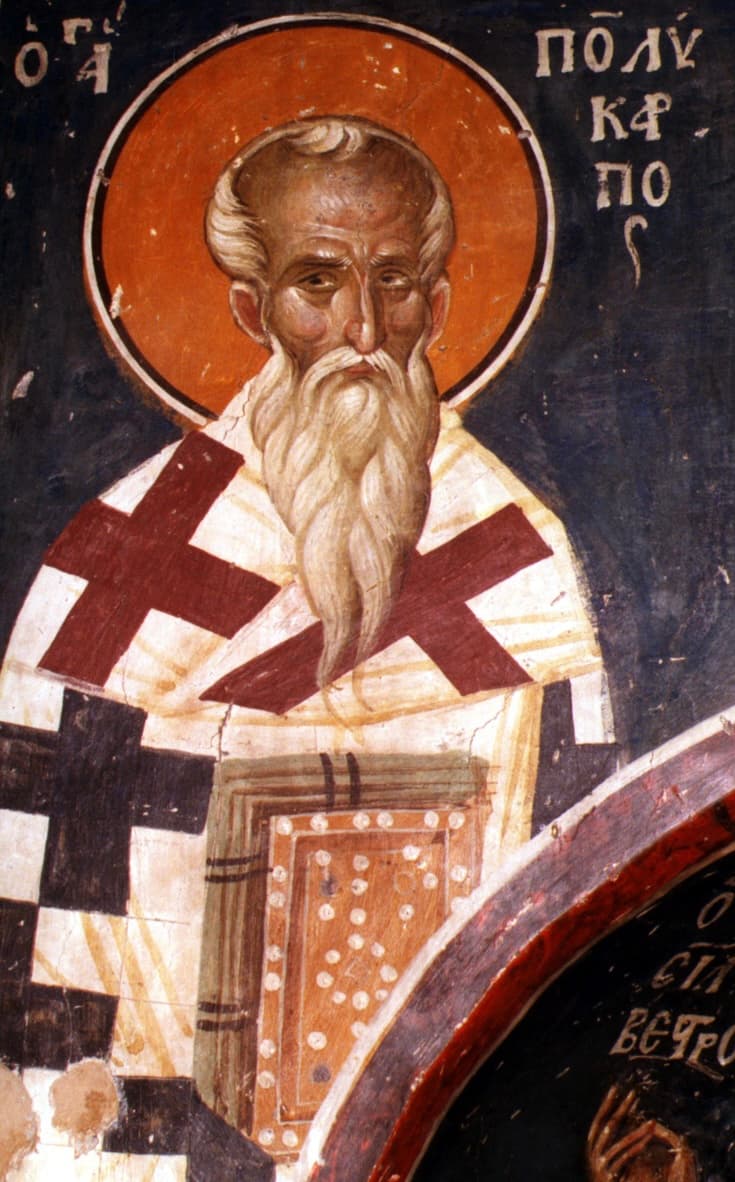
- Feast day
- February 23 1
- Bishop of
- Smyrna, appointed in Asia by the apostles themselves, according to Irenaeus 1
- Probably not true
- The dove from his body. Bacchus says it "probably arose out of a textual corruption" 1
Saint Polycarp had spoken with people who had spoken with Christ, and lived long enough to be interrogated by a Roman proconsul about it. 1 Irenaeus, who heard him preach as a boy, says he could still describe the room Polycarp sat in and the way he told his stories of John. 1 At eighty-six he was arrested at a farmhouse outside Smyrna, refused to curse Christ, and was burned in the stadium. 12 The letter his own church wrote about it afterward is the earliest reliable account of a martyrdom that survives. 2
A living link, and the reason it mattered
Irenaeus says Polycarp "was not only taught by the Apostles, and lived in familiar intercourse with many that had seen Christ, but also received his appointment in Asia from the Apostles as Bishop in the Church of Smyrna." 1 Franciscan Media puts it more compactly: he was "disciple of Saint John the Apostle and friend of Saint Ignatius of Antioch." 2
Bacchus explains why a single long life was worth so much to the second century. In Rome the apostolic age ended around 67 with Peter and Paul; in Asia it lasted until John died about 100, "and the sub-Apostolic Age till 155, when St. Polycarp was martyred." 1 For as long as he was alive, it was possible to ask someone what the apostles had actually said.
That is exactly the use Irenaeus made of him, against people claiming a secret tradition. And the most vivid passage in the whole article is Irenaeus remembering him, in a letter written to reproach a man who had gone over to heresy: "I distinctly remember the incidents of that time better than events of recent occurrence... I can describe the very place in which the Blessed Polycarp used to sit when he discoursed... his personal appearance... and how he would describe his intercourse with John and with the rest who had seen the Lord, and how he would relate their words." 1
He adds what he thinks Polycarp would have said about the heresy: "he would have cried out, and stopped his ears, and said after his wont, 'O good God, for what times hast thou kept me that I should endure such things?'" 1 The phrase "after his wont" is doing a lot of work. It was a habit of his. People knew it.
Rome, and an argument that did not become a schism
The churches of Asia kept Easter on the fourteenth of Nisan whatever day of the week it fell on; everybody else kept it on a Sunday. Franciscan Media records that the Asian churches sent Polycarp to Rome to discuss it with Pope Anicetus, calling it "a major controversy in the early Church." 2
It was not settled. Irenaeus, telling the story decades later to shame a pope who had just excommunicated the Asians over the same question, describes how it ended instead: "though they disagreed a little about other things, they immediately made peace with one another, not caring to quarrel over this matter. For neither could Anicetus persuade Polycarp... nor Polycarp Anicetus." 1
Then the detail that makes the episode worth reading: "Anicetus conceded the administration of the Eucharist in the Church to Polycarp, manifestly as a mark of respect. And they parted from each other in peace." 1 The pope stood aside and let the man he could not convince say Mass in his own church.
He was not soft. Irenaeus also reports that when Marcion met him and said "Recognise us", Polycarp answered: "Ay, ay, I recognise the first-born of Satan." 1 The same man did both things in the same city.
The letter from Smyrna
The account of his death was written by his own church to another church, and it does not read like propaganda. It opens with the other martyrs, and then it records a failure. "But there was one Quintus, who of his own accord had given himself up to the persecutors. When he saw the wild beasts he lost heart and apostatized." The Smyrnaeans draw the conclusion themselves: "we praise not those who deliver themselves up, since the Gospel does not so teach us." 1
Polycarp was persuaded to leave the city and hide at a farmhouse. He spent the time praying, and "while praying he falleth into a trance three days before his apprehension; and he saw his pillow burning with fire. And he turned and said unto those that were with him, 'it must needs be that I shall be burned alive.'" 1
They found him by torturing two slave boys until one of them told. 1 He could still have run. "Escape was still possible, but the old man refused to flee, saying, 'the will of God be done.'" He came downstairs to meet the police, talked with them pleasantly, and ordered food set in front of them. While they ate he prayed, "remembering all, high and low, who at any time had come in his way, and the Catholic Church throughout the world." 1
The officers tried to talk him out of it in the carriage, and when it did not work they shoved him out so hard he barked his shin, and he walked the rest of the way. 1
Fourscore and six years
The crowd was already in the stadium. "As Polycarp entered into the Stadium a voice came to him from heaven: 'Be strong, Polycarp, and play the man'. And no one saw the speaker, but those of our people who were present heard the voice." 1
The proconsul pressed him to curse Christ, and got the sentence he is remembered for: "Fourscore and six years have I served Him, and he has done me no harm. How then can I curse my King that saved me." 1
It was too late in the day for the animals, so they burned him instead, and the crowd collected the wood. 1 The fire did not do what it was supposed to: it "like the sail of a vessel filled by the wind, made a wall round the body" and left him unscathed, so the executioner was sent in with a blade. 1 Franciscan Media's summary is the same: "The flames did not harm him and he was finally killed by a dagger." 2
His body was burned afterward at the officials' order, "lest the Christians should abandon the worship of the Crucified One, and begin to worship this man" - a sentence that tells you what the authorities thought they were dealing with. 1 The Christians collected the bones and buried them. 1
What is Saint Polycarp the patron saint of?
Neither source cited here gives him a patronage. 12 Bacchus's article is a study of the documents and Franciscan Media's entry ends with the year of his death; the question is not raised in either, and this page does not answer it on their behalf.
What he is for is visible enough in the letter: old age that is not allowed to be quiet, and an argument you cannot win and must not turn into a break.
Saint Polycarp's feast day
The feast of Saint Polycarp is February 23, and it is the date of his death, recorded in the Smyrnaeans' own letter. 1 The subscription to that letter reads that he was martyred "on the second day of the month of Xanthicus, on the seventh day before the Kalends of March, on a great Sabbath at the eighth hour" - which is a Saturday falling on 23 February. 1
The year is less settled than the day. Bacchus lays out a long argument between Waddington, whom Lightfoot follows, and Schmid, turning on which year a man named Quadratus was proconsul of Asia: 155 or 166. 1 Franciscan Media simply says "He died in 155." 2 This page follows the day, which both agree on, and does not pretend the year is closed.
Praying with Saint Polycarp
He is the saint for the end of a long life that does not get to end quietly. He was eighty-six. He had been a bishop for most of a century, had buried the generation that knew Christ, and had just come back from a journey to Rome to argue about a calendar. What was left for him was three days of praying at a farmhouse, a dream about a burning pillow, and a stadium.
The dignity in the account is not in the fire. It is in the small things the letter bothered to record: that he refused to run, that he came down the stairs himself, that he talked to the men sent to arrest him and fed them, and that while they ate he prayed for everyone who had ever crossed his path. 1 He had time to be bitter and used it otherwise.
His answer to the proconsul is worth saying slowly, because it is not defiance. "Fourscore and six years have I served Him, and he has done me no harm." 1 It is an accounting. He had been given a long life and it had been good to him, and he was not going to end it by saying otherwise under pressure.
And the argument with Rome is the other half of him. He could call Marcion the first-born of Satan to his face and, in the same season, fail to convince a pope and part from him in peace. 1 Knowing which disagreements are worth breaking over is its own kind of holiness, and the record of him going home unpersuaded and unbroken was still being used to shame people forty years later.
Saint Polycarp, pray for us.
Sources
Saints to turn to next
Others in this collection who are turned to for some of the same things.
- Saint Claude de la Colombiere1641 - February 15, 1682PrayerSuffering and illnessCourage
- Saint Dominic SavioApril 2, 1842 - March 9, 1857PrayerSuffering and illnessCourage
- Saint Ignatius of Antiochc. 50 - c. 107CourageSuffering and illnessPrayer
- Saint Josephine Bakhitac. 1869 - February 8, 1947Suffering and illnessCouragePrayer