Saint Placid
Sixth century
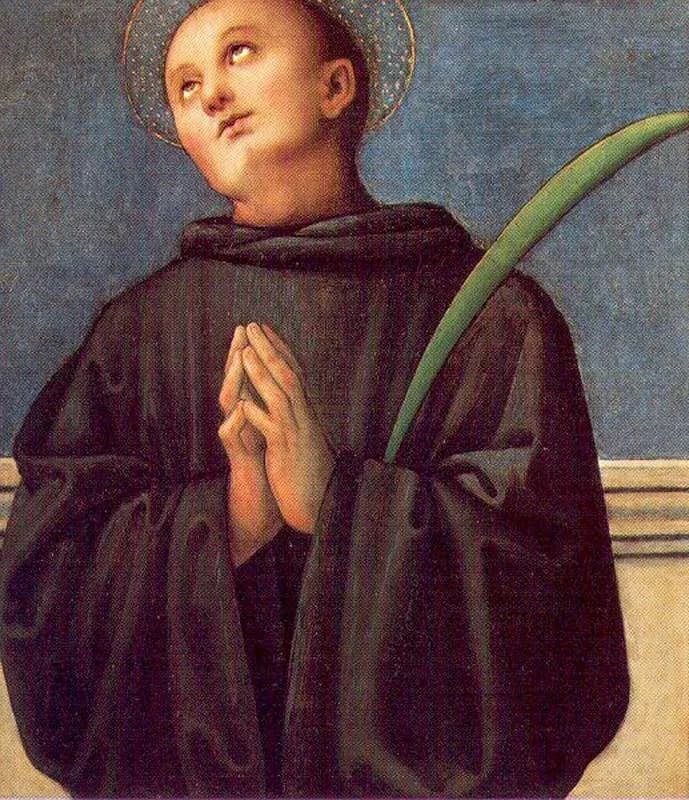
- Earliest source
- Gregory the Great, Dialogues, Book II, chapters 3, 5 and 7 1
- Historical record
- Of his later life "nothing is known"; the account of his martyrdom is a twelfth-century work 2
- Roman Martyrology
- Commemorated on October 5 as a monk and a dearly loved disciple of Saint Benedict 3
Saint Placid was a Roman senator's son handed over to Saint Benedict as a small boy at Subiaco, and he is the child in one of the most famous stories of the Benedictine tradition: the boy who fell into the lake and was pulled out by Maurus, who ran across the water to reach him. 12 That story, and two short glimpses beside it in the Dialogues of Gregory the Great, are nearly all that is known of him. 12 For centuries he was also venerated as a martyr killed in Sicily, but the account behind that claim was written six hundred years after his time, and the Church's calendar now remembers him simply as a monk. 23
A senator's son at Subiaco
Gregory the Great tells how, once Benedict had founded twelve small monasteries at Subiaco, "many noble and religious men of Rome came unto him, and committed their children to be brought up under him, for the service of God." 1 Among them was "Tertullius the Senator," who "brought Placidus." 1 The 1911 editor of the Dialogues notes that Gregory's Latin calls the father Tertullus patricius, a patrician. 1 Of Placid and the other boy who arrived then, Maurus, Gregory writes that Maurus was soon his master's right hand, "but Placidus, as yet, was but a boy of tender years." 1
Children offered to a monastery by their parents were a recognized thing, and Benedict's Rule provides for it. The 1911 Catholic Encyclopedia says Placid was dedicated to God "as provided for in chapter 69 of St. Benedict's Rule." 2 The editor of the Dialogues points instead to chapter 59, and chapter 59 is the one headed "On the Sons of Nobles and of the Poor Who Are Offered" in the text the Order of Saint Benedict publishes. 15 It prescribes the rite: the parents write out a petition, and at the offering "let them wrap the document itself and the boy's hand in the altar cloth." 5 They also promise under oath never to give the boy property of his own, so that he "may have no expectations whereby (which God forbid) he might be deceived and ruined, as we have learned by experience." 5
The night on the mountain
Placid appears next on a night errand. Three of the Subiaco monasteries stood high on the rocks, and the monks complained that the climb down to the lake for water was hard and dangerous and asked to be moved. 1 Benedict sent them home with "sweet words," and that night, Gregory says, "having with him only the little boy Placidus," he climbed to the rock above them and prayed there a long time. 1 Before coming down he set three stones one on another to mark the place. The next day he told the monks to dig where they found the stones, and they found the rock "as it were sweating drops of water"; the spring, Gregory adds, was still running down the hill in his own day. 1 Why Benedict took the boy, Gregory does not say.
Pulled out of the lake
The famous story is in chapter seven of the Dialogues. Placidus, "the holy man's monk," went to draw water at the lake below the monastery, set his pail down carelessly, fell in after it, and was swept out "so far as one may shoot an arrow." 12 Benedict knew of it in his cell and sent Maurus running. Maurus reached the boy by running on the water, without realizing it, took him by the hair, and brought him to shore. 1
Then came a disagreement of the gentlest kind. Benedict said the miracle was due to Maurus's obedience; Maurus said it was due to Benedict's command. 1 Placid ended it. He said that as he was drawn out of the water he had seen "the Abbot's garment upon his head," and so it was the abbot who had saved him. 1 It is the only thing the Dialogues report him saying, and Gregory gives it the last word.
After Subiaco
Huddleston, who wrote the 1911 encyclopedia article, thinks it "certain" that Placid went with Benedict when he moved to Monte Cassino about 529, a mountain that tradition said Placid's own father had made over to Benedict. 2 Then the record stops. "Of his later life nothing is known," the encyclopedia says. 2 What survives is his name in prayer: an ancient psalter at Vallombrosa lists him in the Litany of the Saints among the confessors, immediately after Benedict and Maurus, and a manuscript at Subiaco attributed to the ninth century does the same. 2
The martyr of Messina
Later centuries filled the silence. A text called the "Passio S. Placidi," presented as the work of one Gordianus, a servant of the saint, made Placid an abbot and a martyr, and it is on the strength of that text, Huddleston says, that he was usually described as both. 2 The 1911 editor of the Dialogues repeats the tradition in a footnote: Placidus "died a martyr's death in Sicily in 541, a few years before the death of St. Benedict himself." 1
The encyclopedia is blunt about it. "There seems now to be no doubt," Huddleston writes, that the Passio "is really the work of Peter the Deacon, a monk of Monte Cassino in the twelfth century." 2 He explains how it went wrong. The writer seems first to have confused Placidus with an earlier Placitus, martyred in Sicily under Diocletian with Euticius and thirty companions, whose feast the old martyrologies kept on October 5. Having made Placid a martyr, he then needed someone to kill him, and blamed Saracen raiders from Spain, which Huddleston calls "an utter anachronism in the sixth century." 2
The Church's calendar has since taken the correction on board. The current Roman Martyrology, as the Italian bishops print it, keeps October 5 but now reads simply as a commemoration of Saint Placid, monk, who from his boyhood was a most beloved disciple of Saint Benedict. 3 There is no mention of Sicily, companions or martyrdom. 3
What is Saint Placid the patron saint of?
None of the sources read for this page names a patronage for Saint Placid, and this page does not supply one. The Roman Martyrology describes him only as a monk and Benedict's beloved disciple. 3 Vatican News, in its Spanish calendar, remembers him together with Saint Maurus as Benedict's favorite disciples, and recalls the one episode that shows them together. 4
Saint Placid's feast day
Praying with Saint Placid
Placid's life begins with something done to him. His father brought him to Subiaco, and the Rule's ceremony for such a child, his small hand wrapped with the petition in the altar cloth, is a decision made by adults on a boy's behalf. 15 It is not a story of a young man choosing a vocation. What Gregory shows is the boy afterward: chosen as Benedict's only companion on a night of prayer, and, when he nearly drowned, remembered by name. 1
His one recorded saying is a gift to someone else. When the others disagreed over who had saved him, he did not credit Maurus, who had reached him, and did not speak of himself at all. He described what he had seen over his head as he came up out of the water, and named his abbot. 1 Gregory tells the lake as a story about obedience. 1 It is also the story of a child in the water who knew where to look.
Then there is the palm he carries in Perugino's painting, the sign of a martyrdom that the encyclopedia shows was invented for him six centuries later. 2 The Church has kept his day and set the legend aside. 3 What is left is a monk of whom almost nothing is known except that he was loved, which the Martyrology now says in so many words. 3
Saint Placid, pray for us.
Sources
- 1.Gregory the Great, Dialogues, Book II (the Life of Saint Benedict), chapters 3, 5 and 7, with the editor's notes, in the 1608 English translation, ed. Edmund G. Gardner (London: Philip Lee Warner, 1911).
- 2.Gilbert Huddleston, "St. Placidus," The Catholic Encyclopedia, Vol. 12 (New York: Robert Appleton Company, 1911).
- 3.Roman Martyrology, entry for October 5, "San Placido, monaco," as printed in "Santo del giorno," Conferenza Episcopale Italiana (in Italian).
- 4."ss. Plácido y Mauro, discípulos de s. Benito," Santo del día, October 5, Vatican News (in Spanish).
- 5.The Rule of Saint Benedict, chapter 59, "On the Sons of Nobles and of the Poor Who Are Offered," trans. Leonard J. Doyle, Order of Saint Benedict.
Saints to turn to next
Others in this collection who are turned to for some of the same things.