Saint Arsenius the Great
c. 354 - c. 450
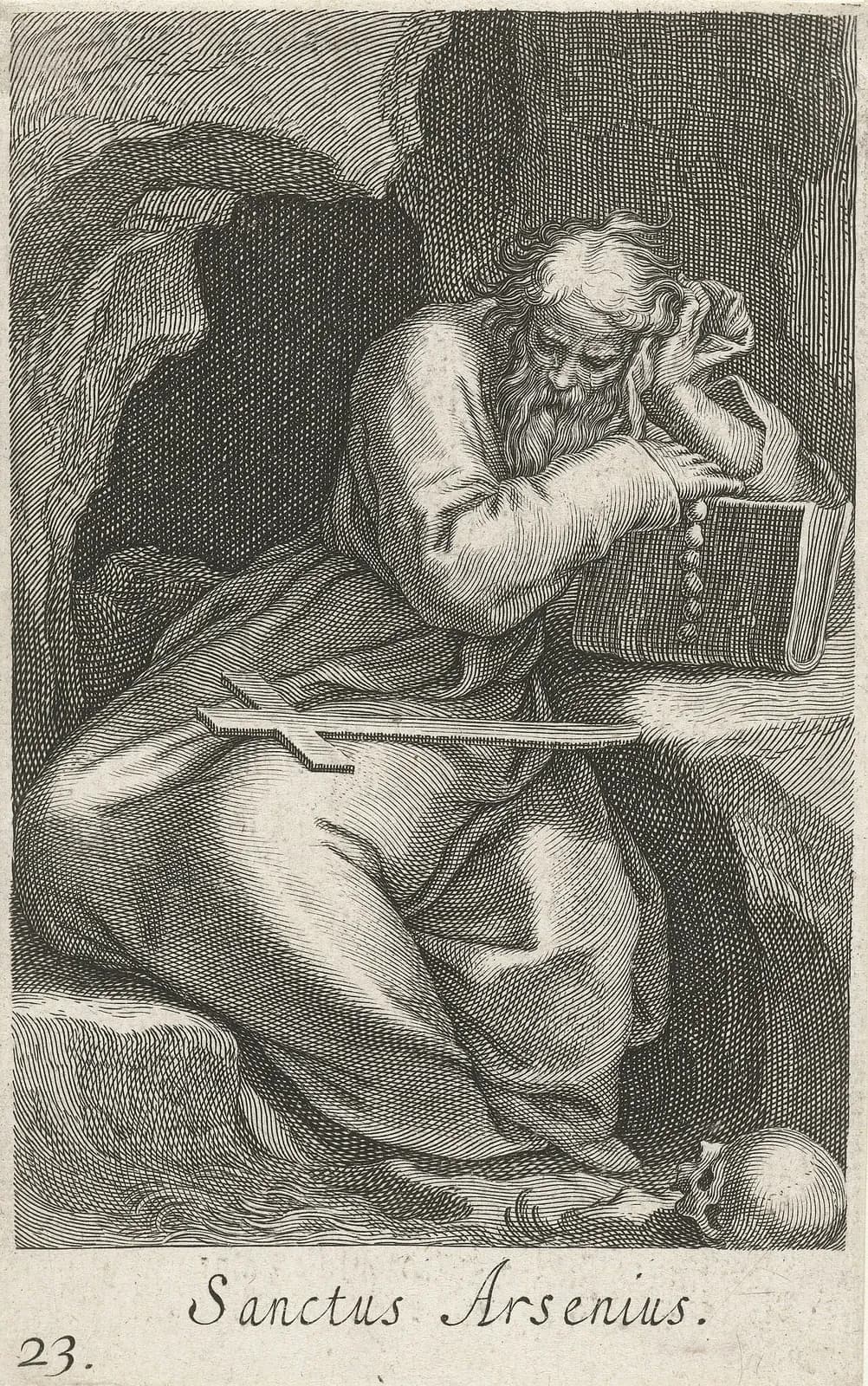
- Also called
- Arsenius the Roman and Arsenius the Deacon 2
Saint Arsenius the Great was a Roman of good family who spent about ten years as tutor to the sons of the emperor Theodosius, Arcadius and Honorius, and then fled the palace at Constantinople for the desert of Egypt. 12 He lived there for more than half a century, refused the emperor's request to come back, and left sayings that were repeated for centuries. 13 His contemporaries, says the 1907 Catholic Encyclopedia, "so admired him as to surname him 'the Great'." 1
Tutor to an emperor's sons
He was born about 354, and the Catholic Encyclopedia's Arsenius Vuibert places his birth at Rome, in a noble family. 1 Katolsk.no, the website of the Catholic Diocese of Oslo, agrees that he was apparently born in Rome and that he came from a senatorial family, and allows that he was at least well educated. 2 He is often called Arsenius the Roman, or Arsenius the Deacon, because he is said to have served as a deacon of the Roman Church. 12 Katolsk.no thinks both the birthplace and the diaconate doubtful. 2
Theodosius the Great wanted a tutor from the West for his son Arcadius. According to Vuibert, he asked the Emperor Gratian and Pope Damasus to find one, and they chose Arsenius, "a man well read in Greek literature." 1 Catholic.net and ACI Prensa simply say that Damasus recommended him. 34 Katolsk.no tells it the same way but calls the recommendation a legend. 2
He arrived at Constantinople in 383. 124 Vuibert says he stayed eleven years, the last three teaching Arcadius's brother Honorius as well; the other sources say ten, or a little more. 1234 Vuibert tells a story from the schoolroom. Theodosius came in one day and found his sons sitting while their teacher stood. "This he would not tolerate," and he made Arsenius sit and the boys stand. 1 The tutor was given a splendid household and lived, Vuibert thinks at the emperor's wish, in great pomp, "but all the time felt a growing inclination to renounce the world." 1
"Flee the company of men"
He prayed for a long time to know what to do. Then, Vuibert writes, "he heard a voice saying 'Arsenius, flee the company of men, and thou shalt be saved.'" 1 Katolsk.no describes a deep spiritual crisis, which ended with his giving up the post. 2 ACI Prensa says he was about forty. 4
He sailed secretly for Alexandria. 14 From there, in Vuibert's account, he went straight to the desert of Scetis and asked to be admitted among the hermits. 1 Katolsk.no has him join the desert monks around 393, at first near Alexandria, and go on to Scetis only after Theodosius died in 395. 2 ACI Prensa puts his arrival at the monastery around 400. 4
At Scetis he was taken to the cell of Saint John the Dwarf, who had been told who was coming. 1 John left him standing while the others sat down to eat, and halfway through the meal threw a piece of bread on the ground in front of him and told him to eat if he wanted to. 1 Arsenius picked it up and ate it sitting on the ground, and John kept him. 12 Habits from the court lingered for a while. He still sat cross-legged, or with one foot over the other, until the abbot had someone imitate the posture at the next gathering and rebuked the imitator in front of everyone. "Arsenius took the hint and corrected himself." 1
Fifty-five years in the desert
He spent the rest of his life, fifty-five years by Vuibert's count, doing penance for the palace. 1 He was always the worst-dressed man in the desert, to atone for his former vanity. 1 At court he had worn perfume, so in his cell he never changed the water in which he soaked the palm leaves for the mats he wove; he only topped it up, and let it stink. 1 Even at work he did not stop praying, and tears fell from his eyes so constantly, katolsk.no says, that he kept a cloth at hand for them. 12 He wept, the same source adds, over his two former pupils, now emperors. 2
Word came that a relative who was a senator had left him a large fortune. Katolsk.no says he tore up the will, saying that he had died before the senator did. 2 ACI Prensa has him give the money to the poor and gives his words more fully: before that man died in his body, he had died to ambition and greed, and wanted no riches of this world that would keep him from the riches of heaven. 4
What marked him most, in Vuibert's judgment, "was his disinclination to all that might interrupt his union with God." 1 When his hiding place was finally discovered he refused to go back to court to advise his former pupil, the Emperor Arcadius, and would not even distribute the emperor's alms to the poor and the monasteries. 1 He would not see visitors of any rank and left his disciples to receive them. 1 Katolsk.no finds him unusually reluctant to keep anyone's company, but not without compassion, and says he sometimes softened his abruptness. 2
His sayings and his death
The sayings that went round under his name were short. The one most often repeated is about speech: he had often been sorry for speaking, and never for keeping silent. 23 Catholic.net adds another, that he had always been afraid of appearing before God's judgment, because he was a sinner. 3 Katolsk.no says forty-four maxims and moral anecdotes are attributed to him, and that he thought learning unimportant and even a hindrance in a man's relationship with God. 2 Travelers came from far away, Catholic.net and ACI Prensa both say, to hear him. 34
Around 434, raiders attacked Scetis and drove him out. 2 Katolsk.no follows him to the rock of Troe, near Memphis, then to the island of Canopus near Alexandria, which he found too close to the city, and back to Troe. 2 He died there in great old age, about 449 by katolsk.no's reckoning and in 450 by Vuibert's. 12 Before the end, katolsk.no says, he admitted plainly to his monks that he was afraid to die, and then died quietly and trusting. 2 He left a brother everything he owned: a leather cloak, sandals of plaited palm leaf, and a shirt of goat hair. 2
His Life was written centuries later by Saint Theodore the Studite, and katolsk.no warns that it came too long after his death to be very trustworthy. 12
What is Saint Arsenius the patron saint of?
Saint Arsenius's feast day
Saint Arsenius's feast day is May 8 in the current Roman Martyrology. The Italian bishops' edition enters him on that day, at Mount Scetis in Egypt, as one who by tradition had been a deacon of the Roman Church, withdrew to solitude in the time of the emperor Theodosius, and gave up his spirit to God full of every virtue. 5 Catholic.net prints the same entry under May 8. 3
Other dates are still in circulation. Catholic.net notes that the old martyrology kept him on July 19, and the Acta Sanctorum, which Vuibert cites, has his Life under that day. 13 Katolsk.no, last revised in 2006, still gives July 19 for the Roman Martyrology and May 8 for the Eastern churches. 2 ACI Prensa wrote in 2025 that the Church remembers him every July 18. 4
Praying with Saint Arsenius
He had what most people want: money, an emperor's confidence, a household of servants and a voice in the education of the next rulers of the world. 12 He also had, by every account, a growing unease that none of it touched. 12 The voice he heard did not tell him to reform the court. It told him to leave. 1
The desert did not change him overnight. He arrived still sitting like a courtier, and an older monk had to embarrass him out of it. 1 He spent the rest of his life correcting himself in small, deliberate ways: the coarse clothes, the foul water, the tears. 12 When the court came looking for him, he did not go back, and he did not let the emperor's money pass through his hands even for the poor. 1
His one famous saying is easy to quote and hard to live: he regretted speaking often, and silence never. 23 It came from a man who had been paid to talk for a living. At the end, katolsk.no records, he did not pretend to be unafraid of death, and told his monks so. 2
Saint Arsenius the Great, pray for us.
Sources
- 1.Arsenius Vuibert, "St. Arsenius," The Catholic Encyclopedia, Vol. 1 (New York: Robert Appleton Company, 1907).
- 2.Per Einar Odden, "Den hellige Arsenius den Store (~354-~449)," katolsk.no, the Catholic Diocese of Oslo (in Norwegian).
- 3."Arsenio, Santo," Santoral, Catholic.net (in Spanish).
- 4."Hoy se celebra a San Arsenio, quien renunció a una gran herencia para vivir en el desierto," ACI Prensa, July 18, 2025 (in Spanish).
- 5.Roman Martyrology, entry for May 8, "Sant'Arsenio, diacono," as printed in "Santo del giorno," Conferenza Episcopale Italiana (in Italian).
Saints to turn to next
Others in this collection who are turned to for some of the same things.