Saint Pius I
Died about 154 or 155
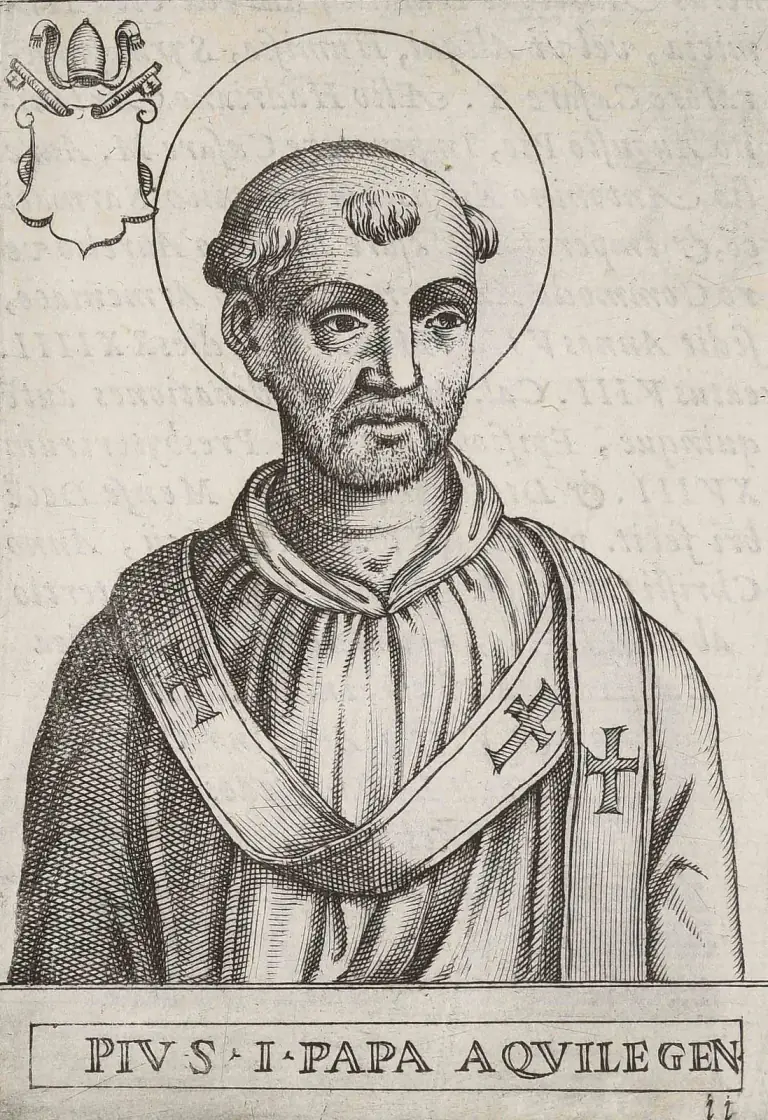
- Born
- Date and place unknown; the Liber Pontificalis says Aquileia, son of Rufinus, which Kirsch thinks a guess 18
- Pope
- About 140 to about 154, by Kirsch's reckoning 1; fifteen years, say Eusebius and the Roman Martyrology 36
- Died
- About 154, says Kirsch 1; about 155, says katolsk.no 2; buried near Saint Peter at the Vatican 28
- Not to be confused with
- Saint Pius V (died 1572) or Saint Pius X (died 1914)
Saint Pius I was bishop of Rome for about fifteen years in the middle of the second century, from about 140 to about 154 by the Catholic Encyclopedia's reckoning. 16 His brother Hermas wrote The Shepherd, a book of visions that was once read aloud in the churches, and in his time the Gnostic teachers Valentinus and Cerdon, and then Marcion, were all at work in Rome. 1589 The Church keeps his memory on July 11. 3
The ninth successor of Peter
The earliest list of Roman bishops, made by Saint Irenaeus of Lyons before the end of the second century, runs from Linus through Clement and Sixtus to Telesphorus, "who was gloriously martyred; then Hyginus; after him, Pius; then after him, Anicetus." 4 Johann Peter Kirsch, writing in the Catholic Encyclopedia, counts Pius as the ninth successor of Saint Peter on that list. 1
Eusebius says that Pius took over the church of Rome when Hyginus died at the end of his fourth year, and that he himself died "in the fifteenth year of his episcopate." 6 The current Roman Martyrology also gives him fifteen years. 3 The Liber Pontificalis, a much later Roman collection, gives nineteen years and four months. 8
Fixing those years to the calendar is harder. Kirsch rejects the dates of the fourth-century Liberian Catalogue, 146 to 161, as resting "on a false calculation of earlier chroniclers." 1 His anchor is Polycarp of Smyrna, who died in 155 or 156 and visited Rome the year before, when Anicetus was already bishop. From that he concludes that Pius must have died about 154. 1 The Norwegian bishops' saints database (katolsk.no) puts his death at about 155. 2
Of his origins almost nothing is sure. The Liber Pontificalis calls him "an Italian, son of Rufinus," from Aquileia. 8 Kirsch suspects that the author had heard of the fourth-century writer Rufinus of Aquileia and supplied the detail himself. 1
Hermas and The Shepherd
The surest thing known about Pius is who his brother was. The Muratorian Fragment, a list of Christian books written in Rome, says that "very recently, in our own times, in the city of Rome, Herma wrote the Pastor, when his brother Pius, the bishop, sat upon the chair of the Church of the city of Rome." 9 The Liberian Catalogue says the same in other words, and so does a third-century poem against Marcion. 9 John Chapman, in the encyclopedia's article on Hermas, thinks all three probably drew on one early list of popes, and calls the Muratorian witness "now almost universally received." 9
The Shepherd is a book of visions, commands and parables delivered to Hermas by an angel "in the guise of a Shepherd." 9 The Muratorian Fragment says it ought to be read, but not publicly in church among the Prophets or the Apostles. 9 In it Hermas describes himself as having been a slave and then a freedman. 1 Kirsch notes that if that were history we would know more about the pope's family, and adds that "it is very possible that the story which Hermas relates of himself is a fiction." 1 katolsk.no allows that, if it is true, Pius too may have come from humble origins, perhaps even from slavery. 2
Valentinus, Cerdon and Marcion
Rome drew teachers of every kind in these years. Irenaeus writes that "Valentinus came to Rome in the time of Hyginus, flourished under Pius, and remained until Anicetus." 5 Cerdon arrived under Hyginus too, and kept coming to church and making public confession while teaching in secret, until "having been denounced for corrupt teaching, he was excommunicated from the assembly of the brethren." 56
Marcion of Pontus followed Cerdon and taught that the God of the Old Testament was not the Father of Jesus Christ. 6 John Arendzen, in the encyclopedia's article on the Marcionites, says he arrived in Rome about 140, gave the Roman church two hundred thousand sesterces, and had the money returned to him when he broke with it; that final breach came "in the autumn of 144." 7 Kirsch says it was Pius who excluded him from communion, after which Marcion founded a church of his own. 1 katolsk.no puts it as a synod led by Pius in July 144. 2 Irenaeus, for his part, says that Marcion "flourished under Anicetus," the next pope, which Arendzen reads as the time of his greatest success rather than of his arrival. 57
Catholic teachers came as well. Kirsch names Saint Justin, the philosopher and apologist, who taught in Rome under Pius and his successor. 1 He describes the result as "a great activity" in the Roman community, "which stands clearly conspicuous as the centre of the Church." 1
Easter, and the peace that held
Pius belonged to the Roman custom of keeping Easter on a Sunday, while the churches of Asia kept it on the fourteenth day of the month, whatever the day of the week. Decades later Irenaeus reminded Pope Victor that his predecessors, "Anicetus, and Pius, and Hyginus, and Telesphorus, and Xystus," had not observed the Asian date and had not allowed their own people to. 11 "And yet though not observing it, they were none the less at peace with those who came to them from the parishes in which it was observed." 11 More than that, they "sent the eucharist to those of other parishes who observed it." 11
The Liber Pontificalis goes further and makes Pius the author of the Sunday rule, delivered through the angel who appeared to Hermas. 8 Loomis, its translator, notes drily that "there is no mention of Easter in the book of Hermas." 8 katolsk.no agrees that tradition gives Pius the credit, and says the matter was settled later. 2
Legends and later claims
The Liber Pontificalis also says that Pius ordered converts from Judaism to be received and baptized. 8 Kirsch admits he does not know what this means, and suspects the author was crediting the pope with a rule of his own day. 1 Two letters to a Bishop Justus of Vienne carry Pius's name; Kirsch says they are not authentic. 1
A later legend has Pius founding the Roman churches of Saint Pudentiana and Saint Praxedes and baptizing at a font beside the first. Kirsch says the story "can lay no claim to historical credibility." 1 Both churches came into existence in the fourth century, and he thinks the confusion began when "Pastor," the title of Hermas's book, was taken for the name of a Roman priest. 1 katolsk.no likewise calls the attribution unconfirmed. 2
The older calendars made Pius a martyr. The 1897 English Roman Martyrology entered him on July 11 as "pope and martyr, who was crowned with martyrdom in the persecution of Marcus Aurelius Antoninus." 10 katolsk.no says he is first called a martyr in the martyrology of Ado of Vienne, written in 858, and that there is no reason to trust it. 2 Kirsch says nothing of a martyrdom, and the current Martyrology does not call him one. 13 According to the Liber Pontificalis he was buried near the body of Saint Peter at the Vatican. 8
What is Saint Pius I the patron saint of?
Saint Pius I's feast day
Saint Pius I's feast day is July 11. Kirsch states it plainly: "The feast of St. Pius I is celebrated on 11 July." 1 The Roman Martyrology, in the text the Italian bishops publish, keeps on that day a commemoration of Saint Pius I, pope, brother of the celebrated Hermas who wrote The Shepherd, who guarded the Church as a good shepherd for fifteen years. 3
The date is old. The Liber Pontificalis gives July 11 as the day of his burial, and the 1897 Martyrology has him on the same day. 810 katolsk.no adds that July 11 stood in the Roman calendar until 1969. 2
Praying with Saint Pius I
Pius left no writing of his own, and his name survives mostly beside other people's: his brother's book, the teachers who came to Rome in his time, the bishops who came after him. 19 That is the usual lot of a second-century bishop, and the sources do not dress it up. 12
What can be seen is a household of faith. One brother led the Church of Rome, and the other wrote down the visions and commands he believed an angel had given him, in a book that was once read in the churches. 89 The Shepherd was written while Pius was bishop, says the oldest witness, and it ought to be read. 9
He also kept a church together in a crowded and quarrelsome city. Irenaeus remembered him among the Roman bishops who held to their own custom for Easter and still sent the Eucharist to those who kept another. 11 Marcion, by Kirsch's account, was the one he could not keep, and the break came only after some four years in Rome. 17
Saint Pius I, pray for us.
Sources
- 1.Johann Peter Kirsch, "Pope St. Pius I," The Catholic Encyclopedia, vol. 12 (New York: Robert Appleton Company, 1911).
- 2."Den hellige pave Pius I ( -~155)," Den katolske kirke (katolsk.no), Catholic Diocese of Oslo (in Norwegian).
- 3.Roman Martyrology, entry for July 11, "San Pio I, papa," Santo del giorno, Conferenza Episcopale Italiana (in Italian).
- 4.Saint Irenaeus, Against Heresies, Book III, chapter 3, translated by Alexander Roberts and William Rambaut, Ante-Nicene Fathers, vol. 1 (Buffalo: Christian Literature Publishing Co., 1885), as hosted by New Advent.
- 5.Saint Irenaeus, Against Heresies, Book III, chapter 4, translated by Alexander Roberts and William Rambaut, Ante-Nicene Fathers, vol. 1 (Buffalo: Christian Literature Publishing Co., 1885), as hosted by New Advent.
- 6.Eusebius, Church History, Book IV, chapter 11, translated by Arthur Cushman McGiffert, Nicene and Post-Nicene Fathers, Second Series, vol. 1 (Buffalo: Christian Literature Publishing Co., 1890), as hosted by New Advent.
- 7.John Arendzen, "Marcionites," The Catholic Encyclopedia, vol. 9 (New York: Robert Appleton Company, 1910).
- 8.The Book of the Popes (Liber Pontificalis), I: To the Pontificate of Gregory I, translated by Louise Ropes Loomis (New York: Columbia University Press, 1916), lives of Pius I and Anicetus, with the translator's notes.
- 9.John Chapman, "Hermas," The Catholic Encyclopedia, vol. 7 (New York: Robert Appleton Company, 1910).
- 10.The Roman Martyrology, July 11 (Baltimore: John Murphy Company, 1897).
- 11.Eusebius, Church History, Book V, chapter 24, quoting Irenaeus's letter to Pope Victor, translated by Arthur Cushman McGiffert, Nicene and Post-Nicene Fathers, Second Series, vol. 1 (Buffalo: Christian Literature Publishing Co., 1890), as hosted by New Advent.
Saints to turn to next
Others in this collection who are turned to for some of the same things.
- Saint Adelaide931 - December 16, 999Marriage and familyCourage
- Saint Adrian of Nicomediad. c. 304-306CourageMarriage and family
- Saints Chrysanthus and Dariad. about 283CourageMarriage and family
- Saint EustaceMartyred at Rome, in 118 by tradition; other accounts give 140 or 188CourageMarriage and family