Saint Pirmin
c. 690 - 753
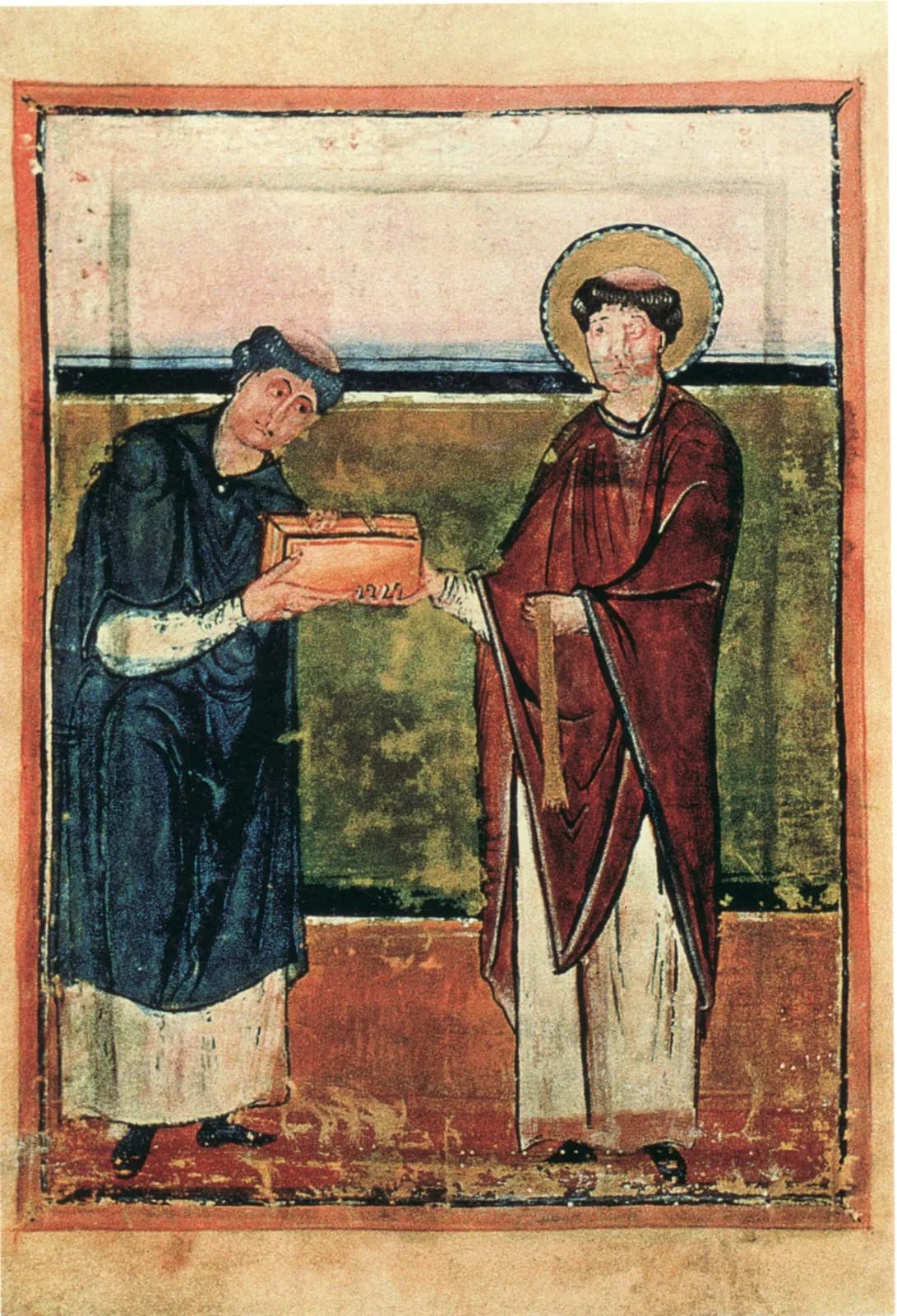
- Born
- About 690, place unknown; perhaps in Aquitaine or Spain, says katolsk.no 1; "the Anglo-Saxon (?)," says the Catholic Encyclopedia 3
- Relics
- Taken from Hornbach to Speyer, and in 1575 to Innsbruck 1
- Patron saint of
- Pregnant women and a good birth; sick animals; against snakes, rats and vermin; city of Innsbruck, against plague 1
Saint Pirmin was a wandering missionary bishop of the eighth century who founded the abbey of Reichenau on Lake Constance and a string of monasteries along the Upper Rhine. 123 Nobody knows where he was born. 1 He left a handbook for missionaries, the Scarapsus, which contains the oldest known text of the Apostles' Creed in its present form. He died in 753 at his monastery of Hornbach, where his grave was found empty twelve hundred years later. 1
A man from nowhere in particular
The Norwegian bishops' saints database is frank about how little is known. Pirmin was born around 690, or perhaps around 670, and nobody knows where. 1 He was probably a Visigoth from Aquitaine, or from Aragon or Catalonia, fleeing the advancing Moors; Paris has also been named, and some traditions give him a Celtic birthplace. 1 katolsk.no thinks he was probably not from the British Isles, unlike most missionaries in eighth-century Germany, though some sources call him Anglo-Saxon or Irish. 1 The 1911 Catholic Encyclopedia, in its article on Reichenau, calls him "the Anglo-Saxon (?)", question mark included. 3
The written sources are late and mixed. katolsk.no names three Lives: one written in Latin around 830 by a monk of Hornbach, rich in legend; a second, the main source, which Mabillon attributed to Bishop Warmann of Constance and others to a Fulda monk of about 1050; and a verse Life by Abbot Heinrich of Reichenau from about 1210, less historical still. 1 The histories of the monasteries he founded fill in the rest. 1
What the sources agree on is his way of life. He belonged to the movement of peregrinatio, the wandering monks who left home for good to preach and to rebuild church life in a Frankish kingdom that was still deeply pagan after the migrations. 1 In 717, katolsk.no says, he had to flee the Muslim invasion of Septimania, in what is now southern France. 1
A bishop without a diocese
The oldest Life places him for a time in a fortified town called "Meltis Castellum," probably in northern France, and one source makes him abbot from 718 of a community at Antwerp, serving the castle church inside the old city wall. 1 In 720, katolsk.no says, he went to Rome to ask the pope's blessing on his mission and was consecrated there as a chorbishop, a missionary bishop without a see; other sources say he was consecrated at Meaux. 1
He was never bishop of Meaux, katolsk.no adds, although the Roman Martyrology before the Second Vatican Council called him "Meldensis Episcopus." 1 He is first named as a bishop in a charter of the Merovingian king Theuderic IV from 727. 1 The present Martyrology calls him simply bishop and abbot of Reichenau. 2
Reichenau
A nobleman called Sintlaz invited him to preach on his lands, where ignorance had let Christians slide back into paganism, and gave him an island in the part of Lake Constance called the Untersee. 1 There, in 724, Pirmin built a church and founded his first monastery. 1 The Catholic Encyclopedia says he founded it "under the protection and at the suggestion of Charles Martel," with the help of Count Berthold and the Alemannian duke Santfrid, and that until the tenth century the house was called Sintleosesau, Sintlaz's island. 3 It came to be known as Augia Dives, the rich island: Reichenau. 13
Pirmin gave the library fifty books. 1 Reichenau became a nursery of bishops for Constance, Basel, Strasbourg and Speyer; katolsk.no counts thirteen archbishops and thirty-four bishops trained there, and says it was an important center of medieval culture until the thirteenth century. 1 The encyclopedia says Reichenau "had attained its full glory when the Abbey of St. Gall was still comparatively unimportant." 3
He did not stay to see it. The encyclopedia speaks of "St. Pirmin's banishment from his monastery through the political machinations of the Alemannian prince," and says his successor, Abbot Heddo, later bishop of Strasbourg, met the same fate. 3
Murbach and the Upper Rhine
After his banishment, katolsk.no says, he founded the monastery of Murbach in Alsace in 727 with the permission of Count Eberhard, and Bishop Werigern of Strasbourg consecrated it in 728. 1 He called it a "vivarium peregrinorum," a home for monks living as pilgrims. 1 He did not stay long there either: by 730 one of his disciples, Romanus, was its abbot. 1
Between 730 and 742 he is said to have founded or reformed a series of monasteries around Strasbourg and in the Black Forest. 1 katolsk.no counts him a cofounder of Gengenbach and of Schwarzach, where his disciple Saroard was the first abbot, and a renewer of Maursmünster and Schuttern, while noting that his work at Gengenbach, Schuttern and Weissenburg is not proven. 1 The Martyrology says he evangelized the Alamanni and the Bavarians and founded many monasteries. 2
His houses began under the "Regula mixta," a modified form of Saint Columban's rule, and little by little he brought all of them under the Rule of Saint Benedict. 1 katolsk.no therefore counts him among the greatest Benedictine missionaries in the German lands, and a forerunner of Benedict of Aniane, who placed every monastery of the Frankish realm under that Rule in 817. 1 He worked at the same time as Saint Boniface, but the two did not know each other. 1
The Scarapsus and the Creed
His most important book is a small handbook, the "Dicta Pirmini," or Scarapsus, written between 710 and 724. 1 It gathers passages from the Fathers and from Scripture, katolsk.no says, probably for missionaries to use or to be read at monastic meals, and it was widely copied in the Middle Ages. 1 It contains the oldest known appearance of the present text of the Apostles' Creed. 1 The Martyrology describes it as a book he wrote for his disciples on how to teach the faith to the unlearned. 2
The Scarapsus also preserves an old story about the Creed itself. Herbert Thurston, writing on the Apostles' Creed in the Catholic Encyclopedia, cites Pirminius among the earliest witnesses to the legend that the twelve apostles, on the day of Pentecost, composed the Creed between them, each contributing one article. 4
Hornbach, Speyer and Innsbruck
He died at the monastery of Hornbach, which the Martyrology places near Strasbourg, and was buried there. 12 Miracles at his grave began his cult. katolsk.no says an eighth-century Metz manuscript of the martyrology already calls him "sanctus," and a Reichenau breviary of the early ninth century mentions his feast. 1
He lay at Hornbach for more than eight hundred years. 1 During the Reformation the monastery dwindled to three monks by 1548 and was dissolved in 1558, and its last abbot, Count Anton of Salm, saved the relics by taking them to Speyer. 1 In 1575 Count Schweikhard of Helfenstein took them to his residence at Innsbruck, where from 1611 Pirmin was honored as patron of the city and a helper against plague. 1 When the Diocese of Speyer celebrated the twelve hundredth anniversary of his death in 1953, his grave at Hornbach was found empty. 1
What is Saint Pirmin the patron saint of?
katolsk.no says Saint Pirmin is invoked by pregnant women and for a good birth, which women hoped for by touching his belt or vestments, and for the healing of animals. 1 Later popular piety made him a helper against snakes and rats; it is still said that neither is found on Reichenau, because he sent them away from the island. 1 As patron of Innsbruck he was invoked against plague. 1 He is shown as an abbot or bishop surrounded by snakes, toads or other creeping things, with a thornbush bearing good fruit, or with a model of a church for his many foundations. 1 The industrial town of Pirmasens in the Palatinate takes its name from him. 1
Saint Pirmin's feast day
Praying with Saint Pirmin
Pirmin spent his life leaving places. He fled Septimania, was driven out of Reichenau, and handed Murbach to a disciple within three years. 13 The ideal he followed was to have no home on earth, and the houses he founded went on long after he had gone. 1
He also cared that ordinary Christians knew what they believed. The Scarapsus is a teaching book, made of short passages from Scripture and the Fathers, and the Creed it preserves is the one Catholics still say. 12
His grave is empty, and his relics were carried from Hornbach to Speyer and on to Innsbruck. 1 What he left in the places he passed through is a set of monasteries, a library of fifty books, and a way of teaching the faith that the Martyrology still remembers him for. 12
Saint Pirmin, pray for us.
Sources
- 1."Den hellige Pirmin av Reichenau (~690-753)," Den katolske kirke (katolsk.no), Catholic Diocese of Oslo (in Norwegian).
- 2.Roman Martyrology, entry for November 3, "San Pirmino, vescovo e abate," as printed in "Santo del giorno," Conferenza Episcopale Italiana (in Italian).
- 3.Ulrich Schmid, "Reichenau," The Catholic Encyclopedia, Vol. 12 (New York: Robert Appleton Company, 1911).
- 4.Herbert Thurston, "Apostles' Creed," The Catholic Encyclopedia, Vol. 1 (New York: Robert Appleton Company, 1907).
Saints to turn to next
Others in this collection who are turned to for some of the same things.
- Saint Godehard of Hildesheimc. 960 - May 1038Work and vocationStudy and teaching
- Saint Virgil of Salzburgc. 700 - 784Study and teachingWork and vocation
- Saint Aelred of Rievaulx1109 - January 12, 1166 (or 1167)Work and vocationStudy and teaching
- Saint Albert the Greatc. 1206 - November 15, 1280Study and teachingWork and vocation