Saint Phocas the Gardener
Martyred at Sinope, date uncertain
- Died
- A martyr at Sinope, possibly under Diocletian about 303, or perhaps under Hadrian in 117, says katolsk.no 1
- Patron of
- Sailors of the Black Sea, the Aegean and the Adriatic, says katolsk.no 1
- In art
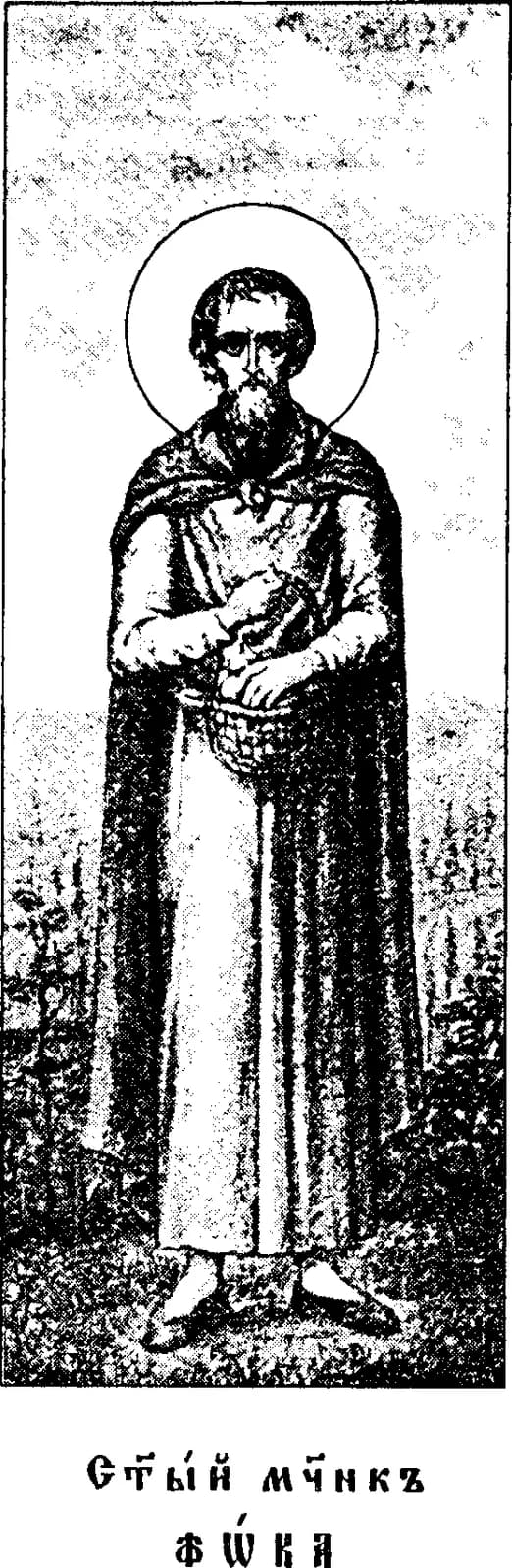
- Shown as a gardener, or with a sword 1
Saint Phocas was a gardener of Sinope, a port on the Black Sea, who was put to death for being a Christian, perhaps around 303. 13 The story told of him about a century later says that soldiers sent to kill him stopped at his house without knowing who he was, that he gave them supper and a bed, and that while they slept he went out and dug his own grave. 1
What is certain
katolsk.no, the Norwegian bishops' saints database, is frank about how little is known. Phocas came from Sinope in Pontus, on the southern shore of the Black Sea, today Sinop in Turkey, and was martyred there at an early date, possibly under Diocletian around 303, or perhaps under Hadrian in 117. 1 He had a shrine at Sinope and was honored far and wide. That, it says, is all that can be said of him with certainty. 1 His name appears four times in the ancient martyrology attributed to Jerome. 1
Sinope was an old Greek city with an early church. Siméon Vailhé, in the 1912 Catholic Encyclopedia, notes that "a Christian community existed there in the first half of the second century," with a bishop who was the father of the heretic Marcion. 2
The current Roman Martyrology gives him one sentence: at Sinope in Pontus, Saint Phocas, martyr, who was a gardener and suffered many torments for the name of the Redeemer. 3
The gardener at the city gate
Almost everything else comes from a sermon. About the year 400, Saint Asterius, bishop of Amasea in Pontus, preached a panegyric on Phocas that gives something like a life, though katolsk.no warns that not much trust can be put in it, and it gives no dates. 1
In Asterius's telling, as katolsk.no summarizes it, Phocas was both a hermit and a skilled market gardener who lived by the city gate of Sinope. 1 He lived an ascetic life of prayer and contemplation. What his garden produced beyond his own needs went to feed guests and pilgrims in his guesthouse, and whatever was left over went to the poor. 1
The guests who came to kill him
During a persecution, the story goes on, Phocas was denounced as a Christian and condemned to death without a trial. 1 One day soldiers arrived at his hut and said they had orders to kill a Christian named Phocas, and asked whether he could tell them where the man lived. 1
The city gate was already shut for the night. Phocas invited them to stay with him and promised to show them the way in the morning. 1 They accepted, and during the night he dug a grave in his garden and prepared himself to die. 1
In the morning he told his guests that he was the man they were looking for. 1 katolsk.no says that when they had recovered from their astonishment, and he had assured them he counted martyrdom the greatest honor, they carried out their orders with great regret and killed him. 1 Christians of the city buried him in the grave he had dug in his own garden. 1
The Martyrology's "many torments" describe a different death from the quiet morning in Asterius's story. 13 The sources do not reconcile the two, and this page does not try.
A gardener patron of sailors
An impressive church was later built over the grave. 1 By Asterius's time, katolsk.no says, it drew pilgrims from near and far and his relics were much sought after. 1 Sailors on the Black Sea, the Aegean and the Adriatic sang sea songs to Phocas as their patron. 1
katolsk.no observes that a gardener patron of sailors is not unique, and points to Saint Simeon the Younger, who lived on top of a pillar. 1 It suggests the reason may lie in his name, which is close to the Greek word for a seal, phoke. 1
He was honored above all in the East. Both Vienne and Antioch claimed his relics, and there were churches dedicated to him in Rome, Constantinople and Sicily. 1 In art he is shown as a gardener or with a sword. 1
Three saints named Phocas
The calendars know more than one Phocas, and the sources treat them as probably the same man. katolsk.no has a Bishop Phocas of Sinope, said to have been martyred under Hadrian or Trajan and kept on July 14, and a Phocas of Antioch, said to have been suffocated in a bath around 320 under Licinius and kept on March 5. 45 Of each it says that he looks like a legendary figure derived from the real martyr, the gardener of Sinope. 45
Its explanation is the relics. They seem to have reached different places by way of sailors, and several legendary saints grew out of one historical one; July 14 may be the feast of the translation of the gardener's relics to Vienne. 15 Vailhé, in the encyclopedia, is more cautious. He lists Saint Phocas among the bishops of Sinope, "venerated on 22 September, with St. Phocas, the gardener of the same town, who is possibly to be identified with him." 2
What is Saint Phocas the patron saint of?
Saint Phocas is a patron of sailors. katolsk.no says that seamen on the Black Sea, the Aegean and the Adriatic sang songs to him as their patron, and suggests his name, close to the Greek for a seal, may be part of the reason. 1 None of the sources consulted calls him patron of gardeners, though he is shown as one. 123
Saint Phocas's feast day
Saint Phocas's feast day is March 5 in the current Roman Martyrology, which keeps the gardener of Sinope on that day. 3
Older sources give September 22. katolsk.no names September 22 as his day, with July 23 also found, and puts Phocas of Antioch on March 5; Vailhé's encyclopedia article also says the Sinope Phocas was "venerated on 22 September." 124 katolsk.no adds that the Eastern churches keep him on several days in July and on December 22. 1
Praying with Saint Phocas
The one story told of Phocas is a story about hospitality. He grew more than he needed and gave the rest away, to travelers first and then to the poor. 1 When strangers came to the door at nightfall, he fed them and found them a place to sleep, and he did it knowing why they had come. 1
He used the night to dig. A gardener knows how to make a hole in the ground, and he made the one he would be buried in. 1 Then in the morning he told the truth. 1
The sources are honest that this may be more sermon than record. 1 What the Church has kept for certain is shorter: a gardener of Sinope who suffered for the name of Christ. 3
Saint Phocas the Gardener, pray for us.
Sources
- 1."Den hellige Fokas Gartneren av Sinope ( -~303)," Den katolske kirke (katolsk.no), Catholic Diocese of Oslo (in Norwegian).
- 2.Siméon Vailhé, "Sinope," The Catholic Encyclopedia, Vol. 14 (New York: Robert Appleton Company, 1912).
- 3.Roman Martyrology, entry for March 5, "San Foca, martire," as printed in "Santo del giorno," Conferenza Episcopale Italiana (in Italian).
- 4."Den hellige Fokas av Antiokia ( -~320)," Den katolske kirke (katolsk.no), Catholic Diocese of Oslo (in Norwegian).
- 5."Den hellige Fokas av Sinope ( -117)," Den katolske kirke (katolsk.no), Catholic Diocese of Oslo (in Norwegian).
Saints to turn to next
Others in this collection who are turned to for some of the same things.
- Saint BarnabasFirst centuryCourageWork and vocationPoverty and simplicity
- Saint Clement Mary HofbauerDecember 26, 1751 - March 15, 1820Work and vocationCouragePoverty and simplicity
- Saint Frances Xavier CabriniJuly 15, 1850 - December 22, 1917CouragePoverty and simplicityWork and vocation
- Saint François de LavalApril 30, 1623 - May 6, 1708CourageWork and vocationPoverty and simplicity