Saint Peter of Verona
c. 1205 - April 6, 1252
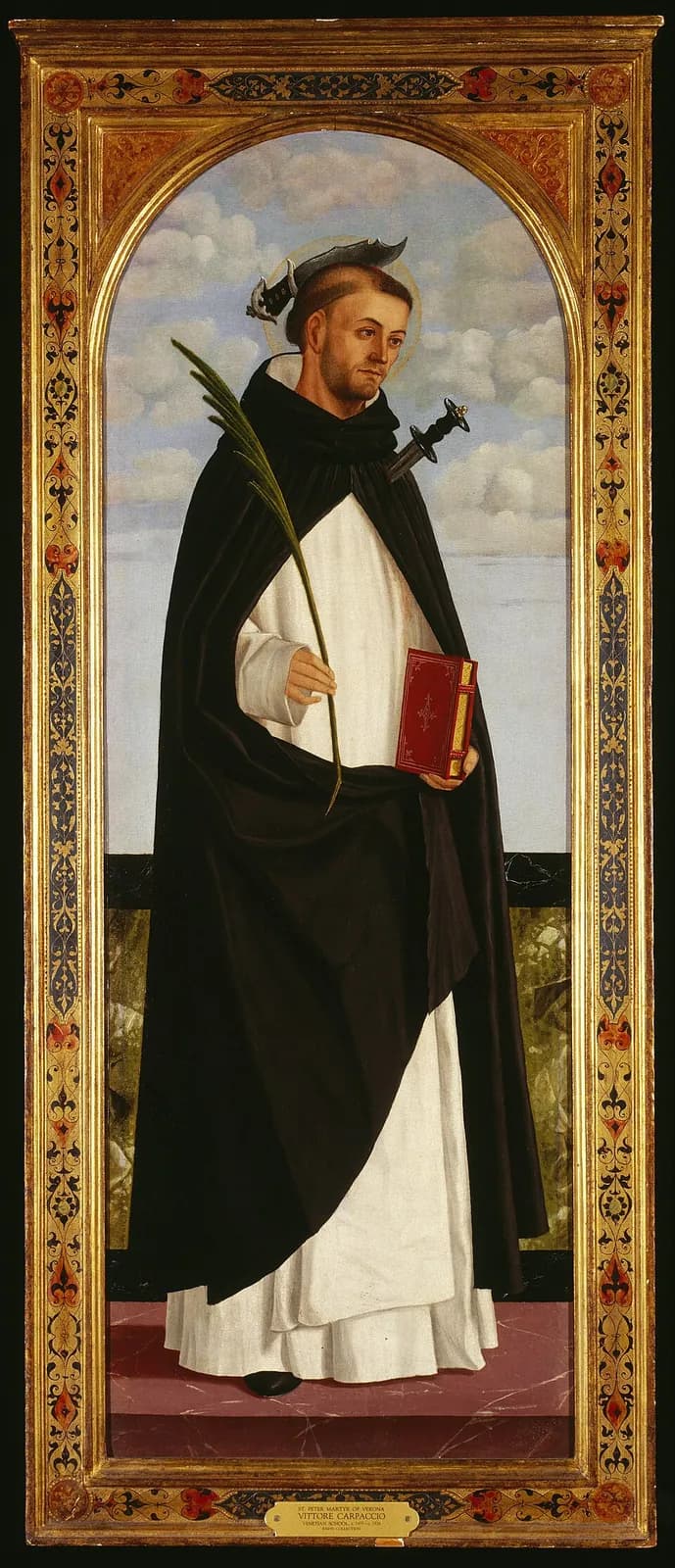
Saint Peter of Verona, called Peter Martyr, was a Dominican friar born to a heretical family in Verona who became one of the best-known preachers in thirteenth-century Italy, served as an inquisitor, and was killed on the road from Como to Milan on April 6, 1252. 123 By the account in the 1911 Catholic Encyclopedia, he rose to his knees after the first blow and wrote "Credo in Deum" on the ground in his own blood. 1 Innocent IV canonized him the next year. 123
A Catholic child in a heretical house
He was born at Verona, in 1206 according to Anthony Allaria's 1911 article and about 1205 according to the New Catholic Encyclopedia; his own order says only "at the end of the 12th century." 123 His parents belonged to the dualist sect that Allaria calls Manichaean, "which still survived in northern Italy in the thirteenth century." 1 The Order of Preachers says he "was converted to the Catholic faith as a child." 2
His family sent him to a Catholic school anyway. 1 Pius Parsch, excerpted by Catholic Culture, tells a story from those years. An uncle who held the family's beliefs asked what he was learning, and the boy answered, "The Apostles' Creed." 4 Neither threats nor coaxing from his father and uncle moved him, Parsch says. 4
Bologna, and Saint Dominic
He went on to the University of Bologna, where he met Saint Dominic and joined the Friars Preachers. 12 The Order says he was moved by Dominic's preaching and received the habit from Dominic himself. 2 The New Catholic Encyclopedia puts his entry around 1221, and Parsch notes that this was the year Dominic died. 34 The Nashville Dominicans say he was sixteen; Parsch has him at school at seventeen, so the two do not quite agree. 48
The Nashville Dominicans pass on one story from his early years in the Order. He was falsely accused of having women in his cell, when, they say, he had been speaking in a vision with three early virgin martyrs. 8 He complained of it in prayer, and the Lord pointed to His cross and to the false charges that had put Him there. 8
Preacher and prior
Allaria says he preached across nearly the whole of Italy, in Rome, Florence, Bologna, Genoa and Como, that crowds came out to meet him, and that conversions were numerous. 1 He was not gentle with his own side: "He never failed to denounce the vices and errors of Catholics who confessed the Faith by words, but in deeds denied it." 1 The Nashville Dominicans add that he drew great crowds even on blistering summer days. 8
He also organized laypeople. The Order says he established "Associations of the Faith" and "Confraternities of Praise of the Blessed Virgin Mary"; the New Catholic Encyclopedia calls them "militant, pious confraternities of laity to counteract heretical influences." 23 At Florence in 1244 and 1245 he helped the seven founders of the Servites. 3
He served as prior at Asti in 1240, at Piacenza in 1241 and at Como in 1251, according to the New Catholic Encyclopedia. 3 The Order remembers him as a defender of common life who "wisely ordered it as prior," and as a spiritual director to Dominican sisters. 2
Inquisitor
The sources agree that he held the office of inquisitor and disagree on when. 1235 Allaria says Gregory IX made him general inquisitor and that his superiors set him to combat the sect his parents had belonged to. 1 The New Catholic Encyclopedia says he was named papal inquisitor in 1232 and again in 1251. 3 Vatican News calls him Inquisitor General for Lombardy. 5 His own order places the appointment "toward the end of his life" and says he carried it out "effectively and with great humanity during the middle of the year 1251." 2
Allaria says the movement he opposed tried everything to stop him: "Persecutions, calumnies, threats, nothing was left untried." 1 The New Catholic Encyclopedia puts it in fewer words. His preaching and his converts, it says, "aroused the hatred of the cathari." 3
The road from Como
At Easter time in 1252, the New Catholic Encyclopedia says, he was on the road from Como back to Milan. 13 Allaria says a man named Carino, with others of the sect, had plotted to kill him. 1 Carino struck him on the head with an axe, "with such violence, that the holy man fell half dead." 1
What happened next is the scene every painting of him shows. "Rising to his knees he recited the first article of the Symbol of the Apostles, and offering his blood as a sacrifice to God he dipped his fingers in it and wrote on the ground the words: 'Credo in Deum'." 1 The nuns of the Monastery of Our Lady of Grace give the words as "Credo in unum Deum." 7 His order says he fell "for devotion to the faith and obedience to the Roman Church," confessing the Creed with his final words. 2 The murderer then pierced his heart, Allaria writes. 1 He died on April 6. 123
The Order of Preachers adds one more fact: Carino "later embraced the Order." 2
Sant'Eustorgio and canonization
His body was carried to Milan and laid in the church of Sant'Eustorgio, where Balduccio Pisano carved a mausoleum for him. 1 Allaria says his miracles grew more numerous after his death. 1 Innocent IV canonized him in 1253, on March 25 by Allaria's date and on March 9 by the Order's. 12 The Dominican Friars of the Province of St. Joseph call him the first Dominican saint to be canonized. 6
Devotion to him produced blessings of its own. The Province of St. Joseph prints two from the Dominican tradition: a blessing of "Peter Martyr water" for the sick, and a blessing of palms and branches asking that storms and lightning spare the homes where they are kept. 6 The New Catholic Encyclopedia says he "enjoyed a wide cult in the Middle Ages and was frequently depicted in art." 3
What is Saint Peter of Verona the patron saint of?
The New Catholic Encyclopedia and Catholic Culture both name Saint Peter of Verona as patron of inquisitors. 34 No other patronage appears in the sources consulted. Catholic Culture lists how he is shown in art: a Dominican with a large knife in or splitting his head, or with a knife in his head and a sword in his breast. 4
Saint Peter of Verona's feast day
Saint Peter of Verona is commemorated on April 6, the day of his death, in the Roman Martyrology, as Catholic Culture records, and Vatican News lists him on that day. 45 The Dominican Order keeps him on June 4 as an obligatory memorial. 26 The Order explains why: Innocent IV set his feast on April 29, and after the most recent liturgical reform it was moved to the anniversary of the translation of his relics in 1340. 2 The New Catholic Encyclopedia prints "April 20 (formerly 29)," a date no other source here gives. 3
Praying with Saint Peter of Verona
He began with the Creed and ended with it. As a schoolboy, by Parsch's account, he told a heretical uncle that the Apostles' Creed was what he was learning. 4 On the road from Como, by Allaria's, he recited its first article on his knees and wrote it in the dirt. 1 Catholic Culture suggests meditating now and then on one article of the Creed in his memory. 4
His story does not sit easily with a modern reader, and it should not be made to. He was an inquisitor, appointed by the papacy to act against a sect, and his own order chose to remember the office as carried out "with great humanity." 123 That is their judgment of him, and readers can weigh it.
He also preached hardest at Catholics who professed the faith and did not live it. 1 And the man who killed him, the Order says, later joined the Order himself. 2 Whatever else the story holds, it ends with a murderer becoming a brother of the man he murdered.
The Nashville Dominicans say he prayed at Mass each day that he might give his life for the Lord who had died for him. 8 He did, on the road from Como. 1
Saint Peter of Verona, pray for us.
Sources
- 1.Anthony Allaria, "St. Peter of Verona," The Catholic Encyclopedia, Vol. 11 (New York: Robert Appleton Company, 1911).
- 2."S. Petri de Verona," Saints of the Order, Order of Preachers, from the Proprium Officiorum Ordinis Praedicatorum (Rome, 1982).
- 3."Peter Martyr, St.," New Catholic Encyclopedia, via Encyclopedia.com.
- 4.Catholic Culture, Liturgical Year, April 6, 2022, with an excerpt from Pius Parsch, The Church's Year of Grace.
- 5.Vatican News, Saint of the Day, April 6.
- 6."The Blessings of St. Peter Martyr," Dominican Friars, Province of St. Joseph, June 2012.
- 7."St. Peter Martyr," Dominican Saints, Dominican Nuns of the Monastery of Our Lady of Grace.
- 8."St. Peter of Verona," Our Saints and Blesseds, Dominican Sisters of St. Cecilia (Nashville Dominicans).
Saints to turn to next
Others in this collection who are turned to for some of the same things.