Saint Peter Nolasco
c. 1189 - December 25, 1256 (or 1259)
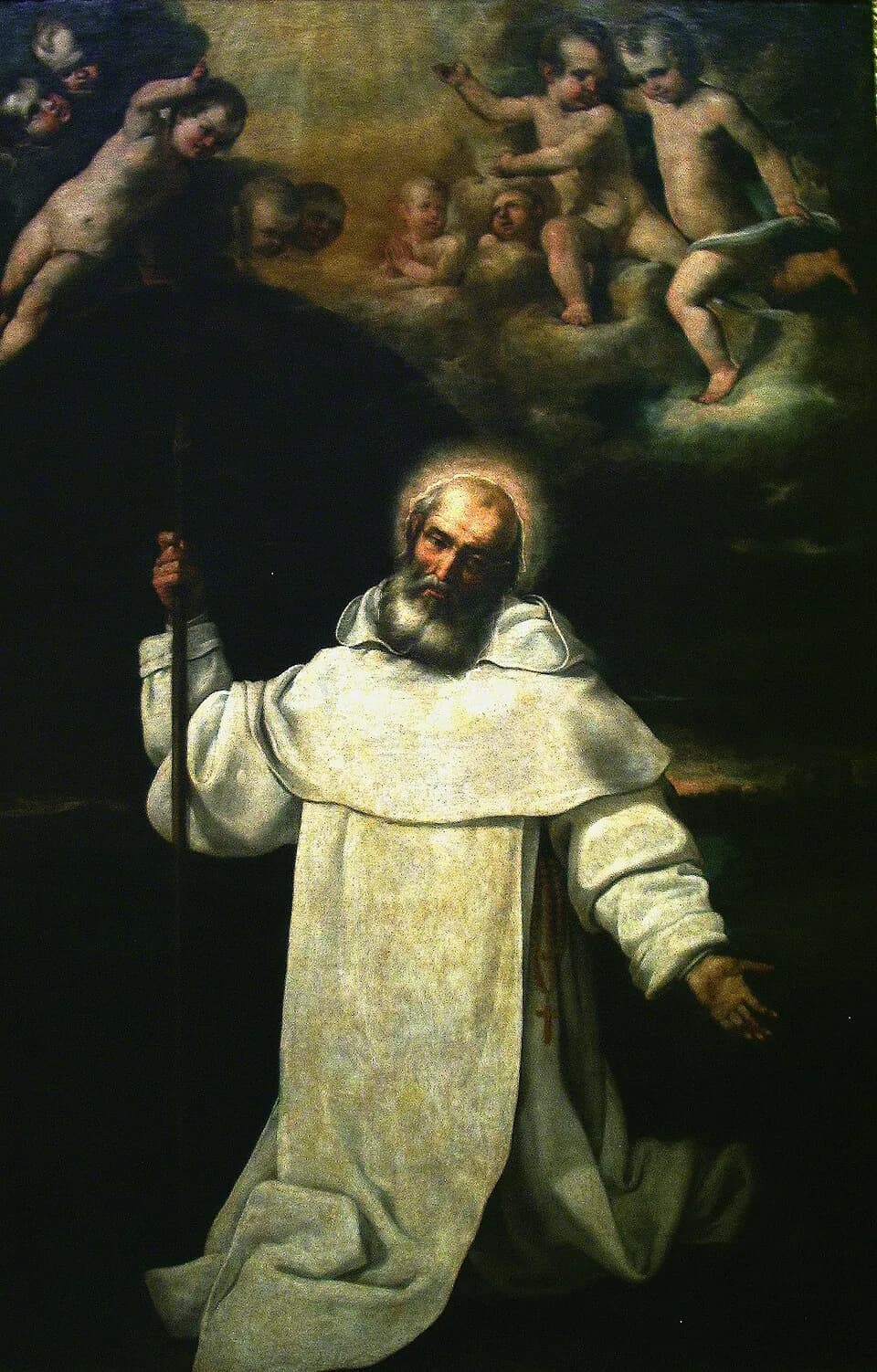
- Patron saint of
- No patronage is named in any source consulted. His order was founded to ransom Christian captives 13
- Feast day
- January 31 in the 1911 Catholic Encyclopedia; January 28 in the Roman Martyrology and local calendars according to New Advent's note 1. May 6 in Catholic Culture's Martyrology listing and in the Mercedarians' own celebration 78
- Born
- 1189 (or 1182) at Mas-des-Saintes-Puelles, near Castelnaudary, France 12; the Mercedarians say Languedoc or Barcelona 5
- Canonized
- 1628, by Urban VIII, according to the Mercedarians 5
Saint Peter Nolasco founded the Mercedarians, a religious order whose members bound themselves by vow to spend everything they had on ransoming Christian captives and, if necessary, to remain in captivity in their place. 16 He began the work at Barcelona in 1218, at a time when, as the 1911 Catholic Encyclopedia puts it, "the Moors were masters of a great part of the Iberian peninsula." 12 Much else about him, down to the year of the founding, comes in more than one version, and this page gives them side by side.
Where he came from
Anthony Allaria, writing in the 1911 Catholic Encyclopedia, says he was born at Mas-des-Saintes-Puelles, near Castelnaudary in southern France, in 1189 "or 1182," and died at Barcelona on Christmas Day, 1256 "or 1259." 1 The encyclopedia's separate article on the Mercedarians gives 1189 and 1256. 2 The Mercedarian Friars are less definite about the start: born "at the end of the twelfth century in either Languedoc, France, or Barcelona, Spain." 5
Accounts of his early life pull in different directions. Allaria describes a young man of noble family, known for piety and almsgiving, who gave his possessions to the poor, took a vow of virginity and went to Barcelona "to avoid communication with the Albigenses." 1 J. Besse, in the encyclopedia's Mercedarians article, has him join Simon de Montfort's army against those same Albigenses and become tutor to the boy-king James of Aragon, whom he followed to Barcelona in 1215. 2 Catholic Culture's note on the Martyrology says he took part in the crusades against the Albigensians. 8 Paul Haffner adds that at twenty-five he made over "his vast estates to the Church" and went on pilgrimage to Our Lady of Montserrat. 9
The order tells it differently again. Its friars describe him as "a merchant by profession," and a 2019 post on their site calls him "a cloth merchant by trade" from "the emerging middle class." 57 On his business trips he saw the condition of Christians carried off in raids and held as slaves in Granada and along the African coast, and after his father died he spent a small inheritance ransoming them until he had nothing left. 5 Allaria agrees on that much: Peter "ransomed many of these and in doing so consumed all his patrimony." 1
The founding of the Mercedarians
All the sources speak of a heavenly vision, and they tell it at different lengths. Allaria says only that Peter, "after mature deliberation, moved also by a heavenly vision," resolved in 1218 to found an order for the redemption of Christian slaves, modeled on the Trinitarians of John de Matha and Felix de Valois. 1 Besse says the Blessed Virgin asked him in a vision to found it. 2 The order's founder page gives her words as "Find me men like yourself, an army of brave, generous, unselfish men." 5 Its 2019 post places the vision during a retreat at Montserrat, with Mary calling herself "a messenger sent by the Most Holy Trinity" and giving him the white scapular his followers would wear. 7
The dates and the cast also vary. The order says the Mercedarians were founded on August 10, 1218, in the cathedral of Saint Eulalia at Barcelona, when Peter and two companions were received as the first members. 57 Haffner dates the vision to the night of August 1, 1218, and says the Virgin appeared that night to Peter, to his confessor Raymond of Penyafort and to King James I. 9 Allaria is more cautious: Raymond and the king encouraged him, and "it seems, had been favoured with the same inspiration." 1 Pius Parsch, excerpted by Catholic Culture, puts the vision in 1228. 8
Raymond's part is weighed differently too. Pope Leo XIV, in his 2025 exhortation Dilexi te, says the order was "founded by Saint Peter Nolasco with the support of the Dominican Saint Raymond of Peñafort." 3 Besse calls Raymond his confessor and says he "encouraged and assisted him" and drew up the order's first rule. 2 The friars call Raymond his spiritual director, who "used his influence to get approbation and support." 5 Vatican News, in its page on Raymond, reverses the roles: a year after becoming a Dominican in 1222, Raymond founded the order "with the help of the future saint Peter Nolasco." 4
Gregory IX approved the order in 1230. 1 Besse says Honorius III had approved it first, and that Gregory gave it the Rule of Saint Augustine, with the earlier rule kept as its constitutions. 2 Peter was its first superior, with the title of commander-general, and also served as ransomer, the friar sent into Moorish lands to arrange the release of prisoners. 2
The fourth vow
What set the order apart was a vow added to poverty, chastity and obedience. Allaria describes it as a special vow "to employ all their substance for the redemption of captive Christians, and if necessary, to remain in captivity in their stead." 1 The friars today describe it as giving "everything, including their lives, should it be necessary," even to the point of physically exchanging themselves for prisoners. 6 Leo XIV writes that the Mercedarians, by adding this fourth vow, "testified that charity can be heroic." 3
Allaria says that at first most of the members were laymen, "as was Peter himself." 1 The order's 2019 post insists that he "was not a priest when he founded the work, nor was he ever ordained." 7 Catholic Culture's calendar nonetheless lists him as "St. Peter Nolasco, Priest." 8 The rule that the head of the order must be a priest came later, by a decree Allaria credits to Clement V and the friars to John XXII in 1318; the friars add that it led the lay knights to leave for the military order of Montesa. 15
Ransoming captives
The friars say Peter and his companions traveled through Christian Spain collecting members and money, then negotiated with slave-owners in Andalusia, Tunis and Morocco, and that Peter himself made two journeys to Africa. 5 Parsch also counts two African journeys "as 'the Ransomer,' not without peril to his own life," and says he once ransomed four hundred captives at Valencia and Granada. 8
The numbers differ. Parsch says records show 890 Christians freed through his personal efforts. 8 The order puts the figure at about 2,700 during the founder's lifetime, and about 70,000 across its history. 5
He resigned as superior seven years before he died and was succeeded by Guillaume Le Bas, according to Besse. 2 The friars say he died in 1256 after a long illness. 5 Parsch says he died with a line of Psalm 110 on his lips: "The Lord has sent redemption to His people." 8 The order dates his canonization to 1628, under Urban VIII. 5
What became of the work
Besse records the order spreading through France, England, Germany, Portugal and Spain, and members sailing with Columbus and founding houses across Latin America. 2 Leo XIV, writing in 2025, says the tradition of the ransoming orders "did not come to an end," and that it has inspired new action against human trafficking, forced labor and sexual exploitation. 3 The friars describe their present work as bearing witness to the same charity among people "oppressed by new forms of captivity." 7
Haffner traces the feast of Our Lady of Ransom, on September 24, to thanksgiving for the order's founding, kept first by the Mercedarians and later extended to the whole Church by Innocent XII. 9
What is Saint Peter Nolasco the patron saint of?
Saint Peter Nolasco's feast day
The sources give three dates. The 1911 Catholic Encyclopedia says: "His feast is celebrated on the thirty-first of January." 1 A bracketed note added by New Advent to the same page says the January 31 feast was removed with the reform of the general Roman calendar in 1969, and that he is now commemorated in the Roman Martyrology and in local calendars on January 28. 1
Catholic Culture lists him on May 6 among that day's commemorations from the Roman Martyrology. 8 The Mercedarian Friars marked "the Feast of their Founder" in a post dated May 6, 2019, writing "As we celebrate today." 7 None of the sources explains why the dates differ.
Praying with Saint Peter Nolasco
By every account the work began with money running out. Allaria says he consumed his whole patrimony on ransoms; the friars say his inheritance was small and that he was close to despair when it was gone. 15 The order he founded grew out of that point, and its members were asked to give in the same way. 16
The vow he required went past giving money. Members promised to stay in captivity themselves if that was the price of someone else's freedom. 1 Leo XIV reads it as "a quasi-liturgical act, the sacramental offering of themselves," and links it to the words of John 15:13, "No one has greater love than this, to lay down one's life for one's friends." 3
Much of the story is uncertain. The sources differ on whether he was a noble, a soldier or a merchant; on whether the founding came in 1218, 1223 or after a vision in 1228; and on how much of it was his and how much Raymond's. 12458 What none of them disputes is the work itself, Christians bought back out of captivity in Spain and North Africa, by a man who went to do the negotiating in person. 1258
The friars describe him as a man of "contemplative action," devoted to the Passion; "it is said," they write, that he would carry a wooden cross around the courtyard of the convent. They also say he attributed everything, the order included, to Mary, which is why they are called Mercedarians and not "Nolascans." 7
Saint Peter Nolasco, pray for us.
Sources
- 1.Anthony Allaria, "St. Peter Nolasco," The Catholic Encyclopedia, Vol. 11 (New York: Robert Appleton Company, 1911), with New Advent's editorial note on the 1969 calendar.
- 2.J. Besse, "Mercedarians," The Catholic Encyclopedia, Vol. 10 (New York: Robert Appleton Company, 1911).
- 3.Pope Leo XIV, Apostolic Exhortation Dilexi te, on love for the poor, nos. 59-61, October 4, 2025.
- 4."St. Raymond of Penyafort, Dominican, Co-founder of the Mercedarians," Saint of the Day, Vatican News.
- 5."Our Founder," Mercedarian Friars (Order of the Blessed Virgin Mary of Mercy), Philadelphia.
- 6."Our History," Mercedarian Friars (Order of the Blessed Virgin Mary of Mercy), Philadelphia.
- 7."Mercedarians Celebrate the Feast of their Founder," Mercedarian Friars, May 6, 2019.
- 8."Friday of the Third Week of Easter," Liturgical Year, May 6, 2022, Catholic Culture, including an excerpt from Pius Parsch, The Church's Year of Grace.
- 9.Paul Haffner, "September 24: Feast of Our Lady of Ransom," Inside the Vatican, August/September 2005, reprinted by Catholic Culture.
Saints to turn to next
Others in this collection who are turned to for some of the same things.