Saint Pedro de San José Betancur
March 19, 1626 - April 25, 1667
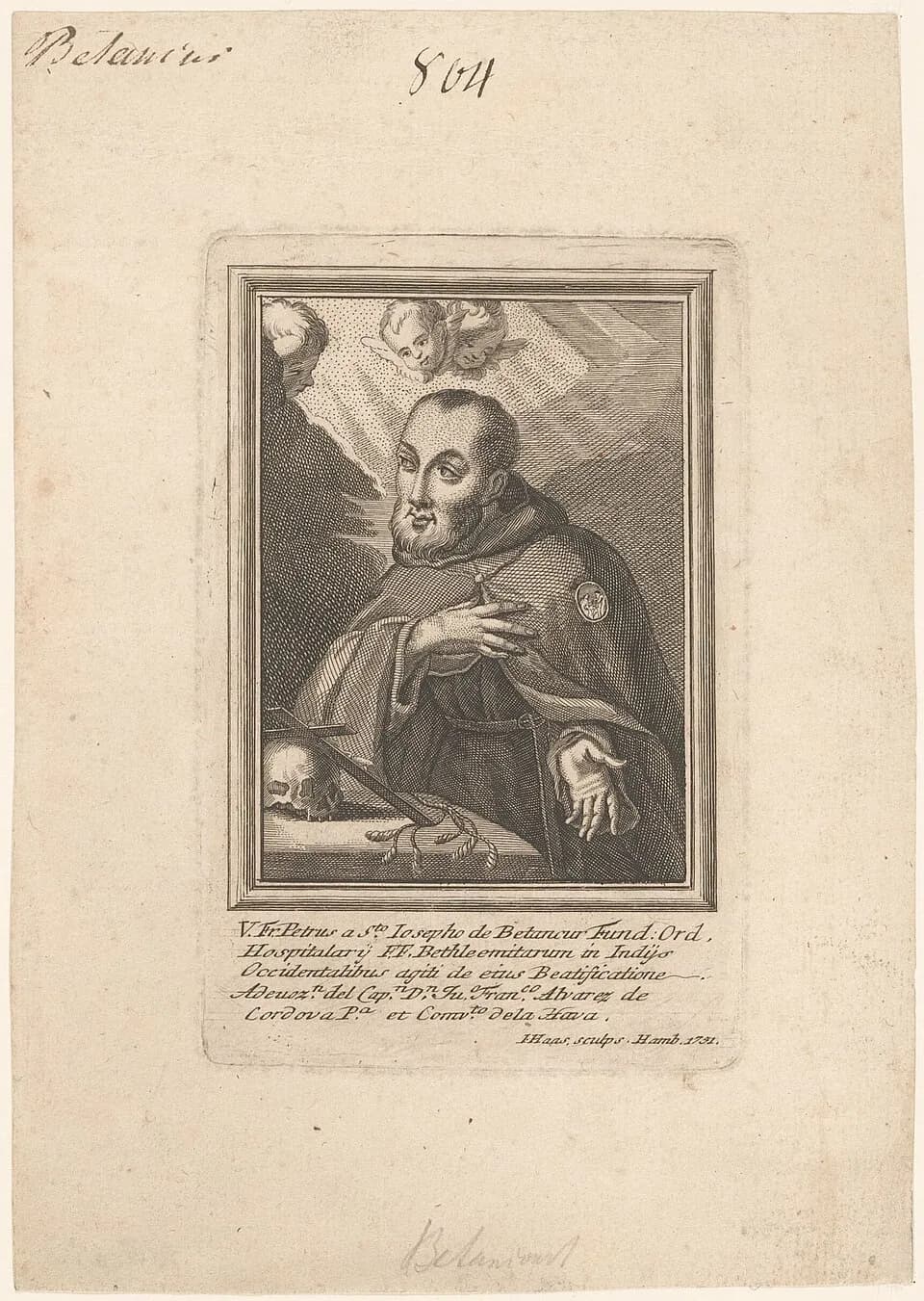
- Born
- March 19, 1626, at Vilaflor on Tenerife, in the Canary Islands; the 1907 encyclopedia says 1619 13
- Founded
- The hospital of Our Lady of Bethlehem for the convalescent poor, 1658, the cradle of the Bethlehemites 12
- Beatified
- June 22, 1980, by Pope John Paul II 5
- Feast day
- April 25 4
Saint Pedro de San José Betancur was a shepherd from Tenerife who arrived in Guatemala so poor that he stood in the Franciscans' bread line, failed at his studies for the priesthood, and as a lay Franciscan tertiary opened a hospital for the convalescent poor, a shelter for the homeless and a school. 14 He is known as Hermano Pedro, Brother Pedro, and the men who came to help him became the Bethlehemites. 23 John Paul II canonized him in Guatemala City on July 30, 2002, and his liturgical feast is April 25. 24
A shepherd from Tenerife
The Vatican's canonization biography says he was born on March 19, 1626, at Chasna de Vilaflor on Tenerife, in the Canary Islands. 1 The Catholic Encyclopedia, writing in 1907, gives the year as 1619. 3 He was descended from Juan de Betancurt, one of the Norman conquerors of the islands, but his own family was very poor, and he began work as the shepherd of its small flock. 13 The biography says the time alone with nature fed a contemplative soul and that as a boy he learned to see God in everything around him. 1
He heard about the misery in which people lived in the West Indies and felt called to carry the Christian message there. 1 He left in 1650. 13 The Vatican biography and John Paul II give his age as twenty-three, Franciscan Media as twenty-four. 145 He was making for Guatemala, where a relative was secretary to the governor general. 1
His money ran out in Havana. He paid for the next stage by working on a ship that put in at Honduras, and from there he walked to Guatemala City, arriving the year after he had set out. 134 John Paul II, preaching in 1980, described him as arriving sick, without resources, alone and unknown. 5
The failed student
He was poor enough to stand in line each day for bread at the Franciscan friary. There he met Friar Fernando Espino, a well-known missionary, who became his friend and lifelong counselor and found him work in a textile factory. 1
In 1653 he entered the local Jesuit college, hoping to become a priest. 1 The encyclopedia adds that he meant to go on from there and evangelize Japan. 3 It did not work. He "showed little aptitude for study", the Vatican biography says, and withdrew; the encyclopedia counts three unsuccessful years. 13 The college did give him a confessor, the Jesuit Manuel Lobo. 1
Friar Fernando invited him to enter the Franciscans as a lay brother. Pedro believed that God wanted him to stay in the world, and in 1655 he joined the Third Order of Saint Francis instead. 14 He wore its habit for the rest of his life. 3 The encyclopedia says he served for a time as sacristan in a church of the Blessed Virgin and then rented a house in a suburb called Calvary, where he taught poor children reading and catechism. 3 John Paul II spoke of the hermitage of Calvary as the place where he sought God's will at every moment. 2
Our Lady of Bethlehem
In 1658 he was given a hut, and he turned it into a hospital for poor people who had been discharged from the city hospital but still needed time to recover. He called it Our Lady of Bethlehem. 1 John Paul II called it the first hospital in the world for convalescents. 5 The encyclopedia tells how it grew: benefactors bought the neighboring houses, the bishop and the governor supplied what was needed, and a proper hospital went up on the site, with Pedro working alongside the masons. 3
A shelter for the homeless followed, a school for poor and abandoned children, and an oratory. 14 The people he served, as both the Vatican biography and the 1980 homily list them, were enslaved Black people, Indians subjected to inhuman labor, emigrants and abandoned children. 15
He begged alms to pay for Masses said by poor priests, and for Masses in the early hours so that the poor could attend, and he had small chapels put up in the poor districts where children were also taught. 1 Every Thursday he begged through the city for the prisoners and visited them in their cells. 3 Each year on August 18 he gathered the children to sing the Seven Joys of the Franciscan Rosary in honor of the Blessed Mother, a custom the Vatican biography says continued in Guatemala in 2002. 1
He also walked the streets with a bell. The encyclopedia says he went at night, asking prayers for the souls in purgatory, for whom he had founded two chapels at the city gates. 3 Franciscan Media says he rang it through the wealthy part of town, inviting the rich to repent. 4 The same source notes that he "is sometimes credited" with originating the Christmas Eve posadas procession, in which people representing Mary and Joseph look for lodging among their neighbors. 4
The Bethlehemites
Helpers joined him, and they came to be called Bethlehemites after the house they served. 3 The sources describe what he intended differently. The Vatican biography says men and women joined him, that they became the Bethlehemite Brothers and Sisters, and that he formulated a rule of active work among the poor and the sick grounded in prayer, fasting and penance. 1 The encyclopedia says he trained his first disciples himself but "had no wish to organize a community, but simply to establish his hospital." 3
He sent one of the brothers, Anthony of the Cross, to Spain to ask the king's approval of the work. It was granted, but Pedro died before the messenger came back. 3 He died on April 25, 1667, worn out, the encyclopedia says, by labor and penance. 13 He was forty-one by the Vatican's dates and forty-eight by the encyclopedia's. 135
It was Brother Anthony who drew up constitutions. Pope Clement X confirmed the congregation in 1673, and a community of Bethlehemite nuns was founded in Guatemala in 1688. 3 Franciscan Media likewise places the papal approval and the sisters after his death. 4 The encyclopedia records that the order spread hospitals and free schools across Latin America and was suppressed in 1820. 3 At the canonization John Paul II greeted the Bethlehemite Brothers and the Bethlehemite Sisters, the latter, he said, born from the inspiration of Mother Encarnación Rosal, the first Guatemalan to be beatified. 2
John Paul II beatified Pedro in Rome on June 22, 1980. 5 He canonized him in Guatemala City on July 30, 2002, before a crowd Franciscan Media puts at half a million, and called him "the first saint of Guatemala and Tenerife". 24
What is Saint Pedro de San José Betancur the patron saint of?
None of the sources used for this page names Saint Pedro de San José Betancur as the patron of anything, so the page claims no patronage for him. 1234 What the sources give him are titles: the Vatican biography and Franciscan Media say he is known as the "St Francis of the Americas", in the biography's spelling, and John Paul II called him the "man who was charity". 124
Saint Pedro de San José Betancur's feast day
Praying with Saint Pedro de San José Betancur
He wanted to be a priest and could not pass the classes. 14 The sources do not dress this up. Franciscan Media says that no matter how hard he tried he could not master the material, and draws from it the reflection that compassion and imagination may matter more to a human life than a clever mind. 4 What he built, he built as a layman in a tertiary's habit, starting from a hut. 13
John Paul II located the source of it in two things Pedro looked at constantly, the crib and the cross. Meditating on the birth and childhood of Jesus led him, the Pope said, "to discover spontaneously, as it were, the face of God in man", and meditating on the cross gave him the strength to practice mercy with the lowliest. 2 The Vatican biography says the Child of Bethlehem was the focus of his prayer all his life, and that he saw the face of the Child Jesus in the poor. 1
The Pope did not let the canonization stay in the seventeenth century. "Let us think of the children and young people who are homeless or deprived of an education; of abandoned women with their many needs; of the hordes of social outcasts who live in the cities", he told the crowd, and went on to the victims of crime and drugs, the neglected sick and the lonely old. 2
All of it rested on prayer. John Paul II called Pedro a deeply prayerful man in every phase of his life, beginning in the land of his birth, and said of that kind of life, "An intensely devout life always bears abundant fruit." 2
Saint Pedro de San José Betancur, pray for us.
Sources
- 1."St Peter de Betancurt: biography," published by the Holy See for his canonization on July 30, 2002.
- 2.Pope John Paul II, Homily at the Canonization Mass of Blessed Hermano Pedro de San José de Betancurt, Guatemala City, July 30, 2002.
- 3.Jean Besse, "Bethlehemites," The Catholic Encyclopedia, vol. 2 (New York: Robert Appleton Company, 1907).
- 4."Saint Pedro de San José Betancur," Saint of the Day for April 26, Franciscan Media.
- 5.Pope John Paul II, Homily at the beatification of five Servants of God, June 22, 1980 (the paragraph on Pedro de Betancur is in Spanish).
Saints to turn to next
Others in this collection who are turned to for some of the same things.
- Saint André BessetteAugust 9, 1845 - January 6, 1937Suffering and illnessWork and vocationPoverty and simplicity
- Saint Giuseppe MoscatiJuly 25, 1880 - April 12, 1927Work and vocationSuffering and illnessPoverty and simplicity
- Saint Ignatius of LaconiDecember 1701 - May 11, 1781Work and vocationPoverty and simplicitySuffering and illness
- Saint John Baptist de RossiFebruary 22, 1698 - May 23, 1764Poverty and simplicitySuffering and illnessWork and vocation