Saint John Baptist de Rossi
February 22, 1698 - May 23, 1764
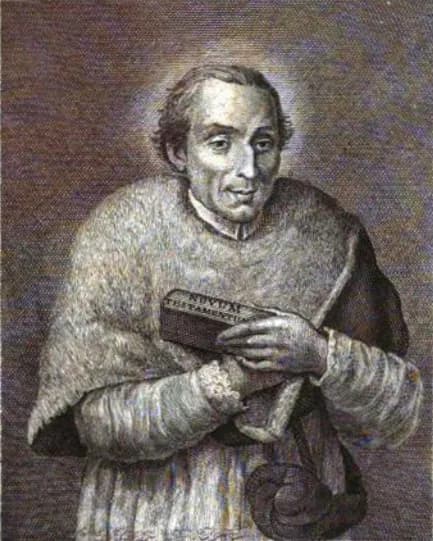
- Ministry
- The hospice of Santa Galla, the herdsmen and teamsters of the Campagna, hospitals and prisons 12
- Canon
- Of Santa Maria in Cosmedin, from 1737, under obedience 1
- Beatified
- May 13, 1860, by Pope Pius IX 1
- Patronage
- CatholicCulture.org lists him as patron "of the abandoned"; no other source read here states one 4
Saint John Baptist de Rossi was a priest of eighteenth-century Rome who suffered from epilepsy and gave his working life to the people the city overlooked: the poor of the hospice of Santa Galla, the herdsmen and teamsters of the Campagna, the sick, and prisoners. 12 The 1910 Catholic Encyclopedia calls him "the apostle of the abandoned, a second Philip Neri, a hunter of souls." 1 He died on May 23, 1764, and May 23 is his feast. 13
From Voltaggio to Rome
He was born on February 22, 1698, at Voltaggio, in the diocese of Genoa. 12 His parents, Charles de Rossi and Frances Anfossi, are described in the encyclopedia as "not rich in earthly goods" but devout and respected, and he was one of four children. 1
At ten, friends of the family took him to Genoa to be educated, and while he was there his father died. Three years later he was called to Rome by Lorenzo de Rossi, a canon of Santa Maria in Cosmedin. 1 The encyclopedia calls Lorenzo a relative; Vatican News says he was a cousin and a priest. 12
In Rome he studied at the Collegio Romano under the Jesuits. He joined the Sodality of the Blessed Virgin there and a group called the Ristretto of the Twelve Apostles, and led its members in their meetings and in visiting the sick in the hospitals, so that, in the encyclopedia's words, he "merited even then the name of apostle." 1
Epilepsy and ordination
He entered the clerical state at sixteen, in 1714. 12 Around the same time he began to have epileptic seizures. The two main sources explain them differently. The encyclopedia says he brought them on by "indiscreet practices of mortification." 1 Vatican News says the relentless pace of prayer, study and service among the young students brought out the first symptoms. 2
He went on regardless. He did his philosophy and theology with the Dominicans and was ordained a priest, by dispensation, on March 8, 1721. 1 Vatican News adds that he said his first Mass at the tomb of Saint Aloysius Gonzaga, in the church of the Jesuits. 2 Once ordained, he bound himself by vow to accept no church benefice unless he was ordered to under obedience. 1
Santa Galla and the Campo Vaccino
His people were the laborers, herdsmen and teamsters of the Campagna. He preached to them at the old Roman Forum, then called the Campo Vaccino, early in the morning or late in the evening. 1
The other center of his work was the hospice of Santa Galla. Vatican News says it had been founded shortly after 1650 by Marco Anastasio Odescalchi, a cousin of Pope Innocent XI, and that John Baptist was drawn to it from his first steps toward the priesthood. He gave its days an order, with set times for prayer and set times for talking with the sick. 2 The encyclopedia has him "visiting, instructing, and assisting the poor" there. 1
In 1731 he opened a second house near it, which the encyclopedia, quoting the Roman Breviary, describes as "a home of refuge for the unfortunates who wander the city by night." 1 Vatican News says this second hospice was for women, that he placed it under the name of Saint Aloysius, and that it still exists and still works. 2
He also drew other priests in. In the church next to the hospice he started the Pious Union of Secular Priests of Santa Galla, which many priests joined in order to grow spiritually. 2 A later president of that union became Pope Pius IX, the pope who beatified him. 2
A canon who would not live in the canon's house
In 1735 he was made a titular canon of Santa Maria in Cosmedin, and when Lorenzo died two years later obedience obliged him, vow or no vow, to accept the canonry itself. The post came with a house. He would not live in it, and spent the rent on good works. 1
The confessional
For years he did not hear confessions. He was afraid to, because of his illness, and he sent the people his preaching had moved to other priests. 1 That changed in 1738. A dangerous sickness sent him to Cività Castellana, a day's journey from Rome, to recover, and the bishop there persuaded him to begin. He went back over his moral theology and was then given an unusual faculty: to hear confessions in any church in Rome. 1
He used it. The encyclopedia says he spent many hours every day hearing "the confessions of the illiterate and the poor whom he sought in the hospitals and in their homes," and that he preached to them five and six times a day "in churches, chapels, convents, hospitals, barracks, and prison cells." 1 CatholicCulture sums up the same years by saying he worked for homeless women, the sick, prisoners and workers, and was a very popular confessor. 4 The Roman Martyrology remembers him in one line, as a priest who took in the poor and the most outcast and taught them the faith. 3
Death and canonization
In 1763, worn out by the work and by continued ill health, his strength began to fail. After several attacks of paralysis he died in his rooms at Trinità dei Pellegrini on May 23, 1764. 1 Vatican News attributes his death to the epilepsy. 2 He was buried in that church, under a marble slab at the altar of the Blessed Virgin. 1
Where he rests now is reported two ways. Vatican News says he is buried at Santissima Trinità dei Pellegrini. 2 CatholicCulture says his relics are in Rome at the church of San Giovanni Battista de Rossi, the church that bears his name. 4
The process for his beatification opened only seventeen years after his death, but the upheavals in Europe stalled it. Pius IX took it up again and beatified him on May 13, 1860, and Leo XIII canonized him on December 8, 1881. 12
What is Saint John Baptist de Rossi the patron saint of?
CatholicCulture.org lists Saint John Baptist de Rossi as patron "of the abandoned." 4 It gives no authority for the line, and neither the encyclopedia, Vatican News nor the Martyrology names a patronage, so this page reports it as CatholicCulture's and goes no further. 123 The phrase matches the encyclopedia's description of him as "the apostle of the abandoned." 1
Saint John Baptist de Rossi's feast day
Praying with Saint John Baptist de Rossi
He had epilepsy from his youth, and Vatican News says it was what killed him. 12 He was ordained by dispensation, kept out of the confessional for years on account of his sickness, and still preached in the Forum early in the morning. 1
The fear is worth staying with. For years a priest whom CatholicCulture remembers as a very popular confessor did not hear confessions at all. It took another illness, a journey out of the city, and a bishop who pressed him. 14
He kept his distance from the comforts of his state. He vowed to take no benefice, took one only when ordered, and gave away the rent of the house that came with it. 1
The people he chose were herdsmen, teamsters, the sick poor, and those the encyclopedia calls "the unfortunates who wander the city by night." 1 The Martyrology says he took them in and taught them. 3
Saint John Baptist de Rossi, pray for us.
Sources
- 1.Francis Mershman, "St. John Baptist de Rossi," The Catholic Encyclopedia, vol. 8 (New York: Robert Appleton Company, 1910).
- 2."San Giovanni Battista de Rossi, sacerdote romano," Santo del giorno, 23 maggio, Vatican News (in Italian).
- 3.Roman Martyrology, May 23, as printed in "Santo del giorno," Conferenza Episcopale Italiana (in Italian).
- 4."Easter: May 23rd," Liturgical Year, CatholicCulture.org.
Saints to turn to next
Others in this collection who are turned to for some of the same things.
- Saint André BessetteAugust 9, 1845 - January 6, 1937Suffering and illnessWork and vocationPoverty and simplicity
- Saint Giuseppe MoscatiJuly 25, 1880 - April 12, 1927Work and vocationSuffering and illnessPoverty and simplicity
- Saint Ignatius of LaconiDecember 1701 - May 11, 1781Work and vocationPoverty and simplicitySuffering and illness
- Saint José Gregorio HernándezOctober 26, 1864 - June 29, 1919Work and vocationPoverty and simplicitySuffering and illness