Saint Ignatius of Laconi
December 1701 - May 11, 1781
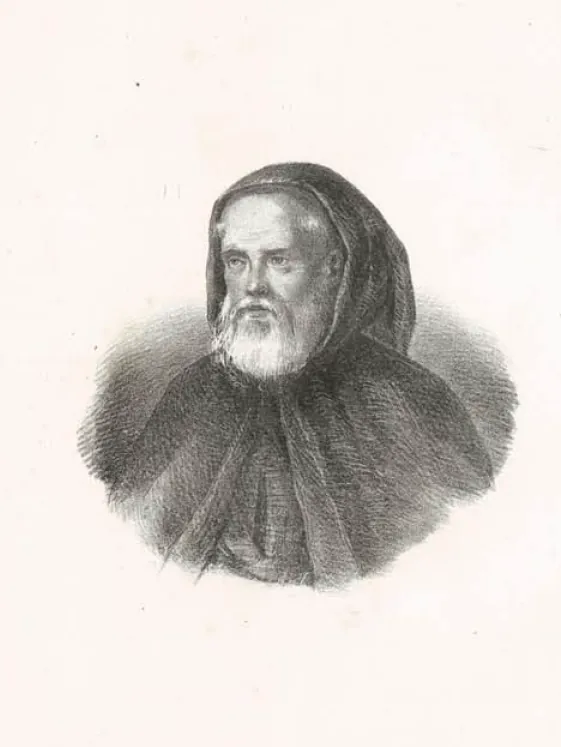
- Born
- Laconi, Sardinia, December 1701; Franciscan Media gives December 17, the Secular Franciscan calendar December 10 124
- Baptismal name
- Vincenzo (Vincent) Peis 2
- Entered the Capuchins
- November 10, 1721, at Cagliari 2
- Beatified
- 1940 3
Saint Ignatius of Laconi was a Sardinian peasant who could not read or write, joined the Capuchins in 1721 after twice nearly dying, and spent about forty years walking the streets of Cagliari with a sack on his back, begging bread for his friars. 12 He was blind for the last two years and kept going. 1 Pope Pius XII canonized him in 1951, and his feast is May 11. 124
The little saint of Laconi
He was born in December 1701 at Laconi, a village on the southern edge of the mountains of central Sardinia, and baptized Vincenzo. 2 Franciscan Media dates his birth to December 17; the calendar kept by the Secular Franciscans in the United States gives December 10. 14 He was the second of seven children of peasant parents, Mattia Cadello and Anna Maria Sanna, and everyone assumed he would farm as they did. 12
The Capuchin accounts of his childhood agree on one detail: the people of Laconi called him "the little saint," which CapDox gives as lu santuxeddu. 23 He served at the early Mass, which was said before dawn, and the capuchins.org account says he called the church "my home" and would kneel at its doors before they opened. 23 He never went to school and never learned to write. 2 He was confirmed before he was seven, on May 17, 1707, by the Archbishop of Oristano. 2
A vow made twice
At eighteen he fell so ill that he was expected to die, and he promised God that if he lived he would become a Franciscan. 2 He recovered and did not go. 12 The capuchins.org account says there is some indication that his parents objected; CapDox, translating the Italian Capuchin historian Felice Accrocca, declines to guess, and says only that "we will never know with certainty why the young man forgot the promise he made." 23
In the autumn of 1721 he was riding up to the high plain of the Sarcidano when his horse bolted toward the edge of a drop. 2 Franciscan Media puts him at twenty. 1 The horse stopped on its own; he remembered the vow, and this time he kept it. 2 The capuchins.org account adds that he called on Saint Francis as the horse ran. 3
Early in November 1721 he went down to Cagliari with his father and asked the Capuchin provincial at the friary of Buoncammino to take him. 2 He was refused, because he looked too frail for the life. 23 Father and son went to the Marquis of Laconi, Gabriele Aymerich, who spoke for him, and on November 10 he was given the habit and the name Ignatius. 2 The novitiate was hard going. When the friars voted on whether to admit him to vows, he passed by one vote, six to four, and he was professed on November 10, 1722. 2
Forty years with a sack
Of the next twenty years almost nothing is known. CapDox says the witnesses are few and contradict one another, that he was probably at Iglesias and Domusnovas, and that he held several jobs in turn without keeping any of them long. 2 Around 1742 he came back to Cagliari as the friary's questor, the brother who goes out to beg for the community, and he did that work for the rest of his life. 12 Franciscan Media and CapDox both count it as forty years. 12
The begging was also his preaching. Franciscan Media says that on his rounds he taught the children, visited the sick and urged sinners to repent. 1 The capuchins.org account calls his manner "a quiet sermon" and quotes a witness at his cause: "I saw with my own eyes how the servant of God went about with downcast eyes. He always held his rosary in his hand. The children ran to him, and he gave them pieces of bread." 3 People who were quarreling, the same witness said, fell silent when he came by. 3
He went into the houses of the rich and the poor alike, and CapDox says the poor in particular "felt welcomed, loved, understood and defended by him." 2 He lived as he begged. His cell had "a poor little cot of bare boards with a rock for a pillow," and when the province introduced a habit of finer cloth, he asked permission to keep wearing his old one of coarse Sardinian wool until he died. 3
The blood of the poor
The story the Capuchins tell most often about him concerns a moneylender. Ignatius used to walk past the man's door, because he did not want to share in the guilt of taking alms from unjust gains. 3 CapDox names the man as Gioacchino Franchino, a merchant who had grown rich "by bleeding the poor" and wanted to be seen as a benefactor. 2 He complained to the guardian, and the guardian ordered Ignatius to call there too. 23
He obeyed. According to both Capuchin accounts, the sack he carried back from that house dripped blood all the way to the friary. 23 The capuchins.org version has him tell the friars, "This is the blood of the poor squeezed from them by usury"; in CapDox he says to the guardian only, "it is the blood of the poor," and nothing more. 23 The page gives the story as his order tells it.
Two smaller stories in the capuchins.org account show the same obedience pointed in other directions. When his sister kept writing to ask him to visit, he went only when his superior told him to, and left once he had given her the advice she wanted. 3 When his brother was jailed and the family hoped his reputation would get him out, he went to the governor and asked only that his brother be dealt with according to justice. 3
A Protestant witness
The process for his canonization is full of miracles; the capuchins.org post says the 1868 summary of it runs to 121 pages of miracles in his lifetime and 86 after his death. 3 CapDox admits that so much of it can seem "somewhat sickly sweet," and points instead to a witness with no stake in the cause. 2 Giuseppe Fuos, a Protestant pastor, came to Cagliari in 1773 as chaplain to a German regiment, and in 1780 he published at Leipzig the letters he had written from Sardinia. 2 CapDox quotes one of them: "Everyday we see a living saint begging around the city," and goes on a few lines later: "If a wheat hoarder has him accept his bread as an alms, it bleeds." 2
He did not take the reputation well. When he was insulted, the capuchins.org account says, he was glad of it: "At long last, one person in Cagliari knows me and calls me what I really am." 3 When people praised his miracles, he told them, "Be quiet, this is the Lord's work." 3
His death in Cagliari
He kept making his rounds until he was about eighty, blind for the last two years of them. 13 He died at Buoncammino on Friday, May 11, 1781, at three in the afternoon. 12 CapDox describes the bell of the friary carrying the news into the city, and a line of people past his body so long that it had to be stopped at nightfall and started again the next morning. 2 The viceroy came with the vicar general of the diocese. 2
Seventeen days after his death his provincial wrote to the friars that he "was always the first in choir, not only in his younger days but even as an octogenarian," and that "Everyone loved him." 3 He was beatified in 1940 and canonized by Pope Pius XII in 1951. 123
What is Saint Ignatius of Laconi the patron saint of?
Saint Ignatius of Laconi's feast day
Praying with Saint Ignatius of Laconi
Grazia Deledda, the Sardinian novelist and Nobel laureate, summed him up in a line CapDox quotes: he "never wrote a single line," "left no teaching," and founded nothing, "And yet he is the most remembered man of the Eighteenth century Sardinia." 2 Everything people remember of him happened on foot, in the streets of one city, asking for bread.
He nearly did not get in. He was turned away for his health and admitted to vows by a margin of one vote. 2 For twenty years after that nobody wrote down much about him at all, and the jobs he was given did not last. 2 The life that Cagliari remembers began when he was past forty.
His obedience was not the passive kind. He avoided the moneylender's door on principle, went when he was ordered, and then let the sack say what he thought. 23 He would not ask the governor for a favor for his own brother. 3 The witness who saw children running to him for bread and quarrels stopping as he passed was describing a man whose begging made the city better than it was. 3
When he lost his sight he kept on with the rounds for two more years. 13 By then, CapDox says, he had come to know every stone in Cagliari and all the people who lived there. 2
Saint Ignatius of Laconi, pray for us.
Sources
- 1."Saint Ignatius of Laconi," Saint of the Day, May 11, Franciscan Media.
- 2."Saint Ignazio da Laconi, Capuchin lay brother," CapDox, Capuchin Friars of Australia; translation based on Felice Accrocca in Sulle orme dei santi (Rome, 2000), 61-68.
- 3.Fr. Joseph Mary Elder, OFM Cap., "May 11: St. Ignatius of Laconi," Capuchin Franciscans, May 11, 2011, quoting Mariano D'Alatri, ed., The Capuchin Way: Lives of Capuchins (North American Capuchin Conference, 1993).
- 4."Franciscan Saints, Blesseds, and Feasts," National Fraternity of the Secular Franciscan Order USA, 2023.
Saints to turn to next
Others in this collection who are turned to for some of the same things.
- Saint André BessetteAugust 9, 1845 - January 6, 1937PrayerSuffering and illnessWork and vocationPoverty and simplicity
- Saint Seraphin of Montegranaroc. 1540 - October 12, 1604PrayerPoverty and simplicityWork and vocationSuffering and illness
- Saint Aelred of Rievaulx1109 - January 12, 1166 (or 1167)PrayerWork and vocationSuffering and illness
- Saint Alphonsus Rodriguez1532 or 1533 - October 1617PrayerWork and vocationSuffering and illness