Saint Pedro de Arbués
1441 - September 17, 1485
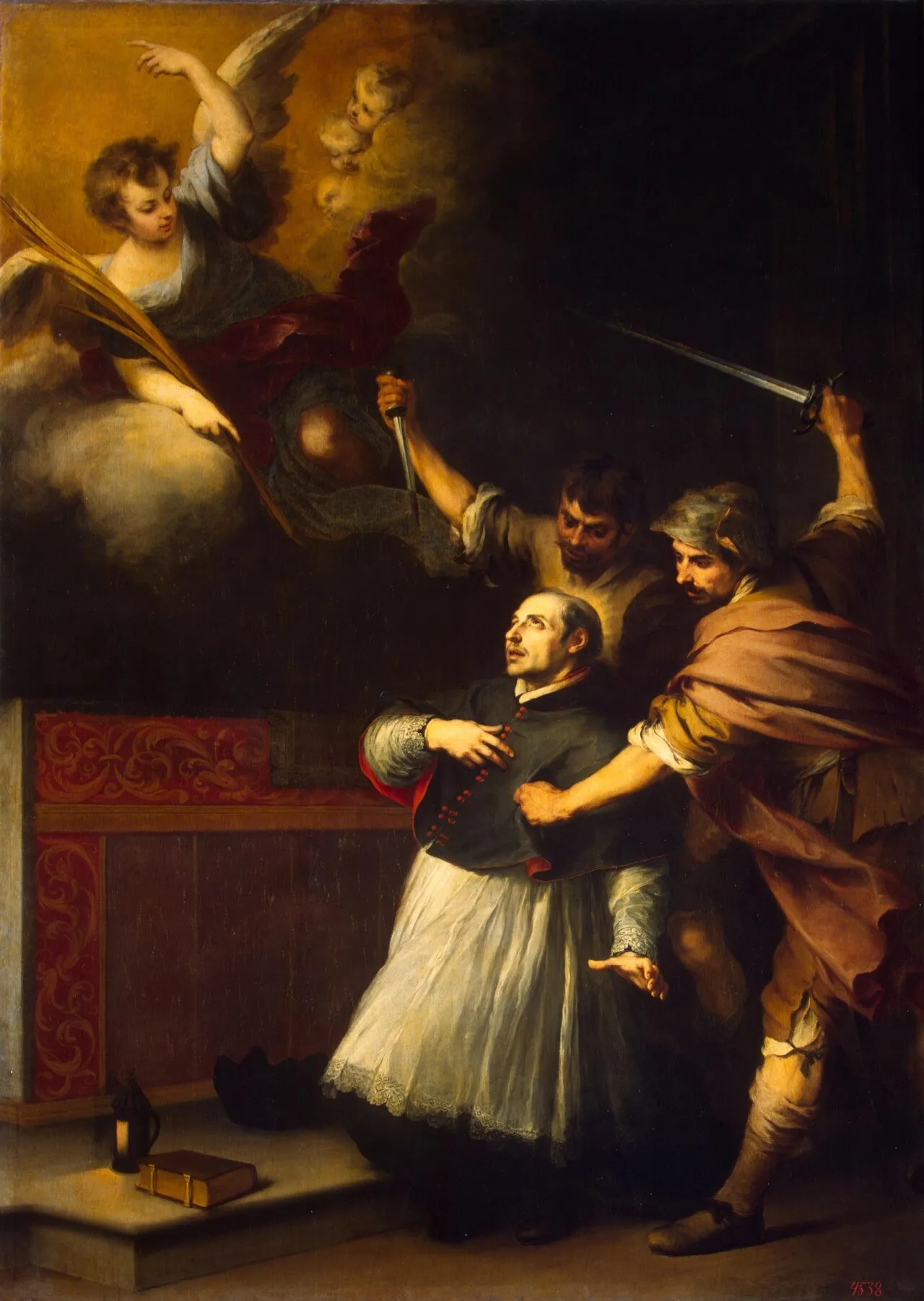
- Office
- Inquisitor provincial for the Kingdom of Aragon from 1484 1
Saint Pedro de Arbués was a canon of the cathedral of Saragossa who served as inquisitor provincial for the Kingdom of Aragon and was stabbed while praying in his own cathedral in September 1485. 1 He died two days later, Spain hailed him as a martyr, and Pius IX canonized him in 1867. 14 He is a saint whom it is impossible to write about without writing about the Spanish Inquisition, and the Church's own sources on him do not all speak about that institution in the same voice. 126
A scholar from Aragon
He was born in 1441 or 1442, according to the Catholic Encyclopedia, the son of a nobleman named Antonio Arbués and of Sancia Ruiz. 1 Catholic.net places his birth at Épila, in Aragon, around 1440. 4 He studied philosophy, probably at Huesca, and then went to Bologna, to the Spanish college of St. Clement, where he was regarded as "a model of learning and piety" and took degrees in theology and law. 1 EWTN's Spanish life says that he left Bologna a doctor in both canon and civil law. 5
Back in Spain he joined the canons regular of the cathedral of Saragossa and made his religious profession there in 1474. 1 The Martyrology calls him a canon regular of the Order of St. Augustine. 3 Catholic.net says it was the reputation of his zeal and learning that drew him out of the cloister a few years after his profession. 4
The Inquisition in Aragon
The office he was drawn into was new. On November 1, 1478, Sixtus IV empowered Ferdinand and Isabella to set up a tribunal in their kingdoms. 2 Its target, as Allaria's encyclopedia article puts it, was heretics, "and especially Jews who after having received baptism had relapsed openly or secretly into Judaism; these were known as Marranos." 1
It quickly produced complaints. Blötzer's article on the Inquisition, in the same encyclopedia, reports that in a brief of January 29, 1482, Sixtus IV rebuked the first inquisitors in Seville for having unjustly imprisoned many people, "subjected them to cruel tortures," and seized the property of the executed. The complaints, Blötzer writes, "were only too well founded." 2 The Dominican Tomás de Torquemada became the institution's real organizer. 2 Allaria says Torquemada knew Arbués by reputation and named him inquisitor provincial for the Kingdom of Aragon in 1484. 1
He held the office for barely a year. Allaria writes that he carried it out "with zeal and justice." 1 Catholic.net says he preached and worked tirelessly during those months against those it calls false Christians and apostates. 4 The Martyrology's own summary is that he fought superstition and heresy in the kingdom of Aragon. 3
The charge of cruelty
The question every reader brings to him is what he actually did as inquisitor. The Catholic sources read here answer it with a negative. Allaria writes: "Although the enemies of the Inquisition accuse him of cruelty, it is certain that not a single sentence of death can be traced to him." 1 Blötzer, writing in 1910, says that his cruelty "belongs to the realms of fable," and gives the reason in slightly more careful words: he is a man "to whom not a single sentence of death can be traced with certainty." 2 Catholic.net goes further than either and says there is no record that he ever pronounced a sentence of death or of torture. 4
Those are claims about the surviving record, and they are the sources' claims. None of the sources read here lists the sentences his tribunal did hand down, and this page does not supply them. Catholic.net blames the opposite picture on the enemies he made and on one painting in particular: Wilhelm von Kaulbach's, in which a canon of forty-four appears as a sadistic old tyrant. 4 Blötzer's overall verdict on the Spanish Inquisition was that it "deserves neither the exaggerated praise nor the equally exaggerated vilification often bestowed on it." 2
Murder in the cathedral
He knew he was in danger. EWTN's life says there had been more than one attempt on him, and that when friends urged him to take bodyguards he answered that if he were murdered he would die defending the Catholic faith, and that he could hope for no greater honor. 5 Catholic.net says that he took no precautions even after one plot failed. 4
EWTN says he went into the cathedral every night to pray at length. 5 One night, kneeling before the altar of Our Lady in the metropolitan church where he recited the office with his fellow canons, he was attacked, and the hired assassins inflicted several wounds. 1 EWTN dates the attack to September 14, 1485; Catholic.net to the night of September 14-15, and it speaks of three men who slipped into the dark cathedral. 45 EWTN gives his last words as "I die for Jesus Christ; praised be his holy name." 5 He died two days after the attack. 1
Who killed him is given most carefully in the Martyrology, which says he died struck down by some of those who were under investigation by the Inquisition, before the altar of the cathedral. 3 The encyclopedia says the conspirators were converts he had punished. 1 EWTN adds that the people of Saragossa were ready to lynch the accused that same night and that the archbishop went into the streets to protect them, that the man said to have planned the killing took his own life in prison, and that those who carried it out were sentenced to death. 5
Martyr and saint
Spain acclaimed him a martyr at once. 4 An immense crowd followed his funeral, EWTN says, and favors were soon reported at his tomb. 5 Pius IX canonized him in 1867. 14 The Martyrology keeps him as a priest and martyr. 3
In the last years of John Paul II, the Church looked at the institution he served in a different light. A Vatican symposium of historians studied the Inquisition in 1998, and in 2004 the Pope wrote that the children of the Church "cannot but return with a spirit of repentance" to "the acquiescence given, especially in certain centuries, to intolerance and even the use of violence in the service of the truth." 6 At the Day of Pardon in 2000, he recalled, forgiveness had been asked "for errors committed in the service of the truth by recourse to methods not in keeping with the Gospel." 6 He also insisted that the historians' work had to come first: "Before asking for forgiveness it is necessary to have exact knowledge of the facts." 6
What is Saint Pedro de Arbués the patron saint of?
None of the sources read for this page names a patronage for Saint Pedro de Arbués. The Martyrology enters him at Saragossa, where he died. 3
Saint Pedro de Arbués's feast day
Praying with Saint Pedro de Arbués
He is not an easy saint, and the sources do not make him one. The Church canonized a man who died at the altar for the office he held, and the same Church, a little over a century later, asked forgiveness for the violence that office was too often used to carry out. 16 Both of those things are true, and a page that kept only one of them would be telling a different story from the one the sources tell.
What can be said about him personally is narrower. He knew there were men in Saragossa who meant to kill him, he declined to protect himself, and he kept going to the cathedral at night to pray. 45 Whatever a reader concludes about the tribunal, the last words EWTN gives him are a prayer. 5
John Paul II's letter offers a way to hold the rest. He asked for exact knowledge of the facts before judgment, and then for a repentance that commits the Church to bearing witness to the truth "in keeping with the Gospel." 6 That is a discipline for anyone who prays at this saint's feast: to see clearly what was done in the Church's name, without exaggeration in either direction, and to ask that the truth be served only by means the Gospel allows. 26
Saint Pedro de Arbués, pray for us.
Sources
- 1.Anthony Allaria, "St. Peter of Arbues," The Catholic Encyclopedia, Vol. 11 (New York: Robert Appleton Company, 1911).
- 2.Joseph Blötzer, "Inquisition," The Catholic Encyclopedia, Vol. 8 (New York: Robert Appleton Company, 1910).
- 3.Roman Martyrology, entry for September 17, "San Pietro de Arbués, sacerdote e martire," as printed in "Santo del giorno," Conferenza Episcopale Italiana (in Italian).
- 4."Pedro de Arbués, Santo," Catholic.net (in Spanish), with the Spanish text of the Roman Martyrology entry.
- 5."San Pedro de Arbués," Santos, EWTN (in Spanish).
- 6.John Paul II, Letter to Cardinal Roger Etchegaray on the publication of the Proceedings of the International Symposium on the Inquisition, June 15, 2004.
Saints to turn to next
Others in this collection who are turned to for some of the same things.