Saint Paul Miki and Companions
c. 1564 - February 5, 1597
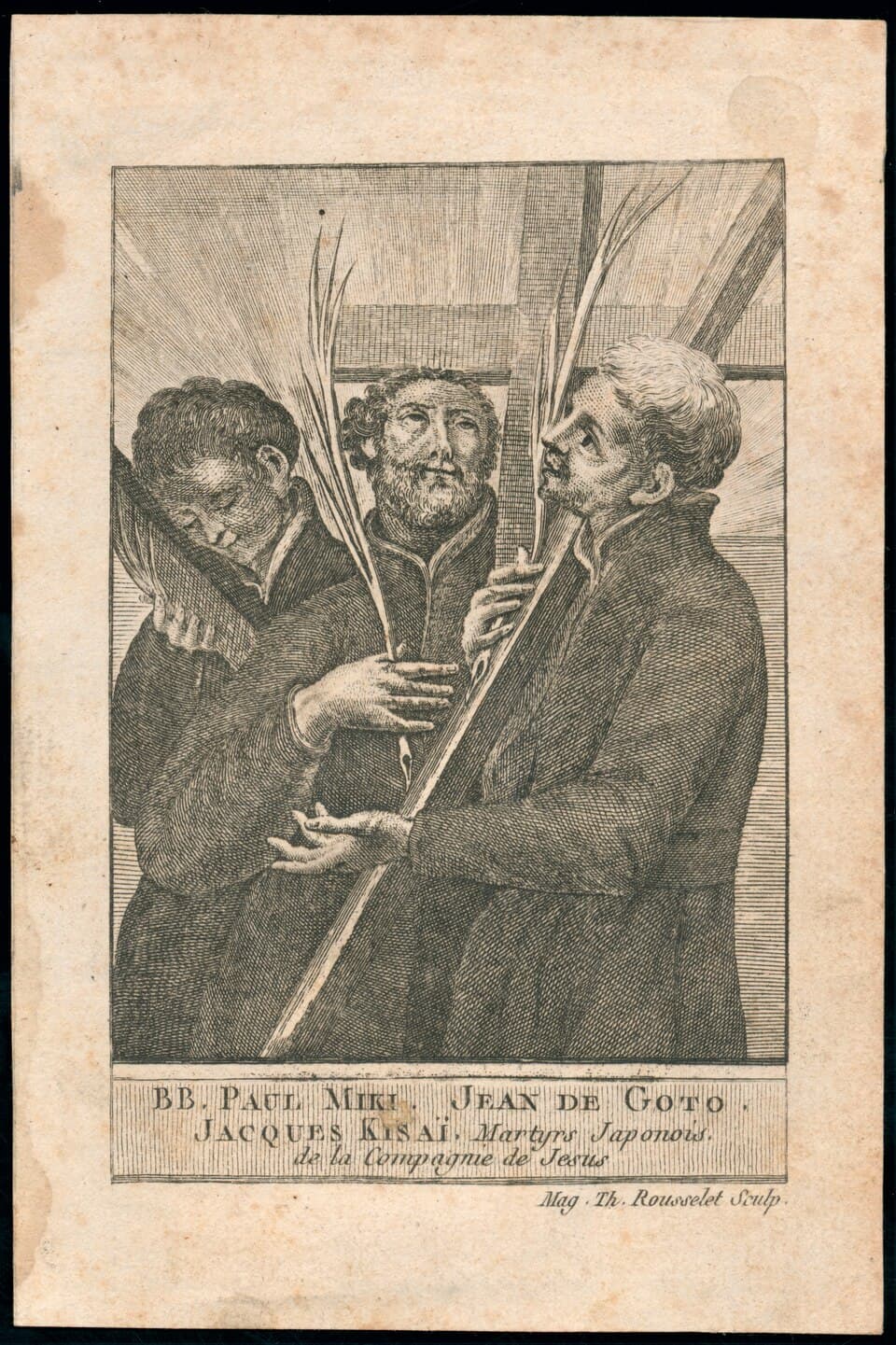
- Born
- Around 1564, the son of a Japanese soldier, Miki Handayu 3
- Religious life
- Entered the Society of Jesus in 1580, the first Japanese to enter any religious order 35
Saint Paul Miki was a Japanese Jesuit, the first Japanese to enter any religious order, and on February 5, 1597, he was crucified on the outskirts of Nagasaki with twenty-five other Christians. 3 From his cross he preached one last time, told the crowd he was dying only for teaching the doctrine of Christ, and forgave the men who had put him there. 345 The twenty-six are kept together on February 6. 45
A church that grew, then an edict
Christianity reached Japan with Saint Francis Xavier, who landed at Kagoshima on August 15, 1549. 23 For a generation it spread with the toleration of the men who held real power, 1 and Bunson notes that the shogunate at first saw the new religion as a check on the Buddhist monks and a door to trade with Europe. 3 By 1587 there were about 200,000 Christians in the country. 13
That year an edict of persecution came "to the surprise of everyone," in the words of the 1910 Catholic Encyclopedia, and churches were destroyed and missionaries ordered out. 1 Bunson and the encyclopedia's article on Japan both name the regent, Hideyoshi, and the article says he had come to believe that the missionaries were spies. 23 The missionaries hid rather than leave. Delplace and Bunson both say the Church grew by about another 100,000 in the following ten years; the "Japan" article gives 65,000 baptisms. 123 Delplace records only two martyrdoms in that decade. 1
Then, in 1596, a Spanish ship, the San Felipe, ran aground off Shikoku and its cargo was seized. 23 Guns were found on board, and someone from the ship boasted that the missionaries were preparing the way for a Spanish conquest. Delplace and Bunson both say it was the pilot; the encyclopedia's "Japan" article says it was the captain. 123 Bunson calls the threats "complete fabrications," but they were enough. 3
Delplace also lays part of the blame on the Spanish Franciscans who had come from the Philippines and preached openly in defiance of the edict, which the Jesuits had been careful not to provoke. 1 That is his judgment, and he gives it in his own article. The Franciscans he blamed were crucified on the same morning as the Jesuits.
The first Japanese Jesuit
Paul Miki was born around 1564, the son of a Japanese soldier named Miki Handayu, and was educated by the Jesuits. 3 He joined the Society of Jesus in 1580, and both Vatican News and Bunson describe him as the first Japanese to enter religious life. 35 Bunson says he quickly became known for the eloquence of his preaching. 3
Whether he had been ordained is where the sources part. Vatican News lists him as "St. Paulo Miki, priest." 5 Franciscan Media calls him "Brother Paul Miki," and Bunson says that he was on the verge of ordination when he was arrested. 34 The speech that Bunson quotes from the cross has him describe himself as "a brother of the Society of Jesus." 3
The march to Nagasaki
The arrests began on December 9, 1596, when nine religious were taken and a list of Japanese Christians was ordered drawn up. 2 Those condemned were Franciscans and Jesuits, priests, brothers and laymen; Franciscan Media lists catechists, doctors, artisans and servants, "old men and innocent children." 4 Bunson counts six Franciscan missionaries, two other Japanese Jesuits and sixteen Japanese laymen alongside Miki himself; a carpenter who joined them on the road made twenty-six. 3 Among the laymen were Cosmas Takeya, a sword maker; Paul Ibaraki, from a samurai family, and his brother Leo Karasumaru, who had been a Buddhist monk. 3 The two youngest were Louis Ibaraki, twelve, and Anthony of Nagasaki, thirteen. 13
They were condemned at Kyoto, and each had his left ear cut off to mark him. 3 The walk to Nagasaki took a month, and Bunson writes that they went bleeding and exhausted, still praying and singing. 3 A carpenter from Kyoto named Francis followed the column until he too was arrested, and was glad of it. 3
February 5, 1597
They reached the place of execution on the morning of February 5. Franciscan Media says the crosses stood on a hill overlooking Nagasaki, now known as the Holy Mountain. 4 Bunson gives a more particular account: the hill, Nishizaka, was where common criminals were executed, and after Portuguese merchants protested, the governor let the crosses be moved to a wheat field across the road. 3
They were not nailed. Iron rings held each one at the neck, hands and feet, with ropes around the waist, except the Franciscan superior Peter Baptist, who held out his hands and asked for nails. 3 Miki turned out to be shorter than his cross had been measured, so his feet did not reach the lower rings and he was tied at the chest. 3 Bunson says there were four thousand Catholics from Nagasaki on the hill, and the martyrs sang the Te Deum and the Sanctus from the crosses. 3 The encyclopedia's "Japan" article says simply that they "died preaching and singing to the end." 2
Miki spoke. Franciscan Media's version begins: "The sentence of judgment says these men came to Japan from the Philippines, but I did not come from any other country. I am a true Japanese. The only reason for my being killed is that I have taught the doctrine of Christ." 4 It ends: "After Christ's example I forgive my persecutors. I do not hate them. I ask God to have pity on all, and I hope my blood will fall on my fellow men as a fruitful rain." 4 Bunson quotes a different translation, from the records of the Jesuit Luis Frois, in which Miki says he is "very happy to die for such a cause" and that "man can find no way to salvation other than the Christian way." 3 Vatican News puts both themes in one line: he said that salvation is found in Jesus alone, and asked everyone to follow Christ joyfully and forgive their enemies. 5
The first to die was Philip de Jesus, a Mexican Franciscan, whose cross had also been badly measured and whose weight hung from the ring at his throat. 3 Soldiers working in pairs then killed the others with spears thrust from either side. 3 Bunson records that Louis Ibaraki called out "Jesus . . . Mary" as he died, and that Christians in the crowd pushed forward to soak cloths in the martyrs' blood before the guards drove them back. 3 A Jesuit writing afterward, quoted by Delplace, said that even the pagans watching "were struck at seeing the joy of the blessed ones as they suffered on their crosses." 1
Two and a half centuries later
It was the first bloody persecution, and far from the last. 1 Delplace counts 3,125 known martyrs by 1660, and the country was closed to foreigners for two centuries. 12 The twenty-six were beatified in 1627, under Urban VIII, and canonized in 1862 by Pius IX. 34
When missionaries returned in the 1860s they found, as Franciscan Media puts it, that "thousands of Christians lived around Nagasaki and that they had secretly preserved the faith." 4 The encyclopedia's "Japan" article dates the moment to March 17, 1865, when fifteen of them made themselves known to Father Petitjean in the new church at Nagasaki, and says about 50,000 came to be known in all. 2 Delplace and Bunson both count 20,000 on Kyushu. 13 Bunson writes that foremost in their memory had been the twenty-six on Nishizaka. 3
Pope Francis came to the martyrs' monument at Nishizaka in November 2019 and said that "as a young Jesuit from 'the ends of the earth'" he had "found powerful inspiration in the story of the early missionaries and the Japanese martyrs." 6 He asked that the Church in Japan "hear anew each day the message proclaimed by Saint Paul Miki from the cross." 6
What is Saint Paul Miki the patron saint of?
None of the sources consulted names a patronage for Paul Miki or for the twenty-six as a group, so this page does not supply one. 123456 One of his companions has his own: Bunson writes that Gonzalo Garcia, the Franciscan lay brother from India who was the first led to his cross, is venerated as the patron saint of Mumbai. 3 Pope Francis, at Nishizaka, asked Paul Miki and his companions to pray for Japan and for the whole Church. 6
Saint Paul Miki's feast day
Praying with Saint Paul Miki
The sentence read against him called the condemned men foreigners, and Miki answered it from the cross: he was Japanese, and the only charge that was true was that he had taught the doctrine of Christ. 34 He did not argue that the faith was harmless to the state. He said what he had done, said why he was dying, and went on preaching.
In Franciscan Media's version he says it without qualification: "After Christ's example I forgive my persecutors. I do not hate them." 4 He said it to the soldiers holding the spears, with a twelve-year-old and a thirteen-year-old fastened to the crosses near him. 13 Nothing in the sources makes that easier to read, and this page does not try to.
The twenty-six were not one community. They were Spanish, Mexican and Indian friars and Japanese Jesuits, whose orders had been at odds over how to work in Japan, and laymen who had made swords, served as monks, or followed the column on foot until they were taken too. 13 On the morning of February 5 they sang the same hymns. 3
What came of it was not visible for a very long time. The country was closed for two centuries and the faith was kept in secret, until fifteen people came to the new church at Nagasaki in 1865 and said who they were. 23
Saint Paul Miki and Companions, pray for us.
Sources
- 1.Louis Delplace, "Japanese Martyrs," The Catholic Encyclopedia, Vol. 9 (New York: Robert Appleton Company, 1910).
- 2.Justin Balette and François Ligneul, "Japan," The Catholic Encyclopedia, Vol. 8 (New York: Robert Appleton Company, 1910).
- 3.Matthew E. Bunson, "Twenty-Six Crosses on a Hill," Catholic Answers Magazine, October 1, 2007.
- 4."Saint Paul Miki and Companions," Saint of the Day, Franciscan Media.
- 5."St. Paulo Miki, priest, and companions, Japanese martyrs," Saint of the Day, February 6, Vatican News.
- 6.Pope Francis, Tribute to the Martyr Saints at the Martyrs' Monument, Nishizaka Hill, Nagasaki, November 24, 2019.
Saints to turn to next
Others in this collection who are turned to for some of the same things.
- Saint CyprianBirth unknown - September 14, 258CourageConversionSuffering and illness
- Saint John Paul IIMay 18, 1920 - April 2, 2005CourageSuffering and illnessConversion
- Saint Josephine Bakhitac. 1869 - February 8, 1947Suffering and illnessConversionCourage
- Saint Patrickc. 415 - 493CourageConversionSuffering and illness