Saint Patricia of Naples
d. August 25, c. 665 or 670
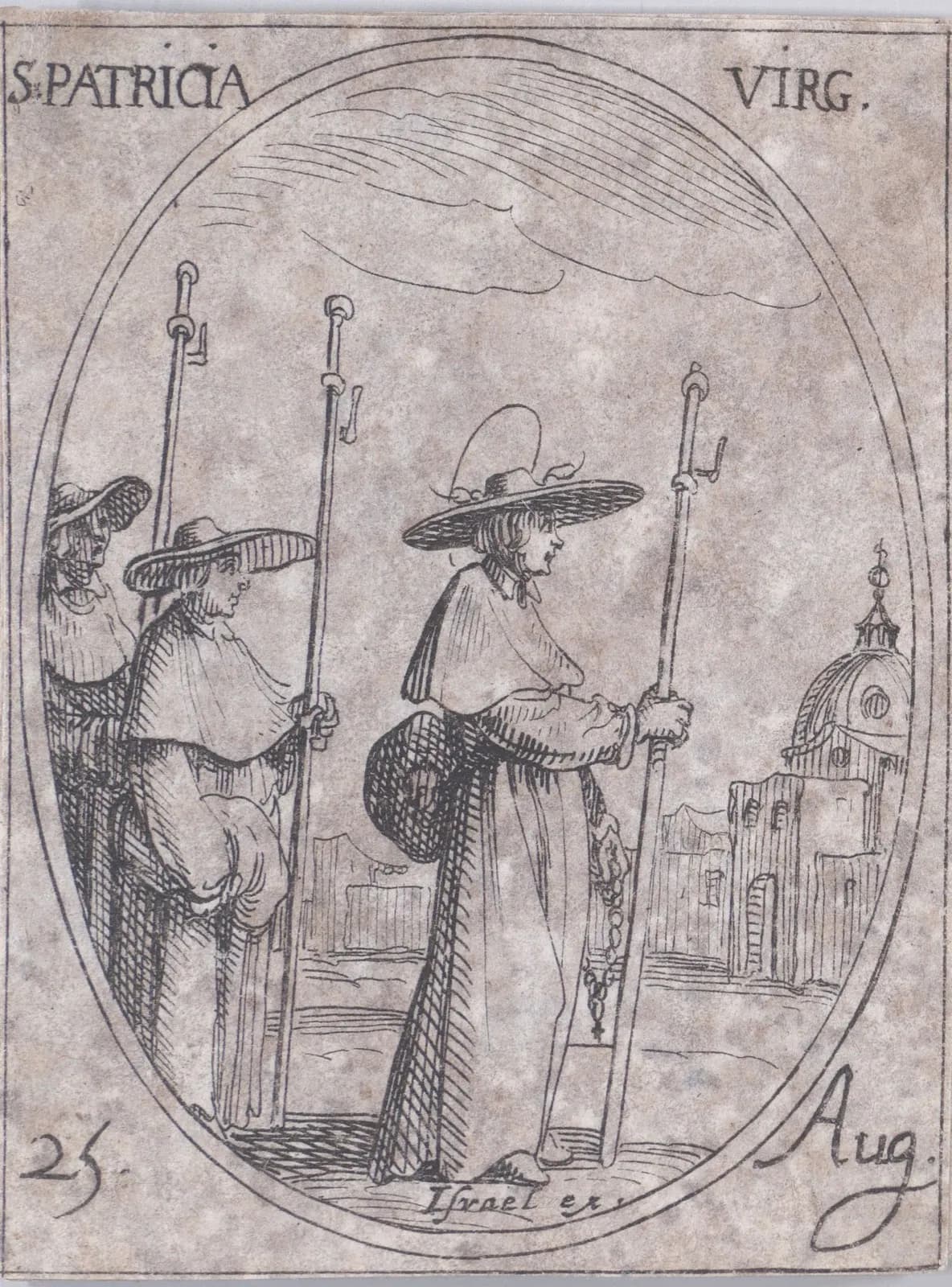
- Also called
- Patrizia, in Italian; Patricia of Constantinople, after the city of her birth 1
Saint Patricia is a co-patron of Naples, venerated as a young woman of the Byzantine imperial family who fled an arranged marriage, gave away her inheritance and died on the islet in the bay of Naples where the Castel dell'Ovo now stands. 12 Her relics are in the church of San Gregorio Armeno, and Naples keeps her feast on August 25 and honors her every Tuesday. 13
A girl of the imperial court
Almost everything told of Patricia comes from her legend, and the sources that tell it do not agree on when she lived. The Norwegian bishops' saints database (katolsk.no) has her born about 644 in Constantinople, a niece, by the legend, of Emperor Constantine III, brought up at the court of his son Constans II. 1 The Archdiocese of Naples, which says it is following some of the sources, gives her birth as 645 and calls her a niece of Constans II. 2 katolsk.no adds that other writers put her three hundred years earlier, as a niece of Constantine the Great raised at the court of his son Constans I. 1
Both accounts agree on the household. She was brought up at court by her nurse, Aglaia, and made a vow of virginity while still young. 12 When the emperor meant to arrange a marriage for her, she left the city rather than break the vow. 12 The archdiocese says plainly that the marriage was imposed on her by Constans II, who was her kinsman. 2
Rome, Constantinople and the sea
She went to Rome with Aglaia and a few other women of her household, and there, the sources say, she received the veil of a consecrated virgin from Pope Liberius. 12 katolsk.no dates Liberius's pontificate to 352-66. 1 That fits the older dating of her life and not the seventh-century one, and neither source tries to reconcile the two. Catholic.net, telling the same story in Spanish, says she placed herself under the pope's protection. 4
When her father died, she went back to Constantinople. 12 There she gave up any claim to the imperial crown and distributed her property to the poor. 124 katolsk.no says she returned to Rome first and set out from there; all the sources agree that she then left on pilgrimage to the Holy Land. 124
She never reached it. A violent storm wrecked her ship off Naples, and she came ashore on the small island of Megaride, where the Castel dell'Ovo stands. 12 katolsk.no explains the castle's name, the "egg castle," by an old story that the poet Virgil set an egg in its foundations. 1 There was a small hermitage on the island, and she stayed in it. 12 After a few months of penance, katolsk.no says, she fell ill and died after a short sickness on August 25, about 665, at twenty-one. 1 The archdiocese gives the date as August 25, 670, and her age as twenty-five. 2
The burial at Caponapoli
The archdiocese tells what followed. By a revelation to Aglaia, the funeral was held with great solemnity, with the bishop, the duke of the city and a large crowd taking part. 2 The cart carrying her body was drawn by two young bulls with no one to drive them, and it stopped of its own accord in front of the monastery of the Basilian monks at Caponapoli, dedicated to Saints Nicander and Marcian. 2 Patricia had foretold, years before, that she would be buried there. 2 Catholic.net tells the same story with two horses. 4
The women who had followed her stayed by her grave, and were named after her the Patrizianes, or Sisters of Saint Patricia. 2 The Basilian monks moved to another house, and the sisters kept the monastery under the Rule of Saint Benedict for centuries. 2 katolsk.no calls her cult well attested from the Middle Ages. 1
The blood of Saint Patricia
What made Patricia famous in Naples was her blood. The archdiocese gives two versions of how it was first collected. Citing the Bibliotheca Sanctorum, it says that on September 13, sometime between 1198 and 1214, a Roman knight, out of what it calls indiscreet devotion, pulled a molar from the saint's body, and blood flowed from the socket. 2 A 1933 article in the Naples daily Il Mattino, which the archdiocese also cites, puts the event about a hundred years after her death: a Roman nobleman healed of a grave illness was allowed to keep vigil by her body overnight, pulled a tooth to keep as a relic, and the nuns caught the blood that ran from the jaw in two phials. 2
katolsk.no says the liquefaction of that blood has recurred for twelve centuries, every year on August 25 and often when pilgrims come to pray, and that Church and civil authorities have examined it several times without finding a natural explanation. 1 Catholic.net describes the blood as flowing from a tooth kept in a reliquary. 4 Both compare it to the better-known liquefaction of the blood of Saint Januarius, the city's principal patron. 14
From the old monastery to San Gregorio Armeno
The archdiocese, citing the scholar Giovanni Alagi, refers to a notarial act of November 29, 1551, recording the transfer of her body from the Capece chapel to the high altar of the church of Santa Patrizia, beside the Incurabili hospital. 2 katolsk.no gives the date of a translation as 1549. 1 On October 28, 1625, she was declared a co-patron of Naples. 2
In 1864, during the upheavals of Italian unification, the new authorities closed the monastery, and the sisters moved to the monastery of San Gregorio Armeno, taking the relics with them. 12 The archdiocese lists what they brought: her bones, the blood, the tooth and the "manna" of Saint Patricia. 2 Her remains, covered in wax, lie in a casket of gold and silver set with precious stones in a side chapel of the church. 14 Since 1922 they have been in the care of the Crucified Adorers of the Eucharist, a congregation of sisters. 1
What is Saint Patricia the patron saint of?
Saint Patricia is a co-patron of Naples. 123 katolsk.no and the archdiocese both date that status to 1625, and the archdiocese's liturgy page names her among the city's co-patrons. 123 Catholic.net calls her the second patroness of the city, after Saint Januarius. 4 None of the sources assigns her a patronage beyond the city.
Saint Patricia's feast day
Saint Patricia's feast day is August 25, the day of her death. 123 The Archdiocese of Naples keeps it as a liturgical feast in the city, with its own Mass: the Beatitudes from Matthew's Gospel, the Preface of Virgins, and the Liturgy of the Hours from the Common of Virgins. 3 Naples also honors her every Tuesday, when, katolsk.no says, crowds come to the church and a priest blesses them with the phials of her blood. 13
katolsk.no says August 25 is also her day in the Roman Martyrology, and Catholic.net prints a Martyrology line for her: at Naples in Campania, Saint Patricia, virgin. 14 The Italian bishops' daily page for August 25, which is built on the current Roman Martyrology and warns that it may leave out saints kept by local tradition, does not list her. 5
Praying with Saint Patricia
The legend gives Patricia a great deal to walk away from: a place in the imperial family, a marriage arranged at the highest level, and a claim to the crown. 12 She left each of them in turn, the first two by running and the last by renouncing it before she gave her property to the poor. 12
She set out to see the places of Christ's life and did not get there. 12 The storm put her ashore in a city she did not know, and she spent her last months in a hermit's cell on a rock in the bay. 12 Whatever is history in the story and whatever is legend, it is the life of someone who meant to go one way and was sent another.
Naples took her as its own. The city that had no claim on her buried her with its bishop and its duke, let her companions keep the monastery where she lay, and still comes to her church every Tuesday. 123 The readings the archdiocese chose for her Mass are the Beatitudes and Paul's words to the Philippians on rejoicing in the Lord. 3
Saint Patricia of Naples, pray for us.
Sources
- 1."Den hellige Patricia av Napoli (~644-~665)," Den katolske kirke (katolsk.no), Catholic Diocese of Oslo (in Norwegian).
- 2."Patrizia," profile of Saint Patricia, Chiesa di Napoli (Archdiocese of Naples) (in Italian).
- 3."Liturgia Santa Patrizia," Chiesa di Napoli (Archdiocese of Naples), 2024 (in Italian).
- 4."Patricia, Santa," Santoral, Catholic.net (in Spanish).
- 5.Roman Martyrology, entries for August 25, as printed in "Santo del giorno," Conferenza Episcopale Italiana (in Italian).
Saints to turn to next
Others in this collection who are turned to for some of the same things.
- Saint Agnes of Bohemiac. 1200-1205 - March 1281 or 1282Poverty and simplicityPrayerDiscernment
- Saint Benedict Joseph Labre1748 - April 16, 1783Poverty and simplicityPrayerDiscernment
- Saint Celestine V1215 (or 1210) - May 19, 1296DiscernmentPrayerPoverty and simplicity
- Saint ChadBirth date unknown - March 2, 672PrayerDiscernmentPoverty and simplicity