Saint Paphnutius
c. 280 - c. 350 or 360
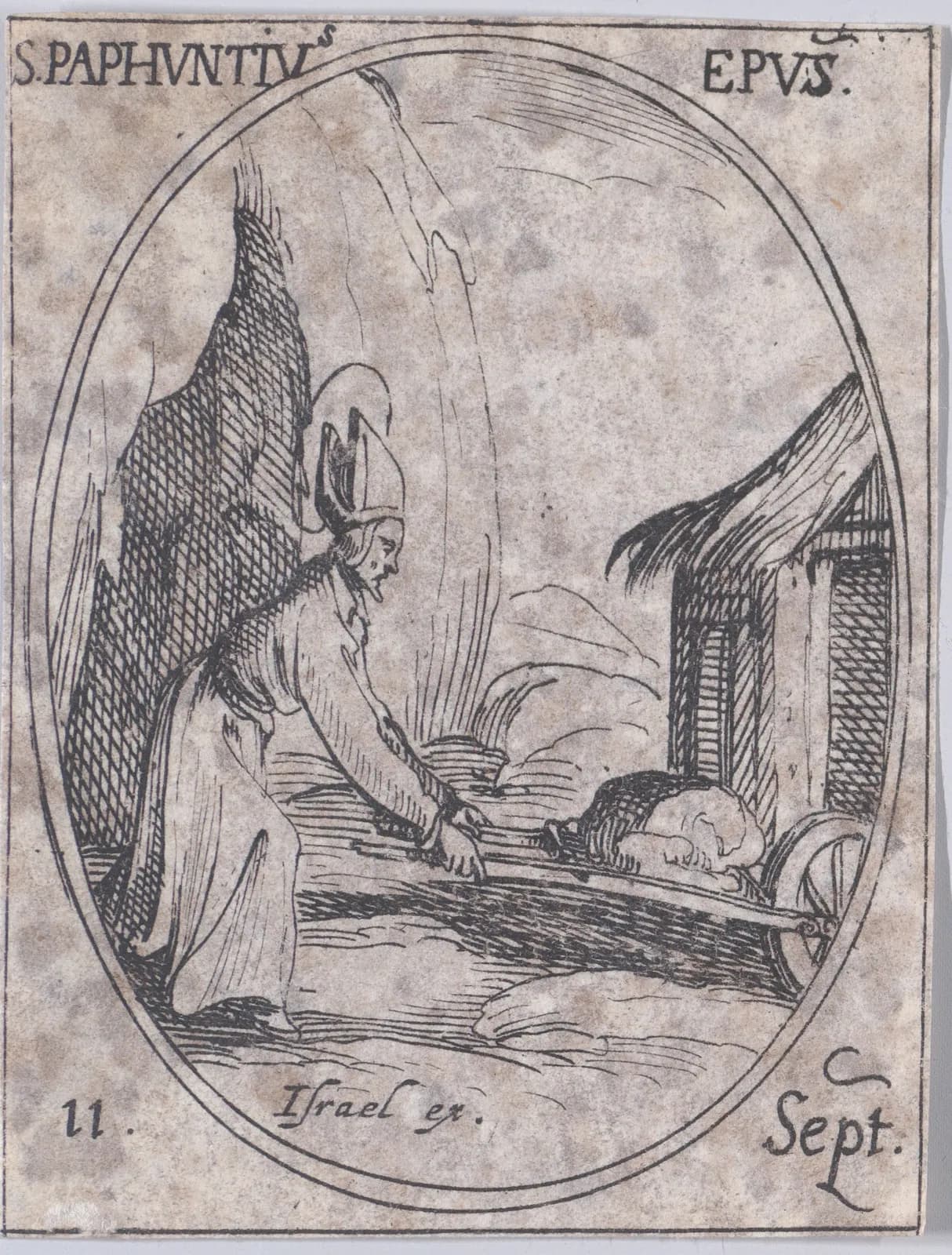
- Patron saint of
- Mine workers 5
Saint Paphnutius was an Egyptian bishop who had lost an eye and the use of a leg for his faith, and been sent to the mines, in the persecution under Maximinus. 136 The fifth-century historians say that Constantine used to kiss the empty socket, and that at Nicaea the old confessor, unmarried himself, persuaded the bishops not to make married clergy separate from their wives. 123 A modern Catholic source doubts that story and more, and this page gives both. 5
Which Paphnutius
The name was common in Egypt, and several saints bore it. 15 Maurice Hassett, writing in the 1911 Catholic Encyclopedia, distinguishes three: this bishop of a city in the Upper Thebaid; Paphnutius called the Buffalo, a hermit priest of Scete whom Cassian visited in 395; and a deacon martyred under Diocletian. 1 The Norwegian bishops' saints database (katolsk.no) says that the figure later called Paphnutius the Great was probably assembled from the bishop and the abbot of Scete, and that many stories told of him belong to others of the name. 5
Of his early life the sources give different pictures. Socrates says that "from a boy he had been brought up in a monastery." 2 The santoral of the Archdiocese of Madrid describes him as a hermit who lived on vegetables, water and a little salt, gave his time to prayer and penance, and left his solitude against his will when he was made bishop. 7 katolsk.no gives one version in which he joined Saint Anthony as a monk in 311 before becoming a bishop, and dates his birth about 280. 5 It derives the name from an Egyptian phrase meaning the man of God, or the one who belongs to God, and calls him a disciple of Saint Macarius and one of the hermits of the Theban desert. 5
A confessor of the persecution
Under the emperor Maximinus, Paphnutius was among the Christians mutilated and sent to labor in the mines. 135 Sozomen says that Maximinus condemned him and Maximus of Jerusalem to the mines "after having deprived them of the right eye, and the use of the left leg." 3 The Roman Martyrology says the right eye was put out and the tendon of the left foot was cut. 6 Hassett speaks of the left knee; Socrates says only that "he had been deprived of one of his eyes"; the Madrid santoral says a leg was amputated. 127
He survived, and the historians remember him as a wonder-worker. Socrates calls him "a man so favored divinely that extraordinary miracles were done by him." 2 Sozomen says God worked many miracles through him, "controlling demons, and giving him grace to heal various kinds of sickness." 3 Theodoret, describing the bishops at Nicaea, writes that "Some had had the right eye dug out, others had lost the right arm. Among these was Paphnutius of Egypt. In short, the Council looked like an assembled army of martyrs." 4
Socrates tells the detail for which he is best known. "The emperor honored this man exceedingly, and often sent for him to the palace, and kissed the part where the eye had been torn out." 2 Hassett repeats it from Socrates. 1
The speech at Nicaea
Socrates and Sozomen both tell what happened when the council turned to the clergy. 23 Some bishops wanted a law that bishops, priests and deacons, and in Sozomen subdeacons too, should have no relations with the wives they had married before ordination. 23 Hassett says most of the bishops were inclined to follow the earlier Council of Elvira, which had forbidden it. 1
Paphnutius rose and asked them not to "impose so heavy a yoke on the ministers of religion," Socrates writes, insisting that "marriage itself is honorable, and the bed undefiled." 2 He called a man's life with his lawful wife chastity, and proposed that the ancient tradition be kept: men already in holy orders should not marry, but "none should be separated from her to whom, while yet unordained, he had been united." 2 Socrates adds that he said this "although himself without experience of marriage," being "specially renowned above all men for his chastity." 2 The bishops agreed, dropped the proposal, and left the matter to the conscience of married clergy. 123 Hassett adds that the weight of the proposal came from the veneration in which he was held and from "the well known fact that he had himself observed the strictest chastity all his life." 1 katolsk.no notes that the rule attributed to him, that married men may be ordained but no ordained man may marry, remains the discipline of the Eastern churches, Catholic and Orthodox, except that married priests are no longer made bishops. 5
Hassett accepts the story and calls the confessor's part in the debate "a prominent, perhaps a decisive" one. 1 The Martyrology says that he took part in the Council of Nicaea and fought hard there for the Catholic faith against the Arians, without mentioning the debate on marriage. 6 katolsk.no is sharply skeptical. It calls the story an unhistorical legend that grew up about a century after his death and was passed on by Socrates and Sozomen, says that many scholars doubt he was at Nicaea at all, and reports the German historian Friedhelm Winkelmann's argument that Paphnutius may not have existed, since Athanasius, his supposed ally, never mentions him. 5
At Tyre, and his death
Hassett says that Paphnutius was present at the Synod of Tyre in 335. 1 katolsk.no tells a story from it: finding Maximus of Jerusalem, maimed like himself in the persecution, sitting among the bishops ranged against Athanasius, Paphnutius took him by the arm and led him out, saying he could not bear to see a man who bore the same marks for the faith misled by those set on condemning its defender; and Maximus, it says, never wavered again. 5 katolsk.no dates his death about 360; the Madrid santoral, about 350. 57
What is Saint Paphnutius the patron saint of?
Saint Paphnutius is the patron saint of mine workers, according to katolsk.no, which connects this with his sentence to the mines and with the images that show him laboring in a quarry, often with an angel beside him. 5 It adds that some opponents of clerical celibacy treat him as patron of married priests and deacons. 5 He is otherwise most often shown as a bishop with the Scriptures in his hand. 5
Saint Paphnutius's feast day
Saint Paphnutius's feast day is September 11. 567 The current Roman Martyrology keeps a commemoration of him that day as a bishop in Egypt and a confessor of the faith. 6 katolsk.no notes that September 24 is also given, that the Orthodox keep him on June 12 and the Copts on February 9 and May 1, and that no trace of a cult is found in East or West before Cardinal Baronius entered him in the Martyrology at the end of the sixteenth century. 5
Praying with Saint Paphnutius
Paphnutius came to the Church's first great council carrying the persecution in his body. 34 Theodoret looked at him and men like him and saw an army of martyrs. 4 Constantine kissed the place where his eye had been. 2
The one speech the historians give him is a plea for other people's marriages, made by a man who had never married. 23 In their telling he knew what continence cost because he had kept it, and would not lay it by law on those who had not chosen it. 2
How much of this is history is disputed, and katolsk.no doubts most of it. 5 The Church has kept his memory all the same, as a bishop in Egypt who suffered for the faith and stood for it afterward. 6
Saint Paphnutius, pray for us.
Sources
- 1.Maurice Hassett, "Paphnutius," The Catholic Encyclopedia, Vol. 11 (New York: Robert Appleton Company, 1911).
- 2.Socrates Scholasticus, Ecclesiastical History, Book I, chapters 8 and 11, trans. A. C. Zenos, Nicene and Post-Nicene Fathers, Second Series, Vol. 2 (1890), via New Advent.
- 3.Sozomen, Ecclesiastical History, Book I, chapters 10 and 23, trans. Chester D. Hartranft, Nicene and Post-Nicene Fathers, Second Series, Vol. 2 (1890), via New Advent.
- 4.Theodoret, Ecclesiastical History, Book I, chapter 6, trans. Blomfield Jackson, Nicene and Post-Nicene Fathers, Second Series, Vol. 3 (1892), via New Advent.
- 5."Den hellige Pafnutios den Store (~280-~360)," Den katolske kirke (katolsk.no), Catholic Diocese of Oslo (in Norwegian).
- 6.Roman Martyrology, entry for September 11, "San Pafnuzio, vescovo," as printed in "Santo del giorno," Conferenza Episcopale Italiana (in Italian).
- 7."San Pafnucio, obispo y confesor (c. a. 280-c. a. 350)," Santoral, Oración y Liturgia, Archdiocese of Madrid, September 11, 2025 (in Spanish).
Saints to turn to next
Others in this collection who are turned to for some of the same things.
- Saint EustaceMartyred at Rome, in 118 by tradition; other accounts give 140 or 188CourageMarriage and familySuffering and illness
- Saint Gianna Beretta MollaOctober 4, 1922 - April 28, 1962Marriage and familyCourageSuffering and illness
- Saint Margaret Clitherowc. 1556 - March 25, 1586CourageMarriage and familySuffering and illness
- Saints Perpetua and FelicityMartyred at Carthage, March 7, 203CourageSuffering and illnessMarriage and family