Saint Pancras
Roman martyr; died under Valerian (257-58) or Diocletian (304-06)
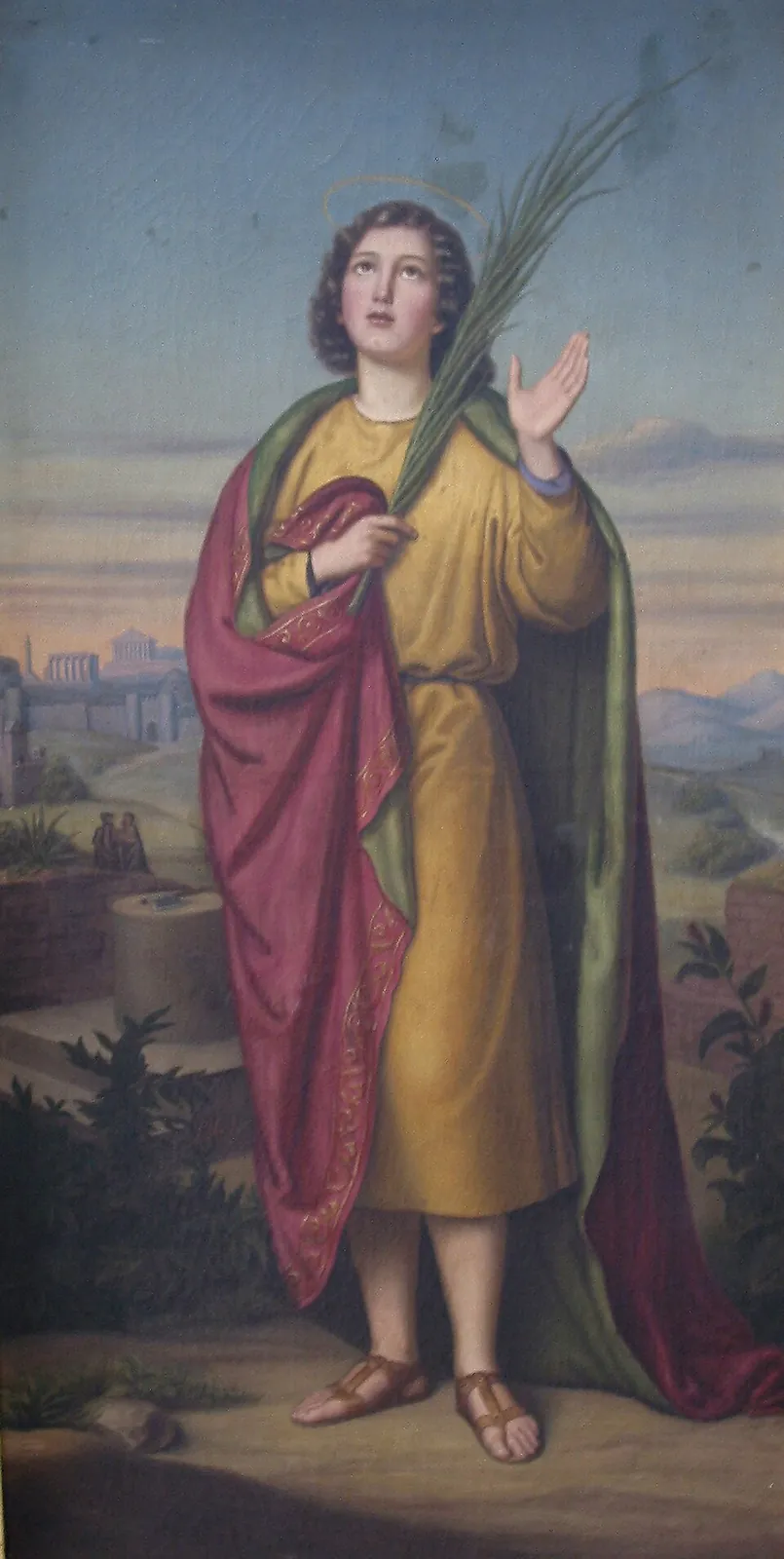
- Died
- In Rome, probably in the persecution of Valerian (257-58) or of Diocletian (304-06), according to the Catholic Encyclopedia; about 304 according to Catholic Culture 12
- Buried
- On the Via Aurelia, at the second milestone from Rome 1
- Age
- Fourteen, according to the legend Catholic Culture repeats 2
- Patron saint of
- Fidelity to oaths 2
Saint Pancras, or Pancratius, was a Roman martyr buried by the Via Aurelia, at the second milestone outside the city, whose name has been kept on May 12 since the fifth-century Roman calendars. 1 The Catholic Encyclopedia says he probably died in the persecution of Valerian or of Diocletian, and calls the legend of his martyrdom, which Catholic Culture tells of a boy of fourteen who would not sacrifice to the gods, "of later origin, and not reliable historically." 12 A church has stood over his grave since the fourth century. 1
What the oldest records say
The earliest evidence for him is his name and his grave. 1 The old Roman lists of the fifth century, which passed into the Martyrologium Hieronymianum, name Saint Pancratius and say that his body rested in a catacomb on the Via Aurelia. 1 The fuller version of that martyrology in the Berne Codex records, under 12 May, "the natal day of St. Pancratius, on the Aurelian Way at the second milestone," in J. P. Kirsch's translation in the Catholic Encyclopedia. 1
The same entry names Nereus and Achilleus, two martyrs buried in the Catacomb of Domitilla across the city, on the same date. 1
Kirsch notes that the Mass prayers of the Gelasian Sacramentary for 12 May name only Nereus and Achilleus. 1 He explains why: Pancras's feast was celebrated at his own church on the Via Aurelia, with its own Mass, whose text has not survived, and in which "his name, without doubt, was alone mentioned." 1 From the fourth century on, a special Mass was said every 12 May at both graves. 1 The guidebooks to the martyrs' tombs written for pilgrims in the seventh century all agree on where he lay. 1
His church on the Via Aurelia
Kirsch says the church built over his grave in the fourth century "stands today in somewhat altered style." 1 Catholic Culture gives a different origin for it: a basilica that Pope Symmachus erected over his remains about the year 500, which later became a station church. 2
On the first Sunday after Easter, Catholic Culture says, the catechumens gathered at his station church, and there the saint "exhorted" them to remain loyal to their baptismal vows. 2 It adds that his relics have been lost since 1798. 2
His church drew other pilgrims too. 6 The Catholic Encyclopedia's article on Saints Faith, Hope and Charity says that a Roman mother, Sophia, and her three daughters, martyred under Hadrian, were buried in a crypt beneath the church "afterwards erected to St. Pancratius," and that their tomb was "long a place of resort for pilgrims." 6 Its evidence is a set of seventh-century documents: a pilgrims' guide to the holy places of Rome kept at Salzburg, and a list, kept at Monza, of the oils gathered from the martyrs' tombs and sent to Queen Theodelinda in the time of Gregory the Great. 6
The legend
Kirsch is blunt: "The legend describing the martyrdom of the saint is of later origin, and not reliable historically." 1 He gives only the likely period of his death, the persecution of Valerian in 257 and 258 or that of Diocletian between 304 and 306. 1
Catholic Culture tells the legend as it has come down. 2 Pancratius was the son of a noble family of Phrygia who came to Rome at fourteen while Diocletian and Maximian were emperors, about the year 304. 2 He was baptized by the pope and instructed in the faith, arrested for it, and refused to sacrifice to the pagan gods. 2 Condemned to death, he "bared his neck for the sword," and during the night his body was taken away by a devout matron named Octavilla, anointed with balsam and buried on the Via Aurelia. 2
Even Catholic Culture's page is not consistent about his dates. Its short summary at the head of the page gives his death as 290 and says he was martyred in 275, while the fuller text below it has him dying about 304. 2 Kirsch, for his part, commits only to the two persecutions. 1
A church of Saint Pancras at Canterbury
A church of Saint Pancras stood at Canterbury by the end of the sixth century. 4 The Catholic Encyclopedia's article on Saint Augustine's Abbey says that King Ethelbert of Kent gave it to Saint Augustine in 597. 4 The Benedictine monastery founded in 605 outside the city walls, later known as Saint Augustine's Abbey, was built on its site. 4
The encyclopedia does not say who dedicated that first church, or when, or whether it was named for the Roman martyr of the Via Aurelia, and the page does not guess. 4
He does appear in an early English calendar. 5 Herbert Thurston, writing on the Christian calendar for the encyclopedia, prints what he calls perhaps the oldest surviving church calendar in the proper sense, the one that belonged to Saint Willibrord, apostle of the Frisians, which was probably written in England between 702 and 706. 5 Among its few entries for May is "Pancratius, Martyr". 5 It sets him on the 11th, a day earlier than the Roman lists. 15
Sharing a day with Nereus and Achilleus
By the early twentieth century he was kept together with Nereus and Achilleus and with Flavia Domitilla, in whose catacomb the two soldiers were buried. 1 Kirsch, writing in 1911, describes the four as commemorated "in common" on 12 May and all named in the Proper of the Mass as martyrs. 1
The current calendars separate them again, much as the separate Masses at their separate graves once did. 123 Vatican News lists "Sts. Nereus and Achilleus, martyred on the Via Ardeatina" and "St. Pancras, martyred on the Via Aurelia" as two entries for May 12, and Catholic Culture prints two optional memorials for the day, one for the pair and one for Pancras. 23
What is Saint Pancras the patron saint of?
Catholic Culture calls Saint Pancras "the patron saint of fidelity to oaths." 2 It draws a lesson from it: to be slow and careful before taking an oath or a vow, and once the word is given, to keep it, whether the promise is a baptismal vow, an ordination, a religious profession or a marriage. 2 None of the other sources consulted names a patronage.
Saint Pancras's feast day
Saint Pancras's feast day is May 12. 123 The date appears in the fifth-century Roman lists, and the Catholic Encyclopedia gives it as the day of his commemoration in 1911. 1 Vatican News lists him on May 12, and Catholic Culture prints the day as an optional memorial of Saint Pancras, Martyr. 23 The early eighth-century calendar of Saint Willibrord, as Thurston prints it, has him on May 11. 5
Praying with Saint Pancras
What is certain about him fits in a sentence: a martyr named Pancratius was buried by the Via Aurelia, and Rome remembered him there every year. 1 The boy of fourteen, the Phrygian family and the matron who carried his body away by night all belong to a later story. 12
The Church has kept his day anyway, since at least the fifth century, on the strength of a name and a grave. 13 The calendars that preserve him do not say what he did, only where he lay and when he was remembered. 1
Catholic Culture's picture of him is of a young man who would not go back on a promise. 2 Whatever the legend adds, the catechumens gathered at his church on the Sunday after Easter were reminded there of their baptismal vows. 2
Saint Pancras, pray for us.
Sources
- 1.J. P. Kirsch, "Sts. Nereus and Achilleus, Domitilla and Pancratius," The Catholic Encyclopedia, vol. 10 (New York: Robert Appleton Company, 1911).
- 2."Optional Memorial of Sts. Nereus and Achilleus, Martyrs; Optional Memorial of St. Pancras, Martyr - May 12, 2026," Liturgical Year, Catholic Culture.
- 3."Saint of the Day: 12 May," Vatican News.
- 4.G. C. Alston, "Abbey of Saint Augustine," The Catholic Encyclopedia, vol. 13 (New York: Robert Appleton Company, 1912).
- 5.Herbert Thurston, "Christian Calendar," The Catholic Encyclopedia, vol. 3 (New York: Robert Appleton Company, 1908).
- 6.J. F. X. Murphy, "Sts. Faith, Hope and Charity," The Catholic Encyclopedia, vol. 5 (New York: Robert Appleton Company, 1909).
Saints to turn to next
Others in this collection who are turned to for some of the same things.