Saint Pamphilus of Caesarea
c. 240 - February 16, 309
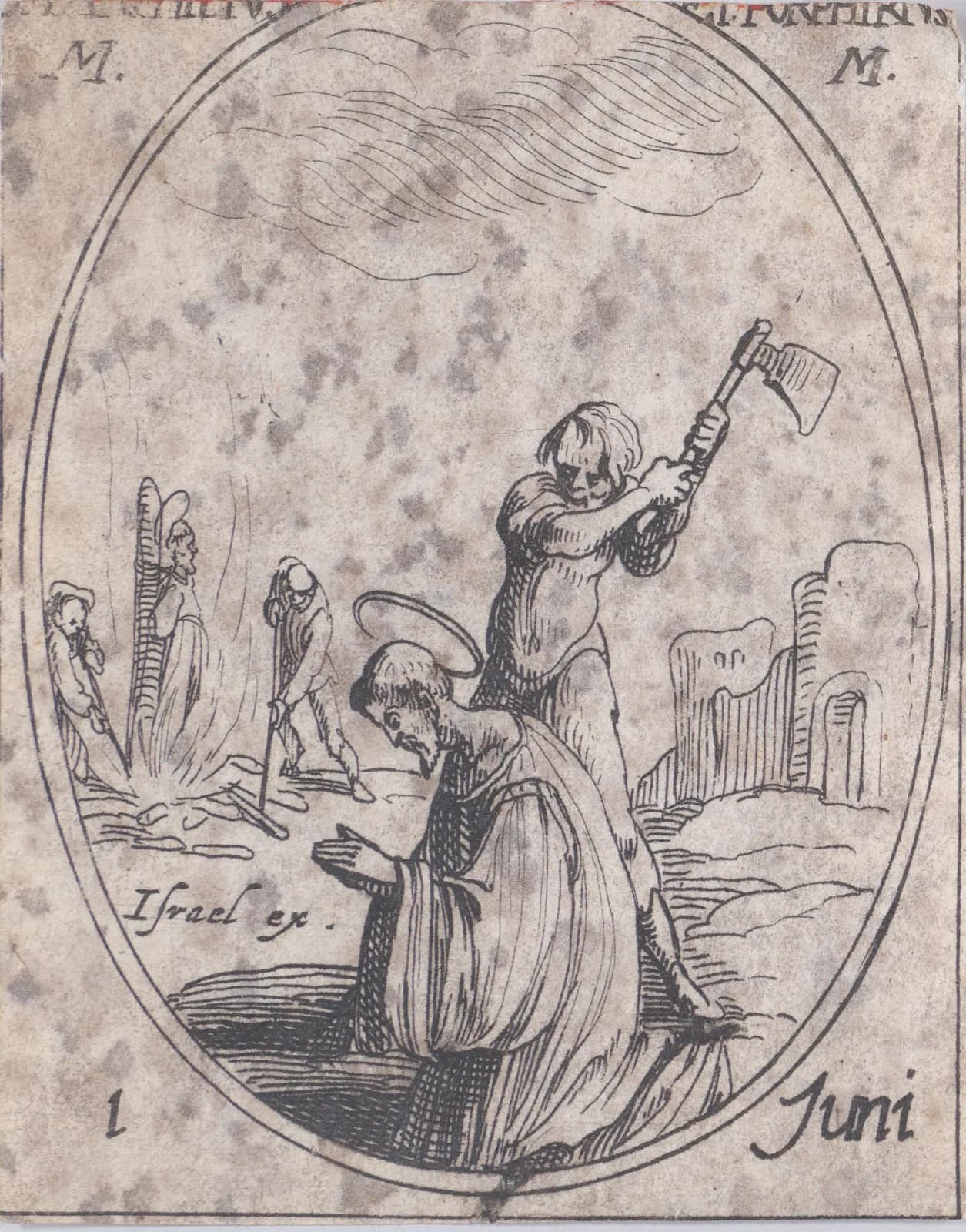
- Martyred
- At Caesarea, in February 309, with eleven companions 125; beheaded, say the encyclopedia and katolsk.no 15
- Emblem
- A philosopher's cloak and a book; sometimes a sword or knife 5
Saint Pamphilus was a priest of Caesarea in Palestine who gave away his inheritance, built one of the great libraries of the ancient Church, and spent his life copying and correcting the Scriptures. 12 Arrested in the persecution under Maximinus, he went on working on manuscripts in prison for two years, and was put to death with eleven companions in February 309. 12 His pupil Eusebius, the first historian of the Church, called him "my dearest friend" and "the most illustrious of the martyrs in our time." 2
From Beirut to Caesarea
Pamphilus was born about 240 at Berytus, the modern Beirut, into a rich and respected family, according to the Norwegian bishops' saints database (katolsk.no). 5 F. J. Bacchus, writing in the 1911 Catholic Encyclopedia, says he had a good education there and then left his native land "after selling all his property and giving the proceeds to the poor." 1 He went to Alexandria and studied under Pierius, the head of its famous Catechetical School. 15
He settled at Caesarea in Palestine and was ordained a priest. 15 There he founded a school for theological study. 13 Eusebius, who knew him there, calls him in his Church History "that most eloquent man, of truly philosophical life," and says he had already described "the school which he established" in a separate work. 3 That work, a Life of Pamphilus in three books, is lost. 125
Eusebius was more than a pupil. katolsk.no calls him a student, a friend and perhaps a relative of Pamphilus, and says that after the martyr's death he called himself Eusebius Pamphili, Eusebius of Pamphilus. 5 In his own account of the martyrdom Eusebius calls Pamphilus "a man thrice dear to me." 2
The library at Caesarea
Bacchus says that Pamphilus "devoted himself chiefly to producing accurate copies of the Holy Scripture." 1 The library he gathered held the works of Origen, and Jerome writes that Pamphilus "transcribed the greater part of the works of Origen with his own hand and these are still preserved in the library at Cæsarea." 4 Its greatest treasure, Bacchus says, was Origen's own copy of the Hexapla, probably the only complete copy ever made. 1
He gave as freely as he collected. A passage of Eusebius's lost Life, preserved by Jerome, describes him supplying poor scholars with what they needed to live, and giving away copies of the Scriptures, of which he kept a large supply, to anyone who wanted them, women devoted to study among them. 1 katolsk.no adds that he treated his slaves as members of the family and was generous with his money to relatives, friends and the poor. 5 Eusebius, writing of the martyrdom, praises him for "sharing his possessions with the needy" and for his "indefatigable industry in whatever he undertook." 2
Jerome owned some of his work. He writes that he had "twenty-five volumes of Commentaries of Origen, written in his hand, On the twelve prophets which I hug and guard with such joy, that I deem myself to have the wealth of Croesus." 4 And he adds: "if it is such joy to have one epistle of a martyr how much more to have so many thousand lines which seem to me to be traced in his blood." 4 The library outlasted its founder by centuries. Bacchus says it certainly existed in the sixth century and probably did not long survive the Saracen capture of Caesarea in 638; katolsk.no says it was scattered by the Arabs in the 600s. 15
Two years in prison
The persecution begun under Diocletian reached Pamphilus in November 307, by Bacchus's date; katolsk.no says 307 or 308. 15 Eusebius describes the governor Urbanus testing him first "in rhetorical philosophy and learning," then ordering him to sacrifice. 2 When he refused, Urbanus had him tortured, his sides scraped again and again, and then sent him to prison with the other confessors. 2
He did not stop working. Bacchus says that in prison he went on copying and correcting manuscripts, and wrote with Eusebius an Apology for Origen in five books, to which Eusebius later added a sixth. 1 Jerome says Pamphilus "wrote an Apology for Origen before Eusebius had written his." 4 Only the first book survives, in a Latin translation by Rufinus; katolsk.no notes that even that book is of doubtful authenticity. 15 Bacchus summarizes its argument: that Origen was a humble man, honored with the priesthood, anxious above all to keep to the rule of faith handed down from the apostles. 1
The martyrdom
After two full years in prison, Pamphilus and two fellow prisoners, the aged deacon Valens of Jerusalem and Paul of Jamnia, were brought before the new governor Firmilianus together with five Egyptian Christians arrested at the city gate. 2 Eusebius dates the hearing to "the fourteenth before the Kalends of March." 2 The Egyptians were tortured first. 2 Then the governor turned to Pamphilus and his companions, asked whether they would now obey, and receiving from each of them the same refusal, condemned them. 2 Bacchus and katolsk.no say they were beheaded. 15
As sentence was given, a young man of Pamphilus's household named Porphyry cried out from the crowd, asking that the bodies be buried. 2 Eusebius says he had been "educated in the noble life and instruction of such a man." 2 He was tortured and burned, calling on Jesus, and died before his master; the news was carried to Pamphilus by Seleucus, a former soldier, who was then killed in his turn. 2 Theodulus, an old servant of the governor's own household, was crucified. 2 Julian, the twelfth, is a Cappadocian just arrived from a journey in Eusebius and in the Martyrology: he kissed the bodies and was burned. 26 katolsk.no makes him a young catechumen who happened to be present and offered himself to the executioners. 5
Eusebius says the bodies were left four days and nights for the wild beasts, that nothing touched them, and that they were then buried in the customary manner. 2 katolsk.no says the Christians recovered them at great risk. 5 Eusebius counted them "twelve in all; being counted worthy of apostolic grace and number." 2
What is Saint Pamphilus the patron saint of?
None of the sources consulted names a patronage for Saint Pamphilus. katolsk.no says he is most often shown in a philosopher's cloak, holding a book, sometimes with a sword, a knife or a razor. 5 He is remembered chiefly as a scholar of the Bible and as the teacher of Eusebius, who says that he "especially excelled all in our time in most sincere devotion to the Divine Scriptures." 25
Saint Pamphilus's feast day
Saint Pamphilus's feast day is February 16, the day of his death. 56 The current Roman Martyrology enters him on that day, after the five Egyptian martyrs, with Valens, Paul, Porphyry, Seleucus, Theodulus and Julian. 6 katolsk.no notes that he and his companions were traditionally kept on June 1, and that the revised Martyrology moved them to the day of their death. 5
Praying with Saint Pamphilus
Most of Pamphilus's life was quiet work at a desk. He sold what he had, gathered books, and copied them out by hand, correcting the text of the Scriptures line by line. 12 What he could not use he gave away, to poor students and to anyone who wanted to read. 15
Prison did not interrupt the work so much as move it. For two years he went on copying and writing, and the book that came out of that cell was a defense of a man he admired who had many enemies. 1 Jerome, a century later, held the volumes in his own hands and thought of them as written in blood. 4
He did not die alone. A servant he had taught, an old deacon who knew the Scriptures by heart, a soldier, a stranger who stopped to kiss the dead: Eusebius names each of them, and the Martyrology keeps them together on one day. 26
Saint Pamphilus of Caesarea, pray for us.
Sources
- 1.F. J. Bacchus, "St. Pamphilus of Cæsarea," The Catholic Encyclopedia, Vol. 11 (New York: Robert Appleton Company, 1911).
- 2.Eusebius of Caesarea, The Martyrs of Palestine, chapters 7 and 11, trans. Arthur Cushman McGiffert, Nicene and Post-Nicene Fathers, Second Series, Vol. 1 (1890), via New Advent.
- 3.Eusebius of Caesarea, Church History, Book VII, chapter 32, trans. Arthur Cushman McGiffert, Nicene and Post-Nicene Fathers, Second Series, Vol. 1 (1890), via New Advent.
- 4.Jerome, De Viris Illustribus (Illustrious Men), chapter 75, trans. Ernest Cushing Richardson, Nicene and Post-Nicene Fathers, Second Series, Vol. 3 (1892), via New Advent.
- 5."Den hellige Pamfilus av Caesarea og hans ledsagere (~240-309)," Den katolske kirke (katolsk.no), Catholic Diocese of Oslo (in Norwegian).
- 6.Roman Martyrology, entry for February 16, the martyrs of Caesarea in Palestine, as printed in "Santo del giorno," Conferenza Episcopale Italiana (in Italian).
Saints to turn to next
Others in this collection who are turned to for some of the same things.