Saint Anselm of Lucca
c. 1035 - March 18, 1086
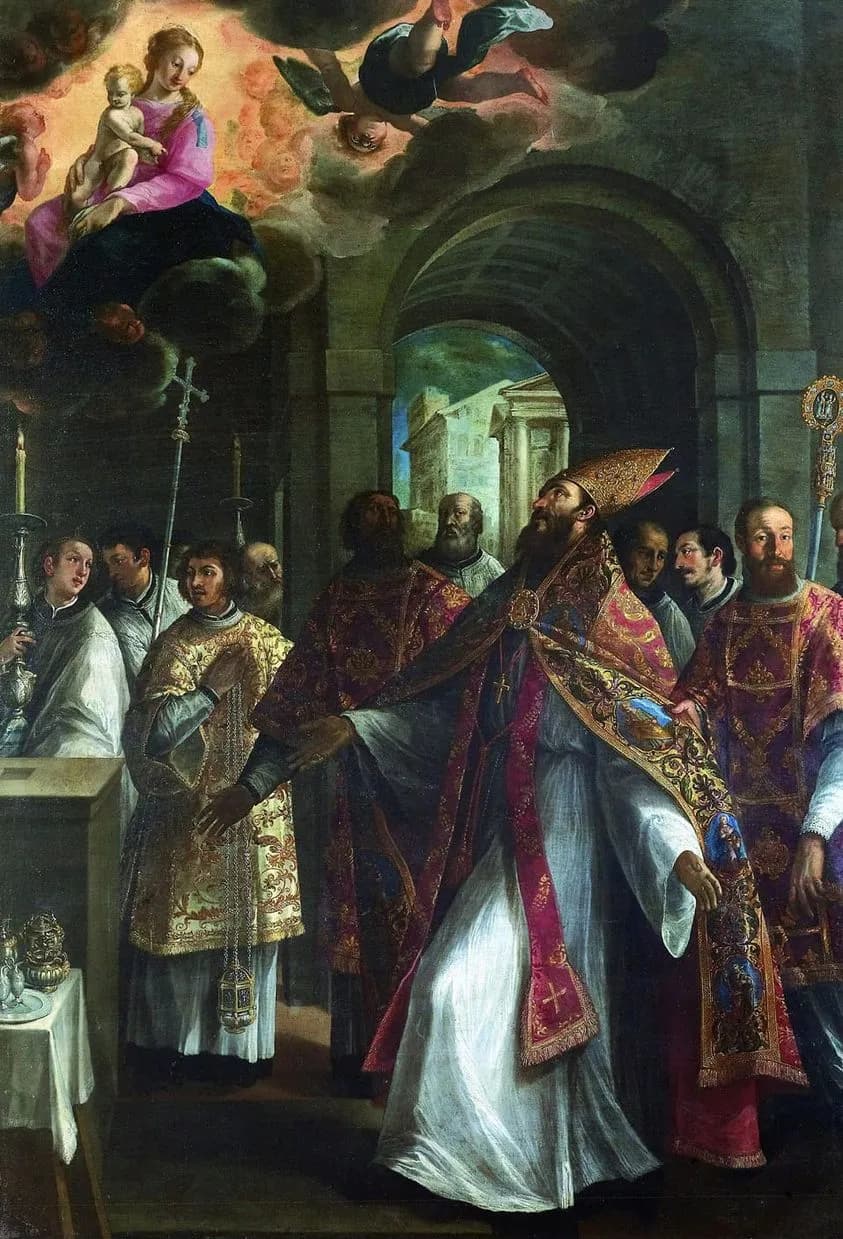
- Born
- About 1036 at Mantua, says the 1907 Catholic Encyclopedia 1; about 1035 at Baggio, near Milan, says the Diocese of Mantua 4
- Feast day
- March 18 2
Saint Anselm of Lucca was a bishop of the Gregorian reform who was driven out of his diocese by his own cathedral clergy and never went back. He spent his last years at Mantua as the pope's legate in Lombardy and as spiritual adviser to Countess Matilda of Tuscany, and he compiled a collection of church law that later passed into Gratian's "Decretum." 124 Mantua, where he died in 1086, has kept him as its principal patron ever since, and his incorrupt body is venerated in its cathedral. 34
The nephew of a pope
The sources do not agree on where he was born. The 1907 Catholic Encyclopedia says Mantua, about 1036. 1 The Diocese of Mantua, in the biographical note it uses for his feast, says he came from Baggio in the Diocese of Milan and was born about 1035, and John Paul II, writing to Mantua in 1986, calls him Anselm "da Baggio." 34 The diocese adds that he had a thorough training in letters, philosophy, law and theology. 4
His uncle and namesake, Anselm of Lucca the elder, became Pope Alexander II in 1061. 1 The Mantua note says it was under his uncle's guidance that the young Anselm came to care so much about the reform of the Church. 4 That reform was the great question of his generation: bishoprics and abbeys were being bought and sold, and kings claimed the right to invest bishops with the ring and staff that were the signs of their spiritual office. 14
A ring and a crosier
In 1071 Alexander II named his nephew Bishop of Lucca and sent him to Germany to receive investiture from King Henry IV. Anselm went, but, in the encyclopedia's words, he "was loath to receive the insignia of spiritual power from a temporal ruler," and he came home without it. 1 In 1073 the new pope, Gregory VII, appointed him again and advised him not to take his ring and crosier from Henry. 1 The Mantua note says Gregory himself ordained him bishop. 4
What happened next is told in two halves. The encyclopedia says that Anselm, for reasons it does not know, did accept investiture from Henry after all, was soon so troubled by it that he resigned his see, and became a Benedictine monk at Polirone (the encyclopedia spells it Padilirone), a monastery of the Cluniac reform near Mantua. 1 The Roman Martyrology says that he placed in Gregory VII's hands the ring and staff he had reluctantly received from the emperor. 2 Gregory ordered him back to Lucca. He went reluctantly, says the encyclopedia, and kept living as a monk until he died. 1
Driven out of Lucca
Back in his diocese, Anselm set out to reform his clergy. The Diocese of Mantua says he wanted them to live poorly and in community, and, following older examples such as that of Saint Augustine, he meant to share a common life with the canons of his cathedral himself. 4 Most of them refused. 1 The Martyrology says simply that he was driven from his see by canons who would not live the common life with him. 2
The resistance was more than a clerical quarrel. The Mantua note says the canons held out against repeated papal interventions, ending in excommunication; they had the support of the emperor's party, and the nobility and townspeople of Lucca, who resented Matilda's authority, joined their revolt. Anselm tried at first to hold out in a castle in the countryside, but in the end he was forced to leave the diocese. 4 The diocese dates this to 1080; the encyclopedia to 1081, adding that the canons had the help of the emperor and of his antipope, Guibert. 14 Anselm never saw Lucca again as its bishop. 4
Legate in Lombardy
He found refuge with Matilda, Countess of Tuscany, and became her spiritual adviser. 14 J.P. Kirsch, writing on Matilda for the same encyclopedia, says that when Henry IV laid waste her lands in 1082 she held to Gregory's side, "confirmed in this by her confessor, Anselm, Bishop of Lucca." 5
Gregory then made him papal legate in Lombardy, with instructions to govern the dioceses that had been left without bishops in the struggle between pope and emperor. 12 The Mantua note says he settled at Mantua around 1083. 4 John Paul II, in his 1986 letter, describes the legate's work there as a wide ministry in service of the whole Church, carried out under the instructions of the Roman pontiff, and calls his relationship with Gregory VII a kind of summary of his whole life: in Peter he saw the center of the Church as Christ had willed it. 3 The Martyrology says he was a great help to the pope. 2
His writings
Anselm was a scholar as well as a pastor. The encyclopedia says he knew the Scriptures well and wrote exegetical and ascetical works. 1 In "Contra Guibertum et sequaces ejus" he argued that lay investiture was unlawful and defended Gregory against the antipope, and he made a collection of canons that was afterward incorporated into Gratian's Decretum. 1 The Mantua booklet prints part of a letter he wrote to Guibert, accusing him of tearing the Church apart with the sword of schism and of choosing his men for what they paid or promised rather than for the honesty of their lives. 4
John Paul II singled out the canon collection, saying Anselm compiled it not only with learning but with a spiritual warmth born of his love for the Church, and he quoted one line from its twelfth book: "Convivium Domini est unitas corporis Christi non solum in sacramento altaris sed etiam in vinculo pacis." 3 The Lord's banquet, it says, is the unity of the body of Christ, not only in the sacrament of the altar but in the bond of peace. The booklet also uses a prayer it says is soundly attributed to Anselm and was probably written for Matilda. 4
Death in exile
Anselm died at Mantua on March 18, 1086. 14 The Diocese of Mantua says he died without ever returning to his diocese and without seeing the fruit of his work, and gives his last words: that he had loved justice and hated iniquity, and therefore died in exile. 4 The booklet notes that the same words are attributed to Gregory VII, who also died far from Rome. 4
According to the Mantua note, Pope Victor III canonized him in 1087, and the devotion of the people soon made him principal patron of the Church of Mantua. 4 John Paul II wrote that the faithful there could still contemplate their patron "nella sua incorrotta presenza corporea," in his incorrupt body, venerated in the cathedral. 3 He also mentioned a particular devotion at Mantua to an image of Mary, crowned as queen, which revealed itself to Anselm, and said that Giuseppe Sarto, the future Pius X, had praised him while still at Mantua as worthy of the gratitude not of Mantua alone but of all peoples. 3
What is Saint Anselm of Lucca the patron saint of?
Saint Anselm of Lucca is the patron saint of Mantua. The 1907 encyclopedia says that "Mantua, the city of his birth and death, honours him as its patron," and both the Diocese of Mantua and John Paul II call him its principal patron. 134 No source consulted here gives him a patronage beyond the city and its diocese.
Saint Anselm of Lucca's feast day
Praying with Saint Anselm of Lucca
Anselm's first struggle was with his own conscience. He went to Germany for investiture and came back without it; he took it later and could not live with having done so. 12 Whatever the exact sequence, the sources agree that he could not settle for what he believed was wrong, even when it was the easier road and even when he had already taken it.
His second struggle was with his own clergy. What he asked of the canons of Lucca was a common life, poor and shared, and they would not have it. 24 The Mantua booklet uses his story to pray about exactly that: the ease with which ministry becomes a private interest, and the cost of trying to call it back. 4
He did not win. He died in exile, with his diocese in other hands, saying that he had loved justice and hated iniquity. 4 Mantua's own reflection on him puts it this way: he gave his life not in a single moment of martyrdom but in daily, unrewarded labor, without seeing visible success. 4 Nine hundred years later, the city that sheltered him still keeps his body and his feast. 23
Saint Anselm of Lucca, pray for us.
Sources
- 1.Michael Ott, "St. Anselm of Lucca, the Younger," The Catholic Encyclopedia, Vol. 1 (New York: Robert Appleton Company, 1907).
- 2.Roman Martyrology, entry for March 18, "Transito di Sant'Anselmo, vescovo," as printed in "Santo del giorno," Conferenza Episcopale Italiana (in Italian).
- 3.John Paul II, Letter on the ninth centenary of the death of the patron of Mantua, January 31, 1986 (in Italian).
- 4.Diocese of Mantua, Liturgical Office, "Adorazione Eucaristica ispirata alla figura di S. Anselmo da Lucca, patrono di Mantova," prepared for the 2011 National Eucharistic Congress, with the biographical note from the Mantua proper missal (in Italian; hosted by the Diocese of Bergamo).
- 5.Johann Peter Kirsch, "Matilda of Canossa," The Catholic Encyclopedia, Vol. 10 (New York: Robert Appleton Company, 1911).
Saints to turn to next
Others in this collection who are turned to for some of the same things.