Saint Alexander of Alexandria
c. 250 - 326 or 328
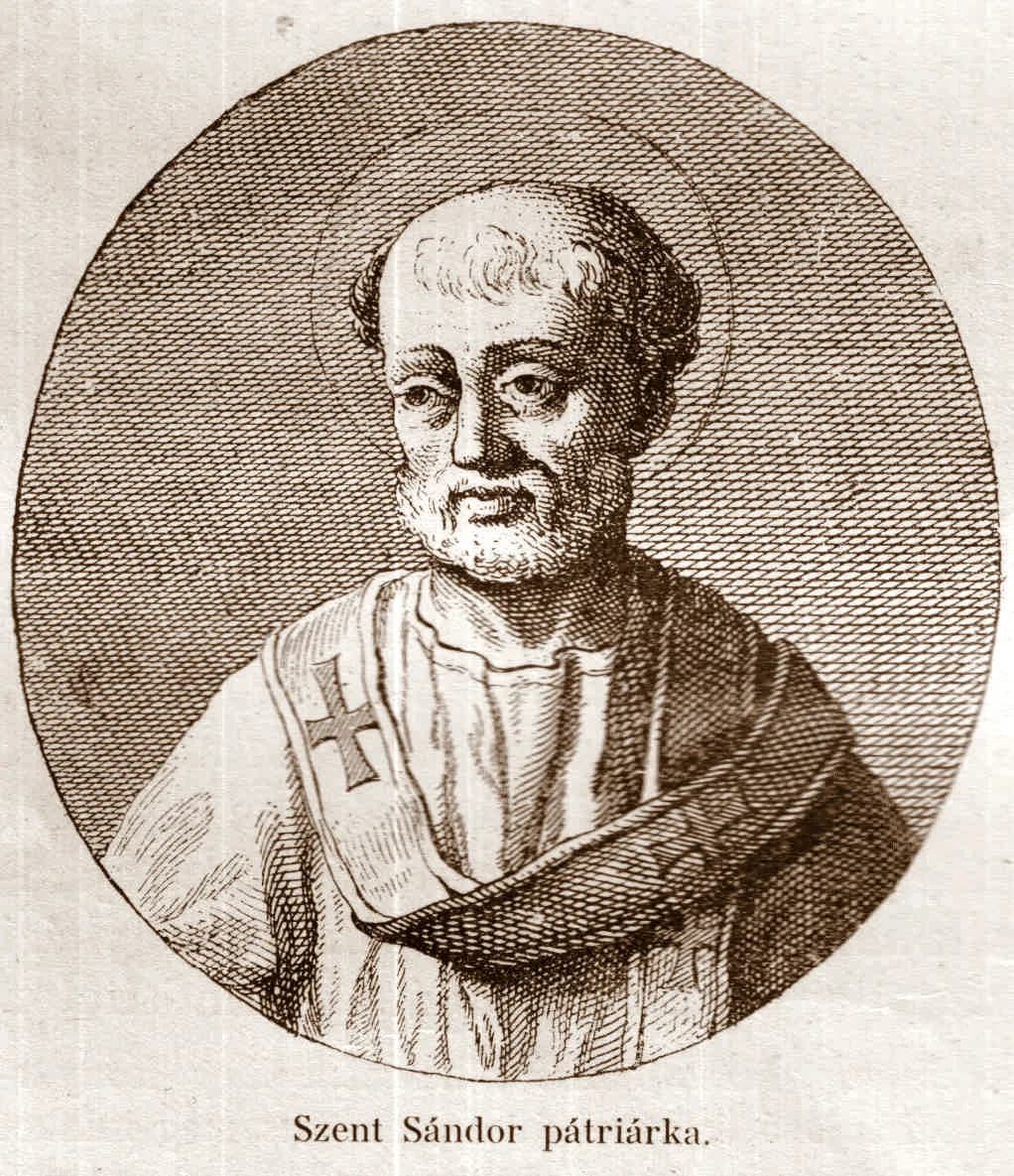
- Bishop of Alexandria
- From 313, succeeding Achillas 1
Saint Alexander of Alexandria was the bishop of the great Egyptian city who first excommunicated the priest Arius for teaching that the Son of God was a creature. 12 He took the case to a council of Egyptian bishops, then to the whole Church in letters, and finally to the Council of Nicaea in 325, where he sat among the fathers who condemned Arius. 14 He is remembered less than the deacon he brought with him, Athanasius, who succeeded him. That was partly his own doing. 12
Bishop of Alexandria
The Norwegian bishops' saints database, which gathers the older scholarship, gives his birth as about 250; the 1907 Catholic Encyclopedia calls the date uncertain. 12 He was a priest in Alexandria through the persecutions under Galerius and Maximinus, and the encyclopedia counts that among his merits. 2 In 313 he succeeded Achillas as bishop, the nineteenth to hold one of the most important sees in Christendom. 1
The encyclopedia preserves an old description of him as "a man held in the highest honour by the people and clergy, magnificent, liberal, eloquent, just, a lover of God and man, devoted to the poor, good and sweet to all, so mortified that he never broke his fast while the sun was in the heavens." 2 katolsk.no adds two practical details. He liked to choose monks for bishops, men who had lived in solitude or in the desert, because he thought them the best model for a shepherd, and his choices across Egypt turned out well. He also built the church of Saint Theonas, the largest in the city. 1
His first years brought two quarrels before the great one. A schismatic group disputed how the date of Easter was reckoned, and Alexander answered with a treatise that cited his predecessor Dionysius the Great; the dispute died down, though it was not settled until Nicaea. 1 The second was the schism of Meletius, bishop of Lycopolis, who took a harder line than Peter of Alexandria on receiving back those who had lapsed in persecution. Meletius ordained bishops of his own without leave, slandered Alexander as he had slandered Achillas, and even complained of him to the court of Constantine. 1
Arius
Arius was one of Alexander's own priests, ordained by Achillas and put in charge of the district of Alexandria called Baucalus. 1 The encyclopedia notes that Alexander's appointment to the see "excluded the heresiarch Arius from that post." 2 katolsk.no reports two versions of the election: that Arius opposed it and became his enemy, or that Alexander was chosen with Arius's support, a story it suggests was invented later to make the bishop look worse for turning on him. 1
Arius was intelligent, ascetic and a good preacher, with one of the city's most popular churches. He taught that Christ was not truly God but had been created, that there was a time when he did not exist, and that he was capable of sin. Around 319 he began to say so in public, and he drew a following. 1
Alexander moved slowly. katolsk.no calls him among the mildest of men and says he tried at first to win Arius back with friendly reproof and argument, and that some of the orthodox were shocked at his patience. 1 The encyclopedia puts it more sharply: Alexander was "so tolerant at first of the errors of Arius that the clergy nearly revolted." 2 When nothing worked, he called Arius before an assembly of his priests, where Arius held his ground and was excommunicated. A council of about a hundred bishops from Egypt and Libya confirmed the sentence around 320. 1
His letters
Arius went to Palestine and found support, above all from Eusebius of Nicomedia and from the historian Eusebius of Caesarea, and many bishops of the East were ready to defend him against his own bishop. 1 Alexander wrote, by katolsk.no's count, some seventy letters on the affair, and two of them survive: one to his namesake Alexander of Constantinople, and a circular letter to the bishops of the whole Church. 13
They show a bishop who thought the matter was simple and could not believe others did not. He opens the circular letter with the reason for writing at all: "Since the body of the Catholic Church is one," what is done in one church should be known to the others. 3 He sets out the teaching in Arius's own terms, that "there was a time when He was not," and reports that he and "the Bishops of Egypt and the Libyas, nearly a hundred in number, have anathematized them." 3 Then he turns to Scripture. "Who that hears John saying, In the beginning was the Word, does not condemn those who say there was a time when He was not?" 3
The letter to Constantinople makes the same argument at greater length and with more heat. He calls the Arian party a "workshop for contending against Christ" and complains that they were "daily stirring up against us seditions and persecutions." 3 According to katolsk.no he also drew up a statement of the orthodox position and gathered some two hundred and fifty signatures for it, a hundred of them from his own territory, sending a copy to Arius with word that he was willing to die for that faith, and another to Pope Sylvester. 1
At Nicaea
In 325 Constantine called the bishops to Nicaea, the first ecumenical council, and Arius and Alexander were both there. 15 The Roman Martyrology says Alexander condemned Arius as one of the three hundred and eighteen fathers of the council. 4 He was old and in poor health. katolsk.no says he was expected to preside, but thought he could not be both judge and chief accuser, and left the chair to Hosius of Córdoba. 1 With him came his deacon Athanasius, who spoke for him. 15
The council condemned Arius and adopted the word homoousios, of one substance, for the relation of the Son to the Father, in the creed that is still recited at Mass. katolsk.no says Alexander played an active part in framing it, and the encyclopedia says he "is credited with having drawn up" the council's Acts. 12
He also settled his older quarrels there. At his request the council let Meletius keep the title of bishop without its powers, and let the men he had ordained keep their places, to be advanced only as the bishops Alexander had consecrated died. The council left the reckoning of Easter to him, asking only that he send his decision to Rome and the other churches. 1
Athanasius
Alexander went home and died soon after. By tradition that was in 326, five months after his return, and the encyclopedia gives April 17 of that year; katolsk.no says some modern writers think he lived until 328, and Benedict XVI dates his death to 328, when Athanasius succeeded him. 125 The encyclopedia says "the dying pontiff" compelled Athanasius to accept the post, and katolsk.no counts it among Alexander's chief merits that he saw what the young man was and made him his deacon and confidant. 12
Rufinus of Aquileia tells a story of how they met. Alexander watched from his window as children played at baptism on the shore, with the boy Athanasius as bishop repeating the words he had heard in church; he had the children and their parents brought to him, judged that the baptisms had been done in the Church's form, and confirmed the children himself. 1 katolsk.no calls it legendary and points out that by Alexander's time Athanasius was a young man, not a boy. What is certain, it says, is that Alexander noticed him early. 1
What is Saint Alexander of Alexandria the patron saint of?
Saint Alexander of Alexandria's feast day
Saint Alexander of Alexandria's feast day is February 26 in the Roman Martyrology, and the Archdiocese of Madrid keeps him on that day as "patriarca de Alejandría." 46 The 1907 Catholic Encyclopedia says his feast was kept on April 17, the day it gives for his death. 2 katolsk.no explains the spread: February 26 and April 18 are both handed down as the day he died, and so both are kept. It adds that the Copts remember him on April 22 and the Orthodox on May 29. 1
Praying with Saint Alexander
His reputation is for firmness, and it is deserved, but the sources are agreed that he began by being patient, patient enough that his own clergy grew restive. 12 He argued with Arius before he excommunicated him, and he went to a council of his fellow bishops before he wrote to the world. He seems to have hoped, for longer than was comfortable, that a priest he had trusted would come back.
When he did write, he wrote as a man appalled. His letters are not detached theology; they lean again and again on the Gospel of John, as though the first verse ought to be enough to end the argument. 3 For him the question whether the Son was a creature was not a technical one. Christ was either the Word who was in the beginning or he was not, and the people of Alexandria were owed a straight answer.
He did not live to see the outcome. Nicaea did not end the Arian crisis; Benedict XVI notes that it went on for decades, and Athanasius was driven from his city at least five times. 5 Alexander's part was to start the fight honestly, to hand it to the council, and to choose the man who would carry it on. A bishop who recognizes that his deacon is greater than he is, and puts him forward anyway, has done something rare. 12
Saint Alexander of Alexandria, pray for us.
Sources
- 1."Den hellige Alexander av Alexandria (~250-328)," Den katolske kirke (katolsk.no), Catholic Diocese of Oslo (in Norwegian).
- 2.Thomas Campbell, "St. Alexander," The Catholic Encyclopedia, Vol. 1 (New York: Robert Appleton Company, 1907).
- 3.Alexander of Alexandria, Epistles on the Arian Heresy and the Deposition of Arius, trans. James B. H. Hawkins, Ante-Nicene Fathers, Vol. 6 (1886), New Advent.
- 4.Roman Martyrology, entry for February 26, "Sant'Alessandro, vescovo," as printed in "Santo del giorno," Conferenza Episcopale Italiana (in Italian).
- 5.Benedict XVI, General Audience on Saint Athanasius of Alexandria, June 20, 2007, vatican.va.
- 6."Alejandro, patriarca de Alejandría, confesor (c. a. 250-326)," santoral for February 26, 2026, Oración y Liturgia, Archdiocese of Madrid (in Spanish).
Saints to turn to next
Others in this collection who are turned to for some of the same things.