Saint Athanasius of Alexandria
c. 296 - May 2, 373
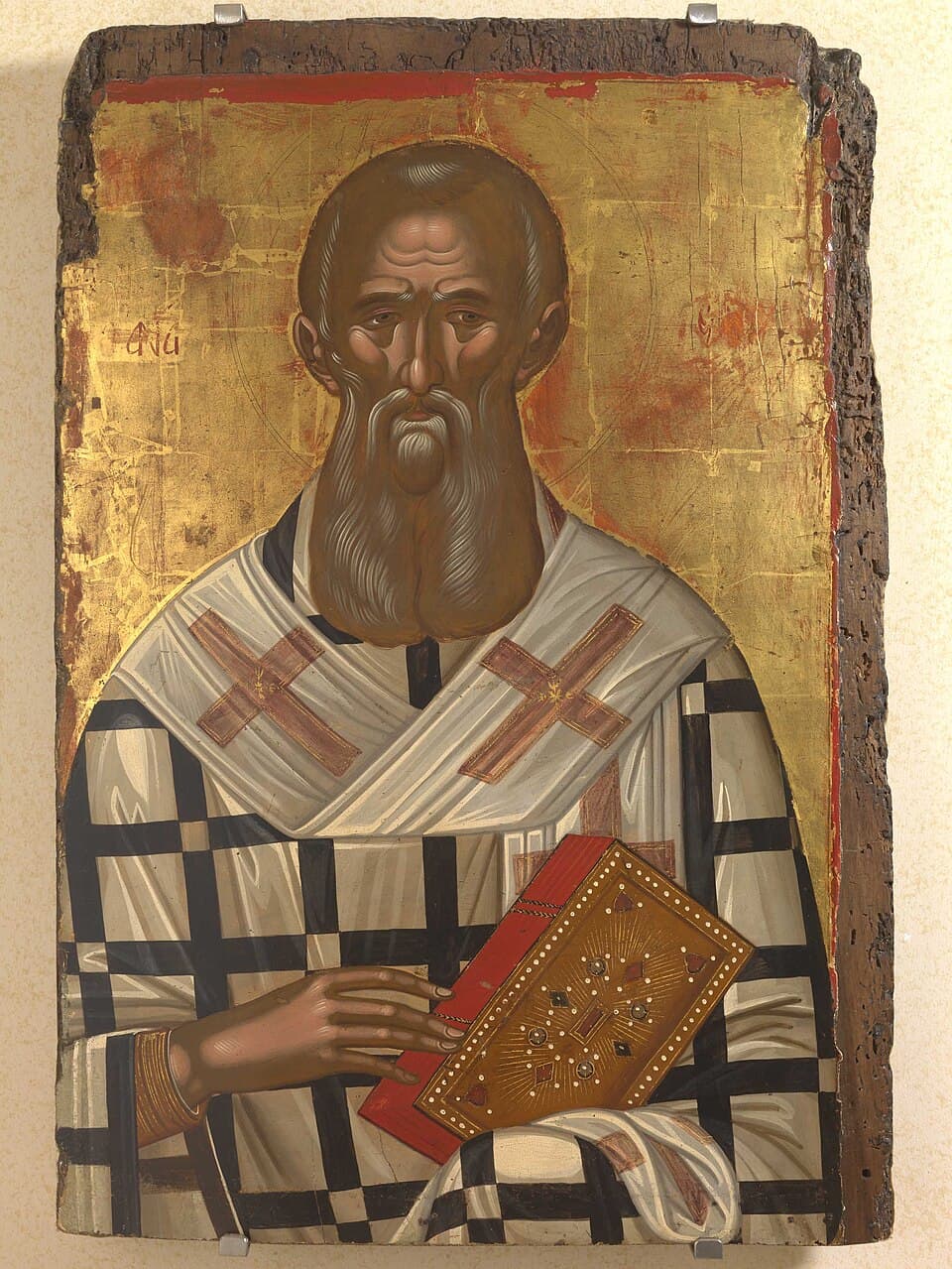
- Feast day
- May 2. Clifford says the Roman Calendar keeps him on the anniversary of his death; Benedict XVI gives that death as 2 May 373 12
- Born
- Alexandria. Clifford gives c. 296, "most probably between the years 296 and 298"; Benedict XVI says about the year 300 12
- Known as
- Father of Orthodoxy, a title Clifford says he earned in his own lifetime 1
- Bishop of Alexandria
- From 328, on the death of Bishop Alexander, whose secretary he had been 2
- Exiled
- At least five times between 336 and 366, spending seventeen years away from his city 2
- In art
- Clifford notes that no accepted emblem was ever assigned to him in western art 1
Saint Athanasius spent seventeen of his years as a bishop somewhere other than his diocese, thrown out of Alexandria at least five times in thirty years, and the position he refused to trade away is the one every Sunday congregation still recites. 2 The word at issue was homoousios, "of the same substance," and the argument was whether Jesus Christ is God or something impressive placed between God and us. 2 He died in his own bed, which given the preceding decades is the surprise. 1
What Arius actually proposed
It helps to be precise about the claim Athanasius spent his life against, because it was not obviously monstrous. Arius, a priest of Alexandria, held that the Logos was not true God but a created God. 2 Benedict XVI puts the consequence in one phrase: a creature "halfway" between God and man, who therefore "remained for ever inaccessible to us." 2 That is the pressure point. If the Son is a superior creature, then what came to meet us in the Incarnation is not God, and the distance is never actually crossed.
Athanasius was present at Nicaea in 325 as a deacon and secretary to his bishop, Alexander, when the council answered Arius with the creed. 2 The Greek term at the heart of it, homoousios - consubstantialis in Latin, "of the same substance" - asserts that the Son is God of God, of the Father's own substance. 2 Benedict notes that this is the text completed at Constantinople which is still said at Mass every Sunday, in the traditions of several Christian communions at once. 2
Benedict is also clear that Nicaea did not end anything. The erroneous ideas "shortly thereafter once again began to prevail," Arius himself was rehabilitated, and the positions were sustained for political reasons by the Emperor Constantine and afterward by his son Constantius II. 2 The reason Benedict gives for Constantine's interest is worth quoting because it explains the next forty years: the emperor "was not so much concerned with theological truth but rather with the unity of the Empire," and wished to politicize the faith to make it more widely acceptable. 2 The crisis believed settled at Nicaea ran on for decades.
The exiles
Athanasius succeeded Alexander as Bishop of Alexandria in 328 and showed at once that he would not compromise with the Arian theories the council had condemned. 2 Benedict does not flatter him about the manner: his intransigence was "tenacious and, if necessary, at times harsh," and it earned him the implacable hostility of the Arians and their sympathizers. 2 Between 336 and 366 he was driven out of his city at least five times and spent seventeen years in exile. 2
The exiles turned out to be productive in a way nobody intended. Benedict points out that during those forced absences the bishop was able to sustain and spread the Nicene faith in the West, first at Trier and then at Rome, and to carry with him the ideals of Egyptian monasticism. 2 A man repeatedly removed from his diocese to keep him quiet instead distributed his position across the empire.
Putting a clean chronology on any of this is harder than it looks, and Clifford says so rather than papering over it. He describes the sequence of Athanasius's career as "for the most part a hopelessly involved problem," and the same difficulty reaches back to the beginning of the life. 1 He settles on about 296 for the birth, most probably between 296 and 298, while recording that some assign 293 on the authority of a Coptic fragment, supported by how mature the early treatises "Contra Gentes" and "De Incarnatione" already are. 1 Benedict XVI says about the year 300. 2 Three or four years is not much, and the disagreement is a fair sample of how much of the fourth century arrives with its dates still loose.
Clifford notes how it ended, and the note lands because of everything before it. Reinstated for good, Athanasius was able to give himself to pacification and to reorganizing his communities, and he died "not by violence or in hiding, but peacefully in his own bed, surrounded by his clergy and mourned by the faithful of the see he had served so well." 1 Gregory of Nazianzus, a few years after, was already calling him "the pillar of the Church." 2
On the Incarnation, and the life of Anthony
His most famous doctrinal work is the treatise "De Incarnatione." 2 The sentence from it that everyone eventually meets is the one Benedict quotes: the Word of God "was made man so that we might be made God; and he manifested himself through a body so that we might receive the idea of the unseen Father; and he endured the insolence of men that we might inherit immortality." 2 Elsewhere in the same work he says the risen Lord banished death from us like "straw from the fire." 2
Benedict identifies the single idea underneath the whole fight, and it is not a technical one. The point of the theological battle was "precisely that God is accessible." 2 Not a secondary God; the true God; and it is through communion with Christ that we are actually united to God, who has really become God-with-us. 2 Everything Athanasius did to his own career follows from being unwilling to let that be traded for imperial calm.
He wrote other things worth knowing about. Four letters to his friend Serapion, Bishop of Thmuis, affirming the divinity of the Holy Spirit; around thirty Festal Letters sent out each year to the Churches and monasteries of Egypt with the date of Easter, and with a good deal more than that; meditations on the Psalms. 2 But the book that traveled furthest was the Life of Anthony, written shortly after the hermit's death while the exiled bishop was staying with monks in the Egyptian desert. 2 Benedict calls it "the bestseller of early Christian literature." 2
Athanasius and Anthony were close enough that the bishop received one of the two sheepskins Anthony left as his legacy, along with the mantle Athanasius had given him. 2 The Life was translated into Latin almost immediately and then into several Eastern languages, and it did much to spread monasticism in both halves of the Church. 2 Its most consequential reader was Augustine, who put the story of two imperial officials converted at Trier by reading it into the Confessions, as the preamble to his own conversion. 2
What is Saint Athanasius the patron saint of?
Neither source used here states a patronage for Saint Athanasius, and this profile does not supply one. 12 What they do give him is a title. Clifford says he "earned the characteristic title of 'Father of Orthodoxy,' by which he has been distinguished ever since," and calls him the greatest champion of Catholic belief about the Incarnation the Church has ever known. 1 Benedict places him among the four great Doctors of the Eastern Church, noting that Bernini set his statue with Ambrose, John Chrysostom and Augustine around the Chair of Saint Peter in the apse of the Vatican Basilica. 2
Saint Athanasius's feast day
The feast of Saint Athanasius is May 2. 12 The two sources arrive at the date by different routes, which is a useful check. Clifford states that his feast in the Roman Calendar is kept on the anniversary of his death; Benedict XVI gives the death as 2 May 373 and calls it "the day when we celebrate his liturgical Memorial." 12
Praying with Saint Athanasius
Most of what is admirable about Athanasius looks, from close up, like being difficult. He would not sign, he would not soften the word, and he would not accept an arrangement that kept the peace by leaving the question open. Benedict does not pretend this was gentle, and uses the word harsh. 2 It is a reminder that the saints are not uniformly pleasant to work with, and that the Church has canonized the outcome rather than the temperament.
The thing he would not give up was not an abstraction, though it was written in a technical word. Benedict states the stake plainly: whether God is genuinely accessible, or whether what reaches us is a creature standing in for him. 2 Five expulsions and seventeen years away from home are a strange price to pay for a syllable, and they are the price of that sentence, not of the syllable.
The friendship with Anthony is the part that softens the picture. The most combative bishop of the fourth century spent his exiles among desert monks, took one of the two sheepskins the old hermit had to leave, and wrote the book that made Anthony famous. 2 Athanasius himself saw what the example could do, and wrote at the end of it that Anthony was renowned "not from writings, nor from worldly wisdom, nor through any art, but solely from his piety towards God." 2
Benedict closes his own catechesis by drawing the two together: the life of Athanasius, like Anthony's and countless others', shows that "those who draw near to God do not withdraw from men, but rather become truly close to them." 2 That is the answer to the suspicion that a man this preoccupied with doctrine must have been remote from people. The record says the opposite, and the record includes how he died - at home, in bed, with his clergy in the room. 1
Saint Athanasius of Alexandria, pray for us.
Sources
Saints to turn to next
Others in this collection who are turned to for some of the same things.