Saint Bruno of Segni
c. 1048 - July 18, 1123
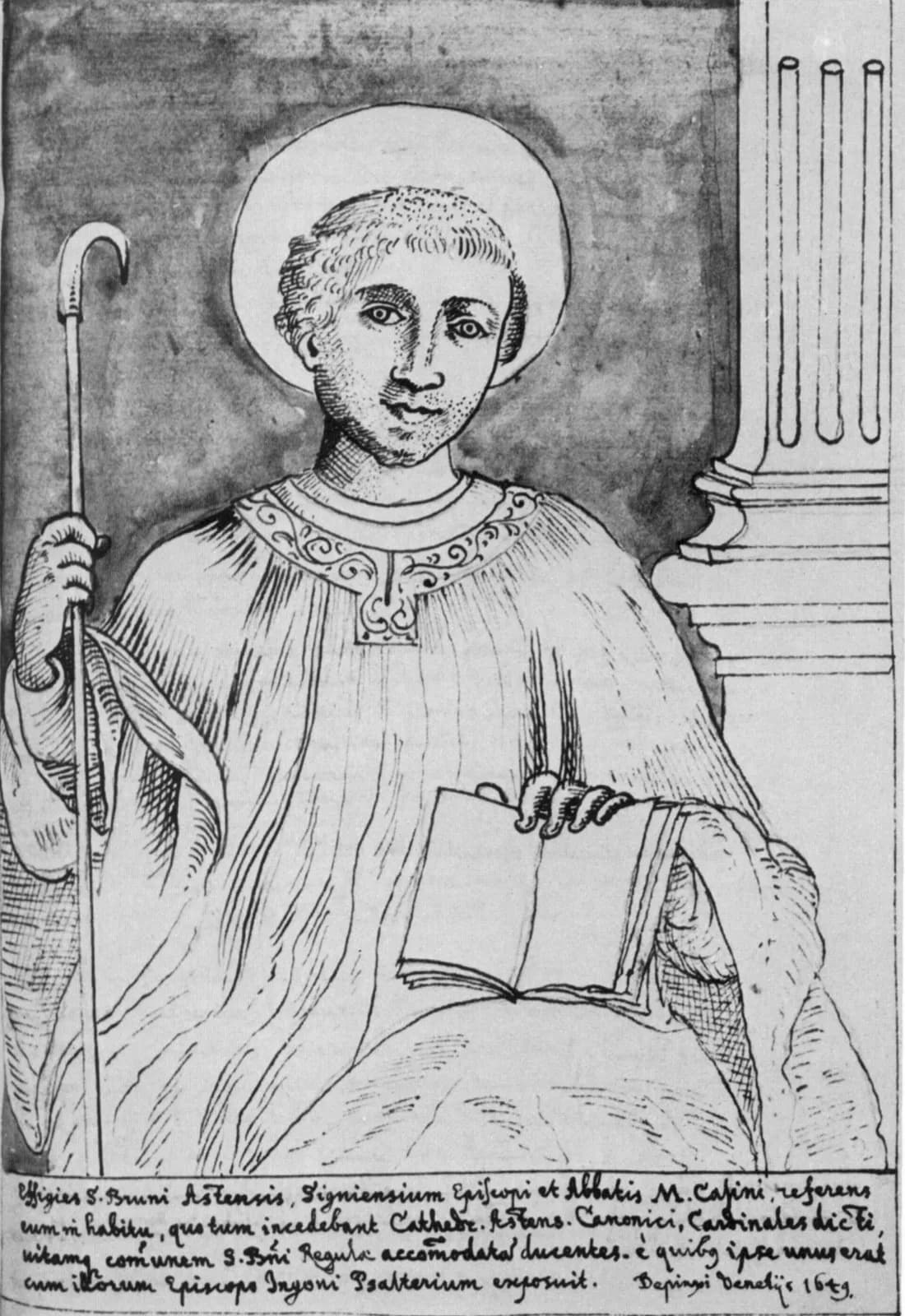
Saint Bruno of Segni was an Italian bishop who advised four popes, refused to be a cardinal, and once wrote to a pope that he had given away too much to an emperor and must take it back. He was also one of the leading Scripture commentators of his time, the author of commentaries on the Pentateuch, Job, the Psalms, the Gospels and the Apocalypse. 12 The Roman Martyrology remembers him as a bishop who "molto lavorò e soffrì," worked and suffered much, for the renewal of the Church. 3
From Solero to Siena
Bruno was born at Solero in Piedmont, near Asti. The 1908 Catholic Encyclopedia puts his birth about 1048; the Norwegian bishops' saints database says 1049, and that he belonged to the old noble family who were lords of Solero. 12 He is sometimes called Bruno of Asti after his birthplace. 2
He was schooled by Benedictines, in his native town according to the encyclopedia, at the monastery of Saint Perpetuus in Asti according to katolsk.no, and then studied at Bologna. 12 The encyclopedia says that after his ordination he was made a canon of Siena. 1 katolsk.no tells it at more length: he was first a canon of Asti, felt more and more drawn to the monastic life, and set out for Monte Cassino, but on the way he stopped at Siena, where Bishop Rodolfo kept him and made him a canon of the cathedral. 2
Berengar and a bishopric
Siena sent him to Rome, and there his learning was noticed. 12 At a synod held in Rome in 1079 he obliged Berengar of Tours, who denied the real presence of Christ in the Eucharist, to retract. 1 katolsk.no describes him defending the Church's teaching on the change of bread and wine into the body and blood of Christ with prudence and much-admired eloquence. 2
Pope Gregory VII, whose personal friend he became, consecrated him Bishop of Segni, in the Roman Campagna, in 1080. 12 The encyclopedia's article on the diocese lists him under 1079. 4 Out of humility he declined to become a cardinal. 12 katolsk.no adds that he served as librarian of the Holy See. 2
Adviser to four popes
His advice, the encyclopedia says, "was sought by four successive popes." 1 katolsk.no names them: Gregory VII, Victor III, Urban II and Paschal II. 2 He went with Urban II to the Council of Clermont in 1095, the council at which the First Crusade was launched. 12
He was, above all, a man of the reform. The encyclopedia says he is called "the brilliant defender of the church" because of the courage with which he supported Gregory VII and the popes after him in their efforts at reform, and especially because he denounced lay investiture, which "he even declared to be heretical." 1 The struggle reached him personally. katolsk.no says he drew the anger of a Count Ainulf, a supporter of Emperor Henry IV, who held him prisoner for three months. 2
Monte Cassino
He never lost the pull toward the cloister that had first sent him on the road to Monte Cassino. In 1102 he became a monk there, and in 1107 he was elected abbot. 12 The sources tell the step differently. The encyclopedia says he became abbot "without, however, resigning his episcopal charge." 1 katolsk.no says that, still harassed by Ainulf, he did resign his see when he entered the monastery, but withdrew the resignation because of the reaction of the people of Segni, and stayed at Monte Cassino all the same. 2 katolsk.no also says he was papal legate to France in 1106 and to Sicily in 1110. 2
Rebuking a pope
The crisis of his life came under Paschal II. The emperor Henry V, the encyclopedia says, had extorted a treaty from the pope while holding him prisoner, the agreement known as the "Privilegium," which in part conceded the imperial claim to invest bishops and abbots with ring and crosier. 1 With many bishops of Italy and France, Bruno rejected it. He wrote to the pope, "very frankly censured him," and demanded that the treaty be annulled. 1
Paschal was irritated, and ordered Bruno to give up his abbey and go back to his diocese. 1 The Martyrology puts it plainly: he was forced to leave his see, found refuge at Monte Cassino, and was for a time its abbot. 3 katolsk.no dates his return to Segni to 1116 and says he obeyed his pope at once. 2 For the rest of his life, the encyclopedia says, he worked with untiring zeal for his own people and for the Church at large. 1
The commentator
Bruno wrote a great deal, most of it on Scripture. The encyclopedia names his commentaries on the Pentateuch, Job, the Psalms, the four Gospels and the Apocalypse. 1 Benigni, in the Segni article, calls his commentary on Scripture "excellent." 4 katolsk.no adds a life of Pope Leo IX, a life of Bishop Peter of Anagni, three liturgical works, and treatises on the sacraments and on the sacrifice of the Mass, and counts him among the foremost Bible commentators of his day. 2
katolsk.no is also frank about a fault. In his theology, it says, he held to the mistaken view that sacraments conferred by bishops or priests guilty of simony were invalid. 2 The database does not soften it. He kept writing at Segni until the end. 2
Death and canonization
What is Saint Bruno of Segni the patron saint of?
Saint Bruno of Segni is the patron saint of the town of Segni, according to katolsk.no. 2 No source consulted here gives him any other patronage.
Saint Bruno of Segni's feast day
Praying with Saint Bruno of Segni
Bruno spent his life between two pulls. One was the monastery, which he set out for as a young canon and finally reached in middle age. 2 The other was the Church's public business, which kept calling him back: to a synod, to a council, to a diocese that would not let him resign. 12
His loyalty to the popes was real, and it was not silent. He served four of them, and when the fourth gave ground he believed could not be given, he said so in writing and asked him to undo it. 1 Then, ordered to leave the abbey he loved, he went. 12 The sources do not present the obedience and the rebuke as a contradiction.
Most of what he left behind is commentary on Scripture, written by a man who was also running a diocese and, for years, an abbey. 12 katolsk.no does not hide that he got one question of sacramental theology wrong. 2 He was canonized anyway, as a bishop who worked and suffered much for the renewal of the Church. 13
Saint Bruno of Segni, pray for us.
Sources
- 1.Jodoc Adolphe Birkhaeuser, "St. Bruno (1048-1123)," The Catholic Encyclopedia, Vol. 3 (New York: Robert Appleton Company, 1908).
- 2."Den hellige Bruno av Segni (1049-1123)," Den katolske kirke (katolsk.no), Catholic Diocese of Oslo (in Norwegian).
- 3.Roman Martyrology, entry for July 18, "San Bruno di Segni, vescovo," as printed in "Santo del giorno," Conferenza Episcopale Italiana (in Italian).
- 4.Umberto Benigni, "Segni," The Catholic Encyclopedia, Vol. 13 (New York: Robert Appleton Company, 1912).
Saints to turn to next
Others in this collection who are turned to for some of the same things.