Saint Nino of Georgia
Died c. 330 or 340
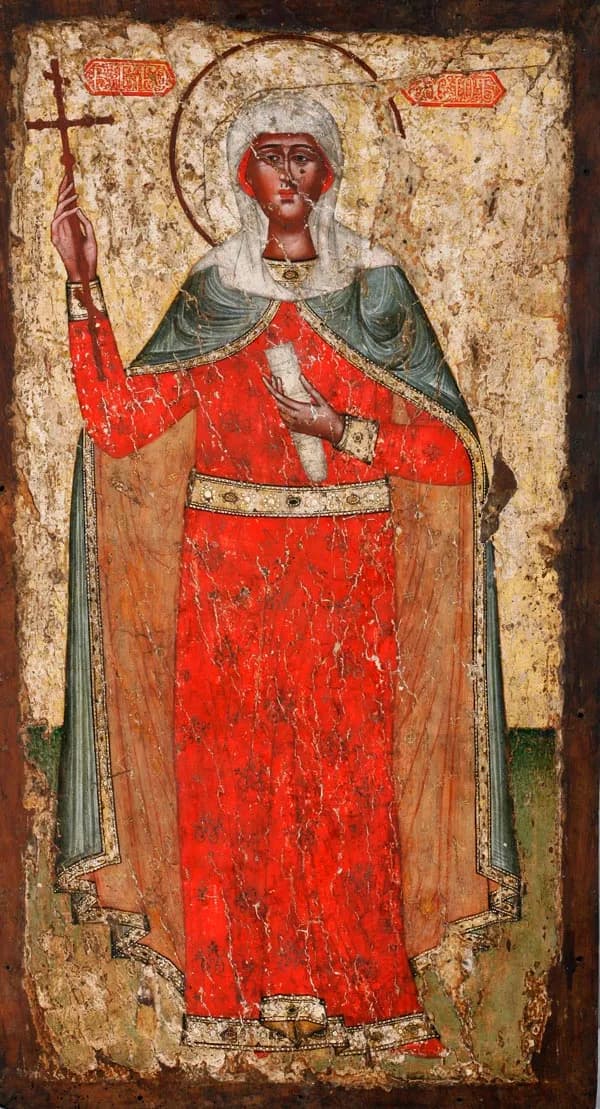
- Also called
- Nina; Christiana in the older Roman Martyrology 4
- Origin
- Colastri in Cappadocia, by one tradition; others say Georgia, Asia Minor, Rome, Jerusalem or Gaul 4
- Converted
- The king and queen of Iberia, and through them the nation, according to the Greek historians 123
- Died
- About 330 or 340 at Bodbe in Kakheti, says katolsk.no, which notes another reckoning of 325 to 361 4
Saint Nino was a Christian woman carried off as a captive to Iberia, the kingdom in the Caucasus that is now Georgia, in the reign of Constantine. 123 Her prayer for a sick child and then for the sick queen led the king, the queen and in time the whole people to ask for baptism. 125 The historians who first told her story never learned her name; the Georgians call her Nino, and the old Roman Martyrology called her simply Christiana. 4
A captive in Iberia
The earliest written account is by Rufinus, who heard it from Bacurius, a prince of the Iberians who had gone over to the Romans and commanded troops in Palestine. 1 katolsk.no dates the meeting to about 395 and Rufinus's history to about 403, and says that Bacurius was describing what had happened in his own grandparents' time. 4 Socrates, Sozomen and Theodoret all retold the story in the fifth century, and their versions are the ones read here. 123 katolsk.no judges that the story was embroidered over time but is regarded as authentic in its main lines. 4
Where she came from is uncertain. katolsk.no gives Colastri in Cappadocia, and lists traditions that make her a native of Georgia, Asia Minor, Rome, Jerusalem or Gaul, one of them a niece of a patriarch of Jerusalem. 4 Socrates says only that she was "a certain woman leading a devout and chaste life" who was taken captive by the Iberians. 1 Sozomen places the Iberians "to the north beyond Armenia" and calls them a large and warlike nation. 2
Her life in captivity drew attention. Sozomen writes that "to fast, to pray night and day, and to praise God, constituted her delight," and that when people asked why, she answered that this was how the Son of God was to be worshiped. 2 Theodoret says she slept on nothing softer than a sack spread on the ground and "accounted fasting her highest luxury." 3 katolsk.no adds that the women who questioned her about her faith called her Christiana, the Christian woman, and that the name gathered up everything they admired in her. 4
The child, the queen and the king
The Iberians had a custom: a sick child was carried from house to house, in case someone knew a cure. 23 The historians differ over whose child was brought to her. Socrates says it was the king's infant son; Sozomen and Theodoret say a mother brought her own child. 123 The present Martyrology speaks of the queen's son. 5 Socrates says she laid the child on her bed of horsecloth and said, "Christ, who healed many, will heal this child also." 1 Sozomen has her tell the mother that she knew nothing of medicine but believed Christ would save the child. 2 The child recovered. 123
Word reached the queen, who was herself gravely ill. Socrates says the captive, being "a person of modest and retiring manners," would not go to the palace, and the queen was carried to her instead; Theodoret says the queen "herself ran to the captive." 13 The queen was healed. 123 Offered gifts, the captive refused them. Socrates reports her answer that the cure was "not mine, but Christ's," and that the greatest gift the king could give her was to acknowledge the God she worshiped. 1 Theodoret lists what she turned down: gold, silver, tunics and mantles. 3
The king hesitated. Sozomen says he respected the religion of his fathers. 2 Then, out hunting, he was caught in a sudden darkness in the forest and could not find his way. 123 When his own gods did nothing, he called on the God of the captive, and the darkness lifted. 123 He sent for her and asked to be taught. 12 Sozomen says she gave him "as much instruction as it was right for a woman to say and do," and katolsk.no adds that there was as yet no priest in the land to baptize anyone. 24 katolsk.no gives the king's name as Mirian and the queen's as Nana; the Greek historians name neither. 4
The church and the bishop
The king called his people together and told them what had happened. 12 Socrates says that both king and queen became preachers of Christ, "the one addressing their male, and the other their female subjects." 1 Sozomen puts it that the men were persuaded by the king, and the women "by those of the queen and the captive." 2
The king had a church built on the plan the captive described. 13 Socrates and Sozomen tell of a column that the builders could not raise with ropes or machines; she spent the night alone in prayer at the site, and in the morning the column stood suspended above its base and then settled into place. 12 Theodoret does not tell the story of the column and says instead that God, who had given Bezaleel his skill, enabled her to devise the plan of the church. 3
At her urging an embassy went to Constantine, asking for an alliance and for priests. 123 Theodoret says the emperor chose a bishop "endowed with great faith, wisdom, and virtue" and sent him with gifts. 3 katolsk.no dates the baptism of the people to 322 and records the tradition that Constantine was more pleased by the news than by the gain of new lands. 4
Bodbe, and the name she was given
The Greek historians end with the conversion. 123 katolsk.no says that she afterward lived as a hermit at the foot of a mountain at Bodbe in Kakheti, and died and was buried there about 330, or perhaps 340. 4 A church was built over the grave and later became a bishop's seat. 4 The Georgian Church still speaks of her as its holy and blessed mother, the apostle Nino who enlightened all Georgia, and in Egypt she is sometimes known as Theognosta. 4 An Armenian writer known as pseudo-Moses of Khorene made her the one survivor of the community of the martyr Rhipsime, a link katolsk.no reports as legend. 4
What is Saint Nino the patron saint of?
None of the sources consulted names a patronage for Saint Nino. katolsk.no notes that some sources call her patron of Cebu in the Philippines, and explains that as a confusion with the Santo Niño, the Christ Child. 4 What the Georgian Church gives her is a title rather than a patronage: the enlightener of the whole country. 4
Saint Nino's feast day
Saint Nino's feast day is January 14. 45 The current Roman Martyrology enters her on that day as a Christian captive in Georgia whose holy life won the queen, the king and all their people to the faith. 5 That date is new to the Roman calendar. katolsk.no explains that Cardinal Baronius put her into the Martyrology in the late sixteenth century, without knowing her Georgian name, as "S. Christiana ancella" under December 15, and that the 2001 revision moved her to January 14 under the name Nino. 4 Georgia keeps her on January 14; the Greek Church remembers her on October 27 and the Armenians on October 29. 4
Praying with Saint Nino
She had no office, no ordination and no freedom. The historians present her as a woman far from home, under the control of strangers, who kept praying and fasting as she always had. 123 That alone was what made people curious. 24
When she was asked for help she gave the credit away each time. The cure was Christ's, not hers, and the reward she wanted was not for herself. 13 Sozomen describes her teaching the king only as far as she judged it right to go, and then the whole thing passed into the hands of a bishop sent from Constantinople. 23
Her own name did not survive in the first accounts. 4 What survived was a description: the captive, the Christian. 14 A nation's faith is traced back to her prayer at a child's bedside and a night spent alone at a building site. 12
Saint Nino of Georgia, pray for us.
Sources
- 1.Socrates Scholasticus, Church History, Book I, ch. 20, "In what Manner the Iberians were converted to Christianity," trans. A. C. Zenos, Nicene and Post-Nicene Fathers, Second Series, Vol. 2 (1890).
- 2.Sozomen, Church History, Book II, ch. 7, "How the Iberians received the Faith of Christ," trans. Chester D. Hartranft, Nicene and Post-Nicene Fathers, Second Series, Vol. 2 (1890).
- 3.Theodoret, Ecclesiastical History, Book I, ch. 23, "Conversion of the Iberians," trans. Blomfield Jackson, Nicene and Post-Nicene Fathers, Second Series, Vol. 3 (1892).
- 4."Den hellige Nino av Georgia ( -~330)," Den katolske kirke (katolsk.no), Catholic Diocese of Oslo (in Norwegian).
- 5.Roman Martyrology, entry for January 14, "Santa Nino," as printed in "Santo del giorno," Conferenza Episcopale Italiana (in Italian).
Saints to turn to next
Others in this collection who are turned to for some of the same things.