Saint Nicephorus of Constantinople
c. 758 - June 2, 828 or 829
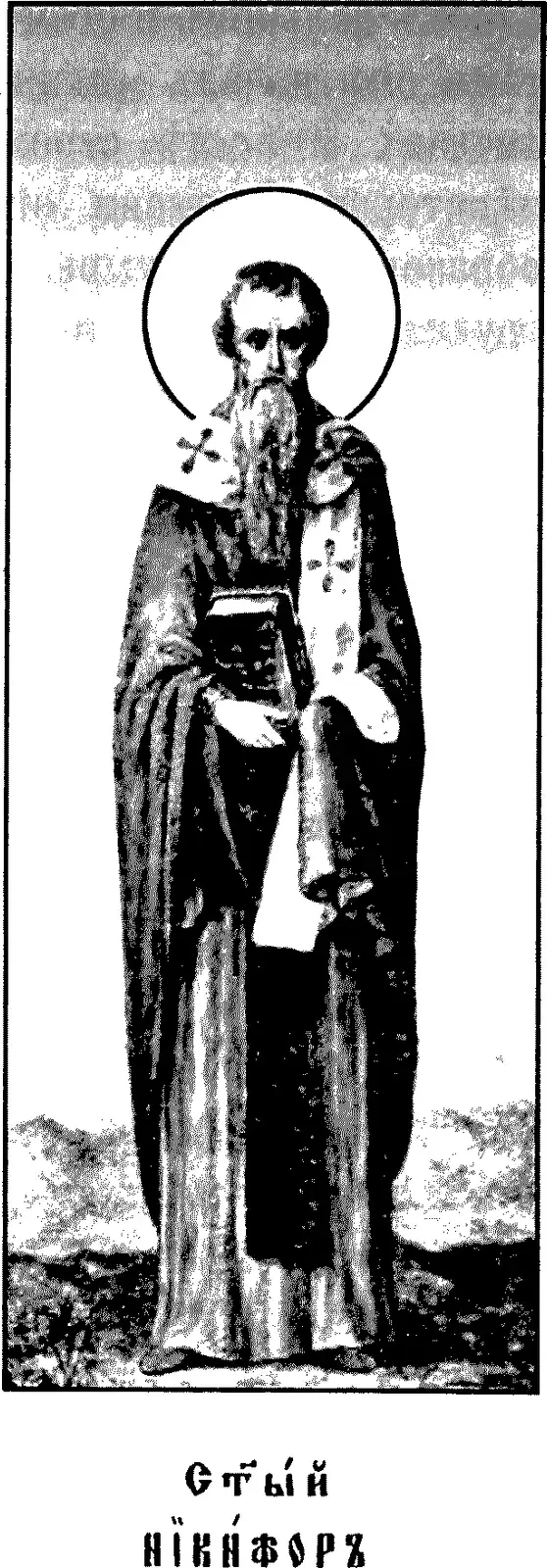
- Patriarch
- Of Constantinople, 806 to 815, consecrated on Easter Sunday, April 12, 806 1
Saint Nicephorus was an imperial secretary who was chosen patriarch of Constantinople in 806 while still a layman, and who was deposed and exiled in 815 for refusing to let the emperor Leo V the Armenian revive the war on holy images. 14 He spent the rest of his life in a monastery he had built on the Bosporus, writing in their defense, and died there on June 2, the day the Church now keeps as his feast. 14
A family that had already paid
He was born about 758 into a well-known family of Constantinople. 1 His father Theodore was secretary to the emperor Constantine V Copronymus, and when the emperor turned on the images, Theodore would not go with him. Butler says he "was stripped of his honors, scourged, tortured, and banished." 2 His mother Eudoxia, Kirsch writes, was "a strict adherent of the Church." 1
The son went to court young and became an imperial secretary himself. 12 When the Empress Irene restored the images, he was one of three high officials who represented her at the Second Council of Nicaea in 787, the Seventh Ecumenical Council, which defined the Church's teaching on their veneration. 1 Butler calls him the council's secretary. 2
Soon afterward he left the court for a monastery he had founded on the Thracian side of the Bosporus, and gave himself to prayer and to study: grammar, mathematics, philosophy and the Scriptures. 1 He was later called back to the capital and put in charge of its great hospital, which santiebeati describes as a house for the poor. 13
A layman made patriarch
The patriarch Tarasius died on February 25, 806. The clergy and the court could not agree on a successor, and the emperor Nicephorus I chose the hospital's director, with the assent of the bishops. "Although still a layman," Kirsch writes, "he was known by all to be very religious and highly educated." 1 He was ordained and consecrated on Easter Sunday, April 12, 806. 1
Butler, who drew on the contemporary life by Ignatius the Deacon, adds a detail. Throughout his consecration Nicephorus held in his hand a treatise he had written in defense of the images, and afterward he laid it behind the altar, "as a pledge that he would always maintain the tradition of the church." 2
Not everyone welcomed him. A layman raised straight to the patriarchate offended the strict party among the monks, led by the abbots Plato of Saccudium and Theodore of Studium; the emperor had Plato imprisoned for twenty-four days. 1 Then the emperor asked the new patriarch to pardon the priest Joseph, who had blessed Constantine VI's unlawful second marriage while his wife was still living. Nicephorus did it, with a small synod, "in order to avert more serious evil," Kirsch says. 1 Theodore and his monks broke communion with him, and in 809 another synod condemned them and sent them into exile. 1
Two emperors crowned
The emperor Nicephorus I was killed fighting the Bulgarians in July 811. His successor, Michael I Rhangabe, promised in writing to defend the faith and was crowned by the patriarch on October 2. 1 Michael reconciled the two men who should have been allies. The patriarch deposed the priest Joseph again and withdrew his decrees against the monks, and Theodore and Plato acknowledged him as the lawful head of their Church. 1 Nicephorus now sent Pope Leo III the customary letter announcing his election, which the troubles had delayed, with a profession of faith. 12
After another defeat by the Bulgarians, Michael abdicated in 813, and the general Leo the Armenian took the throne on July 11. 1 Before the coronation Nicephorus asked him for a written confession of faith. Leo put it off. The patriarch crowned him anyway, and Leo put it off again. 1
"We cannot change the ancient traditions"
Once the frontier was quiet, Leo's sympathies came out. He drew iconoclast bishops around him and, Butler says, first tried persuasion on the patriarch. The answer he got was this: "We cannot change the ancient traditions: we respect holy images as we do the cross and the book of the gospels." 2 Butler tells how the emperor had soldiers insult an image of Christ on the great cross over the Bronze Gate, and then had it taken down to spare it further insult. 2
In December 814 the two men talked at length and agreed on nothing. 1 Nicephorus excommunicated a bishop who had gone over to the emperor, and spent a whole night in prayer in Hagia Sophia with his clergy and a large crowd of the people. 1 Summoned to the palace, he went with bishops and abbots, Theodore of Studium among them. 12 Butler gives their answers to the emperor. Euthymius of Sardis: "For these eight hundred years past, since the coming of Christ, there have been always pictures of him, and he has been honored in them." Theodore: "You he hath intrusted with the care of the state; but leave the church to its pastors." 2
Leo forbade the patriarch to celebrate in public. Nicephorus fell ill. When he recovered, a synod of bishops friendly to the emperor summoned him to answer for himself, and he would not come. 1 Butler has his reply: "Who gave you this authority? was it the pope, or any of the patriarchs? In my diocese you have no jurisdiction." 2 The synod declared him deposed. Crowds of iconoclasts surrounded his house, shouting threats, and soldiers kept him from every official act. 1 He wrote to the emperor that he found it necessary to give up the see, and in March 815 he was arrested at midnight and taken to the monastery of Saint Theodore, which he had built on the Bosporus. 1 Butler adds that there had already been several secret attempts on his life. 2
Fourteen years on the Bosporus
Leo gave the see to Theodotus, a married layman who favored the iconoclasts, consecrated on April 1, 815. 1 Nicephorus went on writing: a shorter apology for the Church written in 813 or 814, a longer one in two parts against those who accused Christians of idolatry, and three refutations, the Antirrhetici, of a treatise against the images by Constantine Copronymus, to which he added seventy-five passages from the Fathers. 1 He also left two short histories, the Breviarium and a Chronography. 12
Leo was murdered on Christmas Day, 820. The new emperor, Michael II, stopped the persecution but would not restore the images, and offered to let the old patriarch come home if he would keep quiet. Nicephorus would not promise, and stayed where he was. 13 The older Roman Martyrology calls those years in exile "a long martyrdom of fourteen years." 5
He died at the monastery on June 2, about seventy years old, by Butler's reckoning in the fourteenth year of his banishment. 12 Kirsch gives the year as 829; Butler and santiebeati give 828. 123 Kirsch writes that at the end of his life he was revered, and after his death was regarded as a saint. 1
His body was later brought back to Constantinople and laid in the Church of the Apostles on March 13. The sources disagree on the year: Butler says 848, by order of the Empress Theodora; santiebeati says 846, also by Theodora; Kirsch says 874, by the patriarch Methodius. 123
What is Saint Nicephorus the patron saint of?
Saint Nicephorus's feast day
Saint Nicephorus's feast day is June 2. The current Roman Martyrology, as the Italian bishops print it, enters him on that day, the day of his death, as a bishop of Constantinople and a firm defender of the traditions of his fathers, who opposed the emperor Leo the Armenian over the veneration of sacred images, was driven from his see, and died peacefully after a long confinement in a monastery. 4 santiebeati says that both the Catholic Church and the Orthodox Churches keep him on June 2. 3
The older Roman date was March 13, the day his relics were brought back to Constantinople. Butler places him there and says it is the day "on which he is commemorated in the Roman Martyrology"; Kirsch gives March 13 for both the Greek and Roman Churches, with the Greeks also observing June 2; and the 1897 English edition of the Martyrology enters him on March 13. 125
Praying with Saint Nicephorus
His life was not one long stand. He made concessions: he pardoned the priest Joseph to keep the peace with one emperor, and he crowned another who had refused to state his faith. 1 The concession over Joseph cost him years of division with Theodore of Studium, the man who would stand beside him at the end. 1
On the images he would not give way, and the reason he gave was not his own opinion but what he had received. "We cannot change the ancient traditions." 2 He had seen what that cost before he was born: his father was flogged and exiled for the same images. 2
His exile, as the sources tell it, was quiet. He was shut away for fourteen years and offered his freedom on condition of silence, and he declined it. 1 Most of what he wrote in defense of the faith he wrote there. 1
The treatise he laid behind the altar on the day of his consecration was a promise. 2 He kept it in the palace, before the synod that deposed him, and in the monastery where he died. 12
Saint Nicephorus of Constantinople, pray for us.
Sources
- 1.J. P. Kirsch, "St. Nicephorus," The Catholic Encyclopedia, Vol. 11 (New York: Robert Appleton Company, 1911).
- 2.Alban Butler, "St. Nicephorus, C., Patriarch of Constantinople," March 13, in The Lives of the Fathers, Martyrs, and Other Principal Saints, Vol. I (New York, 1895), Project Gutenberg eBook #20450.
- 3.Ruggiero Lattanzio, "San Niceforo, patriarca di Costantinopoli," with the Roman Martyrology entry, Santi e Beati, santiebeati.it (in Italian).
- 4.Roman Martyrology, entry for June 2, "San Niceforo, vescovo," Santo del giorno, Conferenza Episcopale Italiana (in Italian).
- 5.The Roman Martyrology, March 13 (Baltimore: John Murphy Company, 1897), Internet Archive.
Saints to turn to next
Others in this collection who are turned to for some of the same things.