Saint Amphilochius of Iconium
c. 340 - c. 400
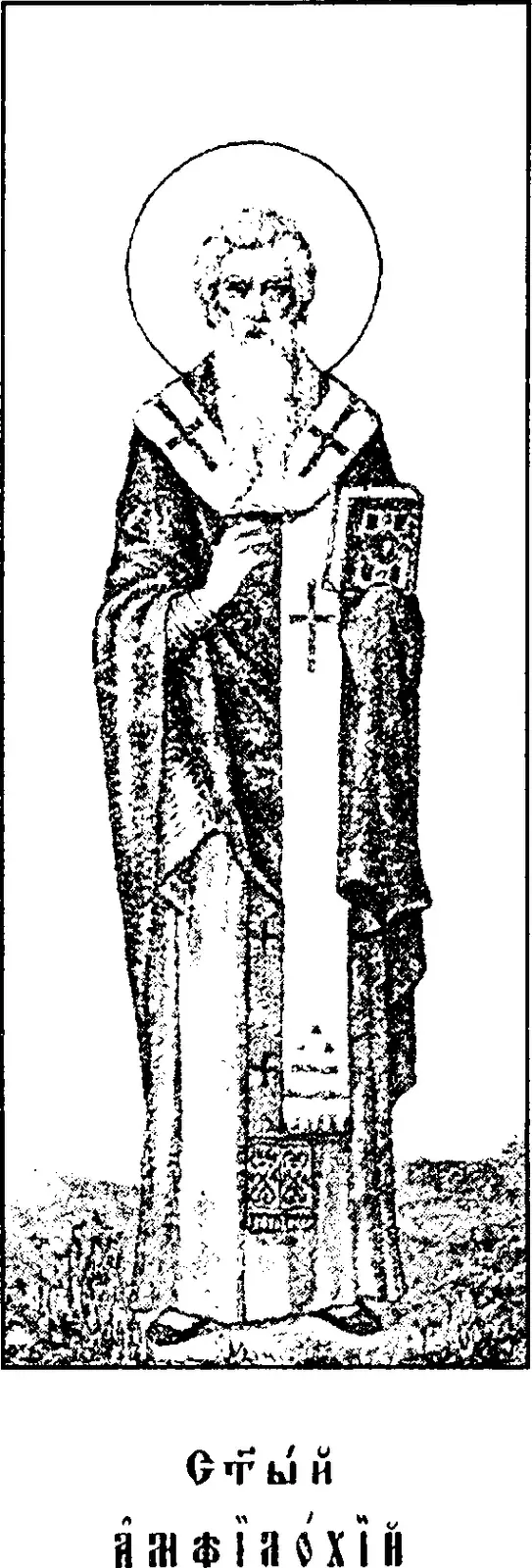
Saint Amphilochius was a lawyer from Cappadocia who gave up the courts to care for his aging father, and was made bishop of Iconium in 374 against his will. 12 Basil the Great wrote his treatise On the Holy Spirit for him, and Gregory of Nazianzus, probably his cousin, called him a herald of the truth. 125 His feast is November 23. 8
A lawyer from Cappadocia
He came of a distinguished Christian family in Cappadocia. The Catholic Encyclopedia suggests he was born at Caesarea about 339 or 340; the Norwegian bishops' database gives 339, and santiebeati puts it between 340 and 345. 267 His father was an eminent lawyer and his mother, Livia, was remembered for her gentleness and wisdom. 2
He was probably a first cousin of Gregory of Nazianzus, the encyclopedia says, and both the Norwegian and Italian accounts call him Gregory's cousin outright. 267 Butler, writing in the eighteenth century, says only that he was an intimate friend of Basil and Gregory, "though much younger than they were." 1
What he did as a young man is told in three ways. Butler says he studied oratory and law, pleaded at the bar with a great reputation for honesty, and served as a judge. 1 The encyclopedia says he studied for the bar and practiced at Constantinople. 2 The Norwegian and Italian accounts say he taught rhetoric there and left the capital after running into money trouble. 67
Bread for vegetables
Before 373 he left public life. 1 He settled near Nazianzus, close to his friend, 26 and his elderly father followed him there. 1 Butler names the place Ozizala, a district "so barren that no corn grew in all that country." 1 Gregory sent him grain, and Amphilochius paid him back in fruit and vegetables from a garden he worked himself. 16
Butler stresses the care he gave his father, who was old and infirm. 1 It was one of two reasons, Butler says, that he did not follow Basil to Caesarea when Basil became its archbishop. The other was a fear that Basil would draw him into the ministry, and so he avoided his friend whenever he could. 1 The encyclopedia suggests he did spend some time in the "City of the Poor," the charitable settlement Basil built at Caesarea. 2
Bishop of Iconium
In 374 he became bishop of Iconium, the chief city of Lycaonia. 12 Butler tells it as an ambush: passing through the region at a moment when the church had no pastor, he was elected by the clergy and people "with one voice," and found no way to escape. 1 The encyclopedia says he was probably placed there by Basil, and the Norwegian and Italian accounts think Basil may well have been behind it. 267
Basil's letter to him on his consecration survives. "Though you were trying to flee, as you confess, not from me, but from the calling you expected through me, He has netted you in the sure meshes of grace," Basil wrote, "and has brought you into the midst of Pisidia to catch men for the Lord." 4 He told the new bishop not to lament a burden beyond his strength, since the Lord would share it, and to lead rather than follow: "Christ has sent you not to follow others, but yourself to take the lead of all who are being saved." 4
His father took it badly. Losing the son who cared for him, he complained to Gregory of Nazianzus as though Gregory had arranged it. 1 Gregory answered that he had had no part in it, and that he would miss Amphilochius's company too. 67 Butler adds that the new bishop was some time in being comforted. 1
Basil's friend and correspondent
Soon after his consecration he visited Basil at Caesarea and preached there, and the people liked his sermons better than any visitor's. 1 He consulted Basil often on doctrine and discipline, and Butler notes that Basil answered "with extraordinary modesty," as though he were the one learning. 1 When Basil was dangerously ill, he asked Amphilochius to look after the church of Caesarea if he died. 1
Basil dedicated On the Holy Spirit to him. The treatise opens with praise for his questions: "Your desire for information, my right well-beloved and most deeply respected brother Amphilochius, I highly commend, and not less your industrious energy." 5 Basil goes on to say that he admired him for asking "with the honest desire to arrive at the actual truth," and not to set a trap. 5
For the divinity of the Holy Spirit
In 376 he held a council at Iconium against the Macedonians, who denied that the Holy Spirit is God, and in 381 he sat at the Council of Constantinople, which condemned them. 167 The encyclopedia names this as his place in the history of theology: he defended the divinity of the Holy Spirit and wrote his own book on it, now lost, which he read aloud to Saint Jerome when the two met at Constantinople. 2
Jerome thought highly of the whole circle. Of Basil, Gregory and Amphilochius he wrote that they so filled their books with the lessons of the philosophers "that you cannot tell which you ought to admire most in them, their secular erudition or their scriptural knowledge." 2 Butler adds that a law of Theodosius in 381 named him among the bishops whose communion marked a Catholic in the East. 1
The emperor's son
The story most often told of him comes from Theodoret's Church History. Amphilochius asked the emperor Theodosius to forbid the Arians to hold their assemblies, and the emperor refused, thinking it too severe. 3 Amphilochius said nothing, but the next time he came to the palace he greeted Theodosius as usual and paid no honor at all to his son Arcadius, who had lately been made emperor and stood beside his father. 3
Theodosius told him to greet the boy. "Sir, said he, the honour which I have paid you is enough." 3 The emperor grew angry, and then the bishop made his point: "You see, sir, that you do not brook dishonour done your son, and are bitterly angry with those who are rude to him. Believe then that the God of all the world abominates them that blaspheme the Only begotten Son." 3 Theodoret says the emperor understood, admired both the act and the words, and issued an edict against the heretics' meetings. 3
Against the Messalians
He was as firm against the Messalians, a movement that taught that prayer alone was the whole of religion. 16 Butler describes them as rejecting the sacraments and even fasting, living in the fields and praying without interruption. 1 Amphilochius presided at the council of Side in Pamphylia that condemned them, which katolsk.no and santiebeati date to 394, and he wrote against them. 167
Little of what he wrote survives. The encyclopedia counts one genuine work, the "Synodical Epistle" against the Macedonians, written in the name of the bishops of Lycaonia. 2 It calls the "Iambics to Seleucus," an early list of the books of Scripture, spurious. 2 Butler thought the poem had the style of Gregory of Nazianzus, who perhaps wrote it for him, while katolsk.no lists 333 verses on the Christian life among his works. 16
Old age and death
Gregory of Nazianzus, Butler writes, called him "a pontiff without reproach, an angel, and a herald of the truth," and his own father testified that the sick were healed by his prayers. 1 Councils were still quoting him as late as 787. 2
When he died is not certain. Butler found no mention of him after 394 and supposed he died about then, in a good old age. 1 The encyclopedia says probably between 394 and 403; katolsk.no gives 400 and santiebeati 403. 267
What is Saint Amphilochius the patron saint of?
Saint Amphilochius's feast day
Saint Amphilochius's feast day is November 23. The current Roman Martyrology enters him that day at Konya in Lycaonia, as a bishop who shared the hermit's life of Saints Basil and Gregory Nazianzen, was their colleague as a bishop, was outstanding for holiness and learning, and bore many trials for the Catholic faith. 8 Butler says he was honored on November 23 in the Roman Martyrology and by the Greeks, and the Norwegian and Italian accounts give the same day. 167
Praying with Saint Amphilochius
For years his life was small and quiet: a garden in poor country, an old father to look after, grain from a friend in exchange for vegetables. 1 He was afraid of being made a priest and kept away from Basil to avoid it. 1 The office came anyway, and the first person to grieve over it was the father he had been caring for. 1
Basil's letter to him is the advice of a friend who had carried the same weight. Do not lament a burden beyond your strength; if the Lord shares the load, cast your care on him. 4 It is honest about the fear rather than dismissing it.
He went on asking questions. Basil admired that he asked for the truth and not to win, and wrote him a book in answer. 5 The bishop who could make his point to an emperor by withholding a greeting was also a man who wanted to learn. 35
Saint Amphilochius of Iconium, pray for us.
Sources
- 1.Alban Butler, "St. Amphilochius, Bishop of Iconium, C.," November 23, in The Lives of the Fathers, Martyrs, and Other Principal Saints, Vol. XI (Derby: Richardson and Son, 1842), Internet Archive.
- 2.Thomas Shahan, "Amphilochius of Iconium," The Catholic Encyclopedia, Vol. 1 (New York: Robert Appleton Company, 1907).
- 3.Theodoret, Ecclesiastical History, Book V, chapter 16, "Of Amphilochius, bishop of Iconium," trans. Blomfield Jackson, Nicene and Post-Nicene Fathers, Second Series, Vol. 3 (1892).
- 4.Basil of Caesarea, Letter 161, "To Amphilochius on his consecration as Bishop," trans. Blomfield Jackson, Nicene and Post-Nicene Fathers, Second Series, Vol. 8 (1895).
- 5.Basil of Caesarea, On the Holy Spirit, chapter 1, trans. Blomfield Jackson, Nicene and Post-Nicene Fathers, Second Series, Vol. 8 (1895).
- 6."Amfilokius av Ikonium (339-400)," Den katolske kirke, katolsk.no (in Norwegian).
- 7.Fabio Arduino, "Sant' Anfilochio di Iconio, Vescovo," Santi, beati e testimoni, santiebeati.it (in Italian).
- 8.Roman Martyrology, entries for November 23, Santo del giorno, Conferenza Episcopale Italiana (in Italian).
Saints to turn to next
Others in this collection who are turned to for some of the same things.