Saint Agapetus I
Died April 22, 536
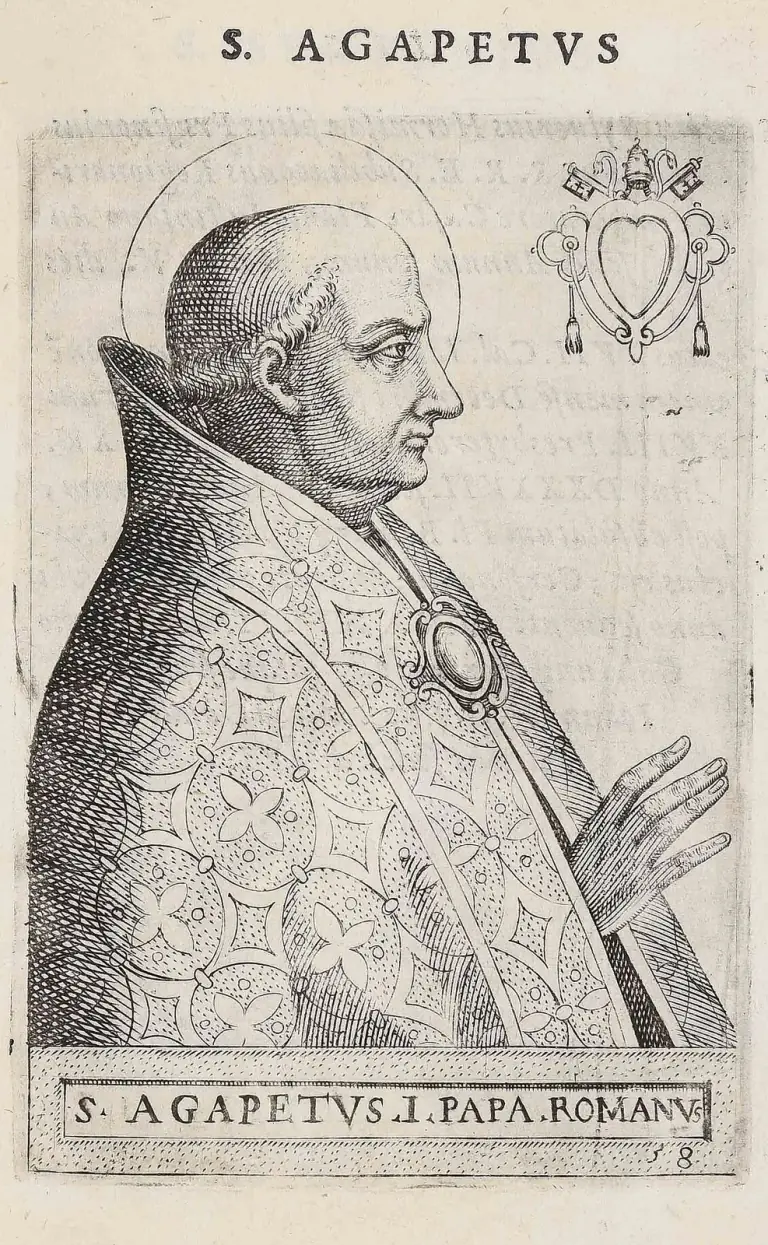
- Known for
- His embassy to the emperor Justinian at Constantinople; deposing the patriarch Anthimus and consecrating Menas in his place 124
- Not to be confused with
- Saint Agapitus of Palestrina, a martyr kept on August 18 7
Saint Agapetus I was pope for less than a year, from 535 to 536, and spent most of it away from Rome. 3 The Gothic king of Italy sent him to Constantinople to talk the emperor Justinian out of invading, and he failed; but while he was there he refused communion with the city's patriarch, deposed him, and consecrated his successor with his own hands. 12 He died in Constantinople, and his feast is April 22. 14
A priest's son and a library
Agapetus was a Roman, the son of a priest named Gordianus who served the church of Saints John and Paul. 2 Gordianus was killed in the riots of Pope Symmachus's troubled reign. 1 katolsk.no says it was supporters of the antipope Laurentius who killed him, in September 502; Loomis puts his death in 501. 32 katolsk.no adds that the family belonged to the Anicii, the house that would later produce Gregory the Great, and that under Pope John II Agapetus became archdeacon of Rome. 3
He was a man of books. Louise Ropes Loomis, in the notes to her translation of the Liber Pontificalis, says that his father's house stood near the church Gordianus served, and that Agapetus founded a library of Greek and Latin theology in it, with an inscription painted on the wall above the bookcases. 2 Gregory the Great later turned the house into a monastery. 2 katolsk.no says that Agapetus and the statesman Cassiodorus planned a Christian university in Rome, on the model of the schools of Alexandria and Nisibis, and that he helped Cassiodorus found his monastery at Vivarium. 3
Ten months in office
John II died in May 535, and Agapetus became pope on May 13, by the Holy See's reckoning; Butler has him ordained on May 4. 386 His first act was a public one. Pope Boniface II had pronounced an anathema against his rival Dioscorus and ordered it kept in the Roman archives, and Agapetus gathered the clergy into a church and burned it in front of them. 12 The Liber Pontificalis says he "absolved the whole church from the guilt of perfidy." 2
Africa had just been taken back from the Arian Vandals, and its bishops asked what to do with Arian clergy who became Catholic. Agapetus confirmed their council's ruling: converts from Arianism could not be ordained, and those already ordained were admitted only to lay communion. 1 Justinian had asked him to be lenient, and Butler says the pope answered that he could not act against the canons. 36
In Gaul, Bishop Contumeliosus of Riez had been condemned by a council for immorality and appealed to Rome. Loughlin says Agapetus ordered Saint Caesarius of Arles to give him a new trial before papal delegates. 1 katolsk.no says he appointed new judges and that the outcome is not known, and adds that the same summer he refused Caesarius permission to use church property to relieve the poor. 3
Sent to Justinian
Justinian's general Belisarius had taken Sicily and was preparing to cross into Italy. 1 The Gothic king Theodahad had murdered Amalasuntha, the queen who made him her co-ruler, and so handed the emperor his pretext. 3 He turned to the pope. In Loughlin's words he "begged the aged pontiff to proceed to Constantinople and bring his personal influence to bear on the Emperor Justinian." 1 Loomis's notes quote the chronicler Liberatus, who says the king threatened to put the senators and their wives and children to the sword unless the embassy succeeded. 2
The Roman Church was too poor to pay for the journey. To meet the cost, Agapetus had to pledge the sacred vessels. 13 He set out in midwinter with five bishops and reached Constantinople in February 536; Butler gives the day as February 2. 16
On the road through Greece, Gregory the Great writes, a man who could neither walk nor speak was brought to him by weeping relatives. Agapetus asked whether they believed he could help, and they said they hoped he could, "in the virtue of God by the authority of St. Peter." 5 He said Mass, took the man by the hand and raised him, and when he gave him Communion the man spoke. 5
As for the embassy, it failed. Justinian had gone too far to call off the war. 13 Loughlin thought the pope had probably foreseen as much. 1
Anthimus and Menas
The see of Constantinople was then held by Anthimus, who had left his own see of Trebizond, against the canons, to take it. 1 Loughlin counts him among the crypto-Monophysites who, with the empress Theodora, were working against the Council of Chalcedon; Butler says he "passed for a Catholic." 16 As soon as the pope arrived, leading clergy of the city brought charges against Anthimus as an intruder and a heretic. 1
Agapetus told him to put his faith in writing and go back to Trebizond, and when he refused, would have nothing to do with him. 1 Justinian threatened the pope with exile. The Liber Pontificalis gives the reply this way: "I indeed am a sinner, yet I have desired to come unto the most Christian emperor, Justinian; now, however, I have found Diocletian; nevertheless, I fear not your threats." 2 Loughlin's version is shorter: "In his place I find a Diocletian, whose threats, however, terrify me not." 1 katolsk.no says he resisted threats, promises and bribes alike, and after a public disputation convinced the emperor that Anthimus was a heretic. 3
Anthimus was deposed. Agapetus then consecrated his successor, Menas, himself. 12 Loughlin calls it the first time in the history of the Church that a pope had done so, and katolsk.no says he is the only pope who ever consecrated a patriarch of Constantinople. 13 Loomis dates the consecration to March 13, 536. 2 Justinian gave the pope a written confession of faith, which he accepted with a proviso that Loughlin quotes: "although he could not admit in a layman the right of teaching religion, yet he observed with pleasure that the zeal of the Emperor was in perfect accord with the decisions of the Fathers." 1
Death in Constantinople
A few weeks later Agapetus fell ill. He died in Constantinople on April 22, 536, by the reckoning of the Liber Pontificalis, Loughlin, katolsk.no and the Holy See; Butler gives April 17. 12386 katolsk.no reports that it was said the empress Theodora had him poisoned, and does not vouch for it. 3 The same source says a synod in Constantinople that spring, with clergy of his party taking part, confirmed the deposition of Anthimus. 3
His body was carried home in a lead coffin and buried in Saint Peter's on September 20. 23 Loughlin says the deposition of Anthimus "was not soon forgotten by the Orientals, who, together with the Latins, venerate him as a saint." 1 Gregory the Great, writing later in the same century, already called him "the most blessed man Agapitus." 5
What is Saint Agapetus I the patron saint of?
Saint Agapetus I's feast day
Saint Agapetus I's feast day is April 22, the day he died. 34 The Roman Martyrology, in the text published by the Italian bishops, enters him on that day as dying at Constantinople: a pope who worked to keep the election of the bishop of Rome free to the Roman clergy, and who, sent by the Gothic king to Justinian, defended the true faith and ordained Menas bishop of the city. 4
For centuries the West kept him on September 20, the day of his burial in Rome. Loughlin wrote in 1907 that "his memory is kept on 20 September," and the 1897 English Martyrology has him on that day, "whose sanctity is mentioned by blessed Gregory the Great." 17 katolsk.no says the feast has since moved to April 22. 3 The Eastern churches keep him on the anniversary of his death as well: April 22, according to Loughlin, and April 17, according to Butler and katolsk.no. 163
Praying with Saint Agapetus I
Agapetus went to Constantinople to plead for Italy and could do nothing for it. The war came anyway. 13 He had pawned the Church's vessels to make the journey, and he never came home alive. 12
What he did there was not what he had been sent to do. Threatened with exile over a matter of faith, he would not give way, and the answer the Liber Pontificalis gives him begins, "I indeed am a sinner." 2 Afterward he accepted Justinian's own confession of faith with pleasure, and reminded him in the same sentence that teaching belonged to bishops. 1
Gregory the Great kept a quieter memory of him: a pope on the road through Greece who stopped for a man brought by weeping relatives, asked them what they believed, and said Mass for him. 5 He was on his way to an emperor at the time, with a kingdom's errand to run, and he stopped. 5
Saint Agapetus I, pray for us.
Sources
- 1.James F. Loughlin, "Pope St. Agapetus I," The Catholic Encyclopedia, vol. 1 (New York: Robert Appleton Company, 1907).
- 2.The Book of the Popes (Liber Pontificalis), vol. 1, "LIX. Agapitus," translated with notes by Louise Ropes Loomis (New York: Columbia University Press, 1916).
- 3."Den hellige pave Agapetus I ( - 536)," Den katolske kirke (katolsk.no), Catholic Diocese of Oslo (in Norwegian).
- 4.Roman Martyrology, entry for April 22, "Sant'Agápito I, papa," as printed in "Santo del giorno," Conferenza Episcopale Italiana (in Italian).
- 5.Gregory the Great, Dialogues, Book III, chapter 3, "Of St. Agapitus, the Pope" (London: Philip Lee Warner, 1911), as transcribed by the Tertullian Project.
- 6.Alban Butler, "St. Agapetus, Pope, C.," September 20, The Lives of the Fathers, Martyrs, and Other Principal Saints, Vol. IX.
- 7.The Roman Martyrology, September 20 and August 18 (Baltimore: John Murphy Company, 1897).
- 8."Agapetus I," The Supreme Pontiffs, The Holy See.
Saints to turn to next
Others in this collection who are turned to for some of the same things.