Saint Apollonius the Apologist
Died c. 185
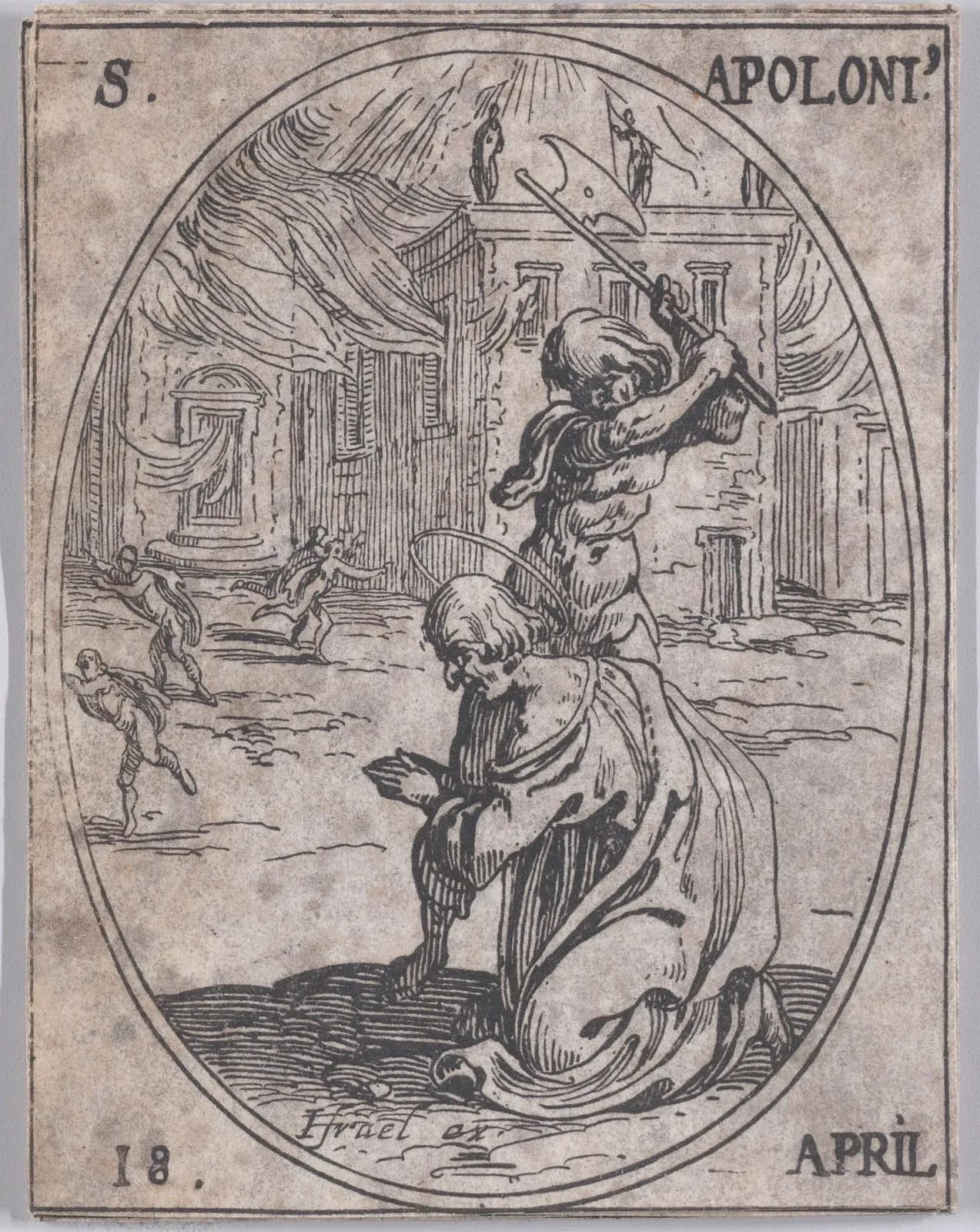
- Also called
- Apollonius of Rome; "the Apologist," for his defense of the faith 1
- Born
- Probably in Greece or Asia Minor, says katolsk.no 1
Saint Apollonius was a learned Christian of Rome, beheaded under the emperor Commodus about the year 185 after defending his faith before the prefect Perennis and the Senate. 123 Eusebius kept the record of his trial in a collection of martyrdoms that is now lost, and an Armenian copy of it surfaced in 1874. 13 It is one of the few second-century trials in which a Christian's own answers can still be read.
A philosopher at Rome
Eusebius introduces him as "Apollonius, of the city of Rome, a man renowned among the faithful for learning and philosophy." 3 The Norwegian bishops' saints database (katolsk.no) says he was probably born in Greece or Asia Minor, that he was well read in pagan philosophy and also in the Old Testament and Christian writings, and that he became a Christian under their influence. 1
Jerome, writing about two centuries later, calls him "a Roman senator under the emperor Commodus." 4 Eusebius does not. His translator Arthur McGiffert noted the silence and asked whether Jerome had simply inferred the rank from the hearing before the Senate, then concluded that Jerome had probably read the fuller account of the martyrdom and found it there. 3 katolsk.no calls him a senator of high rank. 1
He lived in a quiet moment for the Church. Eusebius says that in the reign of Commodus "our condition became more favorable," and that at Rome "many who were highly distinguished for wealth and family turned with all their household and relatives unto their salvation." 3 McGiffert's note credits Marcia, who had great influence over the emperor and favored the Christians. 3 katolsk.no adds that the edicts issued under Marcus Aurelius were still in force all the same. 1
Denounced by his own servant
The charge came from inside his household. Eusebius says one of his servants accused him, and that the accuser fared worse than the accused: "his legs were broken immediately, Perennius the judge having pronounced this sentence upon him," because a decree forbade such informers to live. 3 Jerome says only that he was "denounced by a slave as a Christian." 4 katolsk.no names the slave Severus and says he was killed. 1
McGiffert's notes show how uncertain this corner of the story is. He traces the name Severus to Jerome's Latin, and he quotes the church historian Gieseler, who held that under Roman law either the master or the slave could have been put to death, "but in no case both." 3 McGiffert himself thought it possible that the slave was executed for betraying his master, not for accusing a Christian. 3
Perennis asked Apollonius to renounce his faith, and when he refused, the case went before the Senate. 1 Eusebius says the judge "earnestly entreated and requested" him to give an account of himself there. 3
The trial
The Armenian Acts, in F. C. Conybeare's translation, begin with the prefect's question: why did he refuse to sacrifice to the gods? "Because I am a Christian," Apollonius answered; "therefore, I fear God Who made heaven and earth, and sacrifice not to empty idols." 5 The Armenian calls the prefect Terentius, which Conybeare's note treats as a corruption of Perennius. 5
Told to swear by the fortune of the emperor, he declined the oath but not the emperor: "I am willing to swear in truth by the true God that we, too, love the Emperor, and offer up prayers for his Majesty." 5 Christians, he said, offered God a bloodless sacrifice and prayed for those appointed to rule the earth. 5 The prefect cut him off: "Surely thou wast not summoned hither to talk philosophy." 5 He gave him a day to think and sent him to prison. 5
At the second hearing Apollonius mocked idols made of gold, silver and wood, and the gods of the Egyptians and Athenians. 5 The prefect conceded the performance: "You have philosophised enough, and have filled us with admiration," and reminded him that the Senate had decreed that no one should bear the name of Christian. 5 Apollonius answered that "it is not possible for a human decree of the Senate to prevail over the decree of God." 5
Asked whether he wanted to die, he said: "It is my desire to live in Christ, but I have no fear of death." 5 When the prefect said he did not understand, Apollonius replied that "the Word of God illumines the heart, as the light gives sight to our eyes." 5 A philosopher standing by told him he was insulting himself; Apollonius answered that he had learned "to pray and not to insult." 5
The apology
Pressed to speak plainly, Apollonius gave a short account of Christ. The Word of God, he said, became man in Judea and taught men "to pacify anger, to moderate desire," "to increase love, to cast away vain-glory," and to look for judgment after death and reward after the resurrection. 5 He was slain at last, "as were also before Him philosophers and just men." 5
Then he quoted a pagan: "one of the Greek philosophers said: The just man shall be tortured, he shall be spat upon, and last of all he shall be crucified." 5 Conybeare's note identifies the passage as Plato's Republic. 5 katolsk.no summarizes the argument the same way: the death of Christ was foretold both by Scripture and by Plato, and can be set beside the deaths of the prophets and of Socrates. 1
The prefect said he had hoped Apollonius would change his mind overnight. Apollonius said he had hoped the same of the prefect, "that thy heart would bear fruit," and added that "compassion shown to men by men is a bloodless sacrifice and holy unto God." 5
It is this speech that gave him his name. katolsk.no calls it an eminent apologia, a defense speech for Christianity, from which he is known as the Apologist. 1 Jerome says he "wrote a remarkable volume which he read in the senate." 4 McGiffert thought there was no foundation for a written book, and read Eusebius as describing a spoken defense that was recorded after it was given. 3
Sentence and death
In the Acts the prefect says he would gladly release him but cannot because of the Senate's decree, and pronounces sentence "with benevolence"; Apollonius is to be beheaded with a sword. 5 The executioners led him away, and he died "while he continued to glorify the Father and Son and Holy Spirit." 5 katolsk.no gives the prefect's words as a promise that the sentence would be carried out as humanely as possible, and the date as April 21, about 185. 1
Eusebius explains the Senate's part as the working of "an ancient law requiring that those who were brought to the judgment seat and refused to recant should not be liberated," and says he was put to death "as if by decree of the Senate." 3 McGiffert points out that the Senate was not a court; it could give the prefect its opinion, and he could then pronounce judgment. 3 Jerome repeats the same ancient law, adding that he was "beheaded for Christ." 4
Eusebius closes by telling readers where to find the rest: "his arguments before the judge and his answers to the questions of Perennius" are in "the records of the ancient martyrdoms which we have collected." 3 That collection is lost. katolsk.no says an authentic copy of the dialogue was found in an Armenian text in 1874, and Conybeare published it in English. 15
What is Saint Apollonius the patron saint of?
None of the sources consulted names a patronage for Saint Apollonius. katolsk.no finds no evidence of an early cult, though he was named by Jerome and Eusebius and appears in early liturgical books. 1 It adds that in the Middle Ages he was confused with the Apollonius who died with Saint Philemon and with the Apollos of the Acts of the Apostles. 1
Saint Apollonius's feast day
Saint Apollonius's feast day is April 21. 2 The current Roman Martyrology commemorates him that day at Rome as a philosopher and martyr who, under Commodus, defended the Christian faith before Perennis and the Senate with a refined speech and confirmed it with his blood. 2
The date has moved. katolsk.no says his day was long April 18, the date in the martyrology attributed to Jerome, and that March 10, April 8 and April 10 are also found; the newest edition of the Martyrology moved it back to April 21, the day of his death. 1 The martyrology of Constantinople keeps him on July 23. 1
Praying with Saint Apollonius
Apollonius was offered a way out more than once. The prefect gave him a night to reconsider, asked him to give an account of himself, and in the end said he would gladly have let him go. 35 Each time Apollonius answered with an argument.
He did not treat his accusers as enemies of the state he lived in. He offered to swear by God that Christians loved the emperor and prayed for him, and he refused only the oath and the sacrifice. 5
His last recorded words before the sentence were about mercy. Compassion shown by one person to another, he told the man about to condemn him, is a bloodless sacrifice to God. 5
Eusebius thought the record of that conversation worth keeping, and it survived the loss of his own collection in an Armenian copy. 31 The arguments are still there to be read.
Saint Apollonius the Apologist, pray for us.
Sources
- 1."Den hellige Apollonius Apologeten ( -~185)," Den katolske kirke (katolsk.no), Catholic Diocese of Oslo (in Norwegian).
- 2.Roman Martyrology, entry for April 21, "Sant'Apollonio filosofo, martire," as printed in "Santo del giorno," Conferenza Episcopale Italiana (in Italian).
- 3.Eusebius of Caesarea, Church History, Book V, chapter 21, trans. with notes by Arthur Cushman McGiffert, Nicene and Post-Nicene Fathers, Second Series, Vol. 1 (Buffalo, NY: Christian Literature Publishing Co., 1890), Christian Classics Ethereal Library.
- 4.Jerome, On Illustrious Men, chapter 42, trans. Ernest Cushing Richardson, Nicene and Post-Nicene Fathers, Second Series, Vol. 3 (Buffalo, NY: Christian Literature Publishing Co., 1892), via New Advent.
- 5."The Martyrdom of the Holy Apollonius," in F. C. Conybeare, ed. and trans., The Armenian Apology and Acts of Apollonius and Other Monuments of Early Christianity, 2nd ed. (London: Swan Sonnenschein, 1896), pp. 35-48, Internet Archive.
Saints to turn to next
Others in this collection who are turned to for some of the same things.