Saints Nereus and Achilleus
Roman martyrs; the date of their death is not known
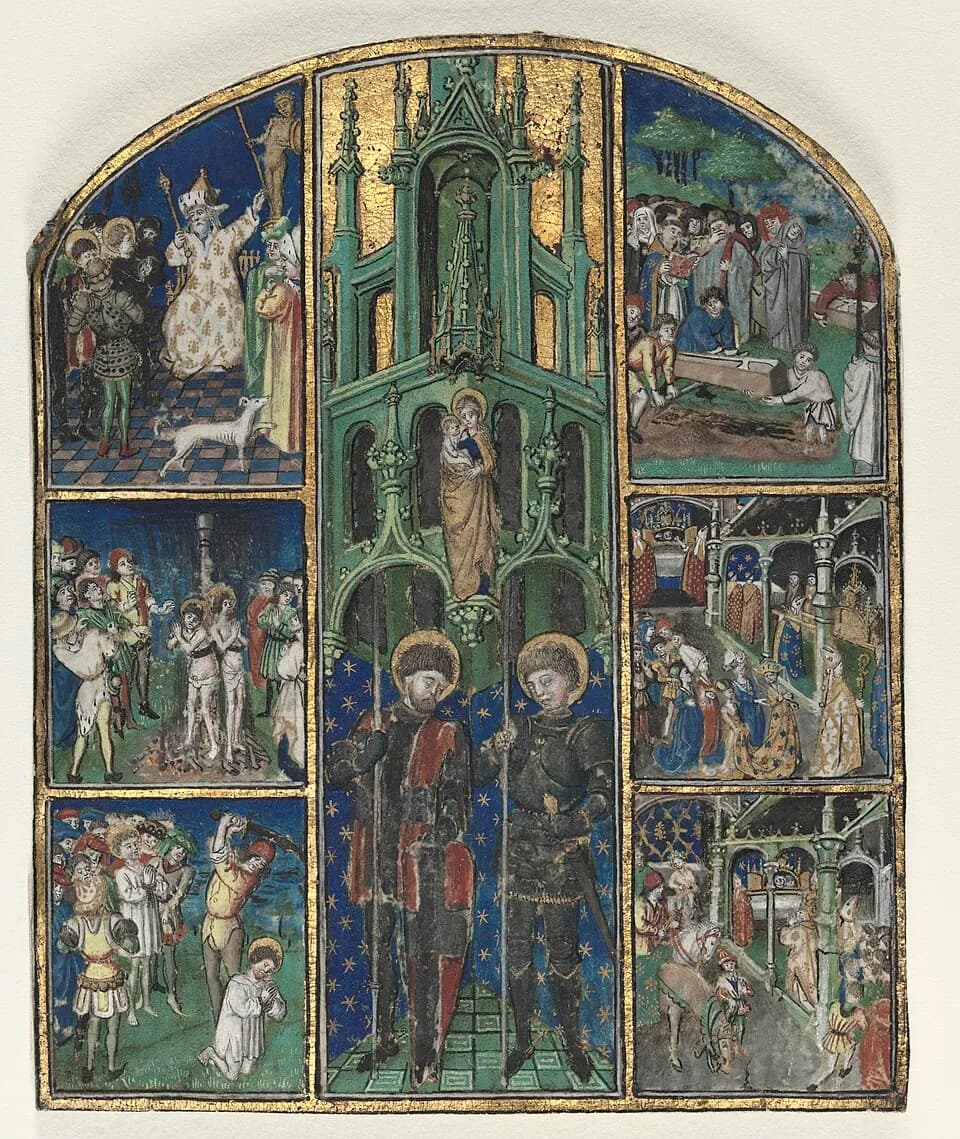
- Who they were
- Two Roman martyrs; soldiers, according to the epitaph of Pope Damasus 1
- Died
- Date unknown; Kirsch thinks them among the most ancient martyrs of the Roman Church, and Catholic Culture gives 98 14
- Earliest record
- An epitaph by Pope Damasus, in the late fourth-century basilica over their grave 1
Saints Nereus and Achilleus were two Roman martyrs buried in the Catacomb of Domitilla on the Via Ardeatina, where a basilica was built over their grave in the late fourth century. 1 Almost everything certain about them comes from a short epitaph by Pope Damasus, which says they were soldiers who served a tyrant, were suddenly converted, threw down their arms and died as martyrs. 1 Their feast is May 12. 145
Names in the oldest calendars
Their names are in the old Roman lists of the fifth century, which passed into the Martyrologium Hieronymianum. 1 The fuller version of it in the Berne Codex records them on 12 May as "Nerei et Achillei fratrum," brothers, though J. P. Kirsch notes in the Catholic Encyclopedia that it places their grave in the cemetery of Praetextatus, "an evident error for Domitilla." 1
In the Gelasian Sacramentary their names alone are invoked in the Mass for the day. 1 From the fourth century onward, Kirsch says, a special Mass was said at their grave on 12 May every year. 1 Seventh-century guidebooks for pilgrims to the Roman martyrs' tombs all agree on where they lay. 1
The basilica in the catacomb
The church built over their grave dates from the latter part of the fourth century: a basilica with three naves, sunk into the Catacomb of Domitilla, which the archaeologist Giovanni Battista de Rossi discovered. 13 Among the ruins were two small pillars that had held up the canopy over the altar. 1 They were carved with scenes of the two saints being beheaded, and one of them, which survives whole, has the name Achilleus cut into it. 1
The same excavation turned up a large fragment of a marble slab with an inscription by Pope Damasus, whose text was already known from an ancient copy. 1 The encyclopedia's article on the Roman catacombs counts the Catacomb of Domitilla among those it dates to the Apostolic Era. 3
What Pope Damasus wrote
Kirsch calls the Damasus epitaph "this oldest historical mention of the two saints." 1 As he summarizes it, Nereus and Achilleus were soldiers who obeyed the tyrant, were suddenly converted to Christianity, "joyfully resigned their commission," and died as martyrs. 1
That is the whole of it. Kirsch adds that "as to the date of their glorious confession we can make no inference." 1 He does draw one conclusion from the grave itself: they were buried in a very old part of the catacomb, dug as early as the beginning of the second century, so they are probably among the most ancient martyrs of the Roman Church, and closely connected with the Flavian family, to which the catacomb's foundress belonged. 1
The name Nereus turns up elsewhere in the old martyrologies too. Kirsch mentions other martyrs called Nereus, noted as African or as martyrs in Africa, one of them still in the Roman Martyrology of his day on 16 October, and says of them only that "nothing more is known." 1
He also notes, carefully, that Saint Paul greets a Nereus and his sister at the end of the Letter to the Romans, and that the martyr was "perhaps even" descended from that disciple. 1
The legend of the Acts
Their Acts are another matter. 1 Kirsch calls them "legendary even to a romantic degree" and says they "have no historical value for their life and death." 1 They survive in Greek and in Latin; scholars disagreed over which came first, and Kirsch prefers a sixth-century date for the whole composition. 1 They bring thirteen different Roman martyrs into a single story, Simon Magus among them. 1
In the Acts, Nereus and Achilleus are eunuchs and chamberlains of Flavia Domitilla, a niece of the Emperor Domitian. 1 They are banished with her, a Christian virgin, to the island of Pontia, and beheaded later at Terracina. 1 Their graves are placed on an estate of hers by the Via Ardeatina, near that of Saint Petronilla. 1 Kirsch points out that the author of the legend "places the two saints quite differently from Pope Damasus." 1
Catholic Culture's page for the day tells the story along the lines of the legend: Roman soldiers in Domitilla's household, instructed and converted by Saint Peter, who in turn moved Domitilla to consecrate her virginity to God, and who were reported to the authorities by her fiancé, Aurelianus; it gives their death as 98. 4
Who was Domitilla?
The catacomb takes its name from Flavia Domitilla, a Christian of the imperial family, and the encyclopedia disagrees with itself about who she was. 123 Kirsch's article and the catacombs article call her Domitian's niece. 13 Patrick Healy's article on her says she was the wife of the consul Flavius Clemens, banished for her faith to the island of Pandataria after her husband was put to death. 2
Healy traces the niece, and the island of Pontia, to Eusebius, Saint Jerome and "the spurious acts of Nereus and Achilles," and, following the scholar Lightfoot, says the opinion that there were two Christian Domitillas comes entirely from mistakes in the sources Eusebius used. 2 Kirsch, for his part, says the Acts are too legendary to settle the question either way. 1
Their church in Rome
Catholic Culture's commentary for the day admits that the mention of these saints in the Missal "awakens within us today little or no memory," but says that "in the Christian Rome of the first centuries these names were dear to popular piety." 4 It describes the Catacomb of Domitilla on the Ardeatine Way as well known, and the two martyrs as buried there. 4
Their relics did not stay in the catacomb. 4 Catholic Culture says their bodies were moved to the old Roman church known as the basilica of the Fasciola, which was already called by their names before the translation. 4 It says the church, after a period of neglect, was given at the end of the sixteenth century as his titular church to Cardinal Baronius, who restored it, and that it can still be visited. 4
What are Saints Nereus and Achilleus the patron saints of?
None of the sources consulted names a patronage for Saints Nereus and Achilleus, and the page does not supply one. Their place in the Church's memory rests on their grave, the basilica over it and the Damasus epitaph. 1
Saints Nereus and Achilleus's feast day
Saints Nereus and Achilleus are remembered on May 12. 145 In 1911 Kirsch described a single commemoration that day of four Roman martyrs, Nereus, Achilleus, Domitilla and Pancras, all named in the Mass. 1 Vatican News now lists "Sts. Nereus and Achilleus, martyred on the Via Ardeatina" on May 12 and Saint Pancras separately on the same day, and Catholic Culture prints the day as an optional memorial of the two. 45
Praying with Saints Nereus and Achilleus
What the Damasus epitaph keeps is a turn: men who had obeyed a tyrant were converted all at once and laid down the work they had been doing. 1 It does not say what it cost them beyond their lives, or how long they had served. 1
The longer story grew up around them later, and the encyclopedia is blunt that it is not history. 1 What lasted without it is a grave that Romans kept visiting for centuries, with a Mass said there every year on their day. 1
Catholic Culture closes its page on them by pointing out that Christians are still suffering and dying for their faith, and suggests a prayer for the persecuted Church and for modern martyrs. 4 The two soldiers of the epitaph stand at the beginning of a long line. 1
Kirsch's guess that they belonged to the first generations of Roman Christians rests on where they were buried, not on anything they are recorded as saying. 1 Nothing they said has come down. They are known by what they gave up. 1
Saints Nereus and Achilleus, pray for us.
Sources
- 1.J. P. Kirsch, "Sts. Nereus and Achilleus, Domitilla and Pancratius," The Catholic Encyclopedia, vol. 10 (New York: Robert Appleton Company, 1911).
- 2.Patrick Healy, "Flavia Domitilla," The Catholic Encyclopedia, vol. 6 (New York: Robert Appleton Company, 1909).
- 3.A. de Waal, "Roman Catacombs," The Catholic Encyclopedia, vol. 3 (New York: Robert Appleton Company, 1908).
- 4."Optional Memorial of Sts. Nereus and Achilleus, Martyrs; Optional Memorial of St. Pancras, Martyr - May 12, 2026," Liturgical Year, Catholic Culture.
- 5."Saint of the Day: 12 May," Vatican News.
Saints to turn to next
Others in this collection who are turned to for some of the same things.