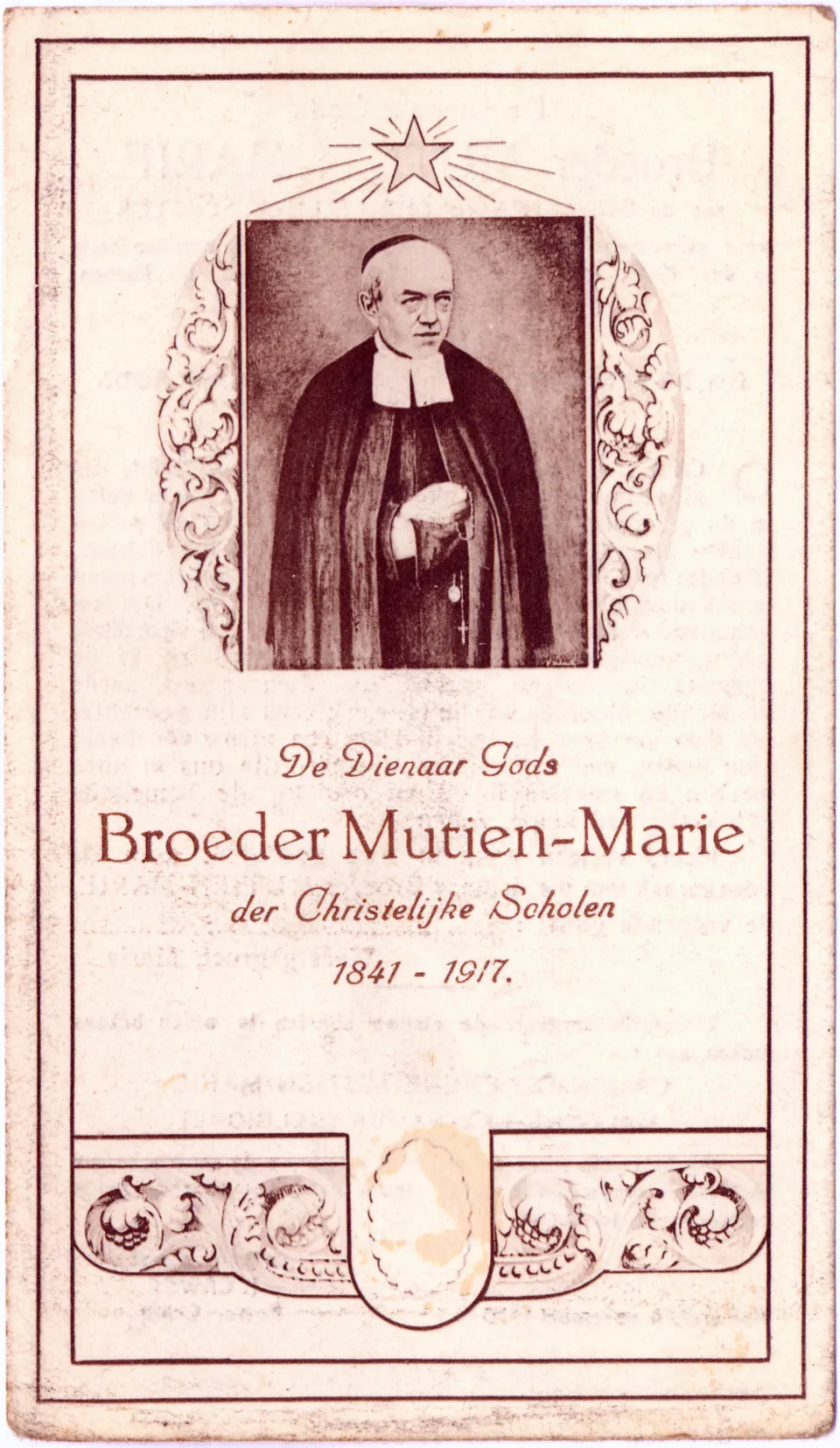
Saint Mutien-Marie Wiaux
March 20, 1841 - January 30, 1917
- Feast day
- January 30, the day he died. The Brothers' proper gives it the rank of a feast in Belgium and a memorial in their Institute 456
- Vows
- First vows September 14, 1859; perpetual profession September 26, 1869 5
Saint Mutien-Marie Wiaux was a Belgian Brother of the Christian Schools who spent fifty-eight years at one boarding school, Malonne, near Namur, supervising the yard, giving lessons in drawing and music, and teaching the catechism. 45 Early in his religious life he was nearly sent away as unfit to teach. 15 His pupils called him "le Frère qui prie toujours", the Brother who always prays, and when John Paul II canonized him in 1989 he presented this obscure and faithful life as a model for every Christian and especially for educators. 12
A blacksmith's son from Mellet
Louis-Joseph Wiaux was born on March 20, 1841, at Mellet, a village in French-speaking Belgium, and was baptized the same day. 14 He was the third of six children. 5 His father, Jean Wiaux, was the village blacksmith; his mother, Elisabeth Badot, saw to the children's education and ran a cafe in part of the family home. 15
The Brothers' profile has a detail about that cafe worth keeping: rough language was not allowed in it, and the evenings of Belgian beer and card playing always ended with the rosary. 4 The Holy See biography says his devotion to the Virgin made him an example to the boys his own age. 1
After primary school he went to work in his father's forge. 1 The Brothers say he was suited to the trade neither in body nor in temperament, and that he was convinced the Lord wanted him at "a different kind of forge." 4 He had met the Brothers of the Christian Schools at their school in Gosselies, near home. 5
Nearly sent home
He entered the novitiate at Namur on April 7, 1856, at fifteen, and took the habit on July 2, the feast of the Visitation, receiving the name Mutien-Marie. 15 Paul VI noted that he gave up even his own name for that of a martyr who was hardly known, and took it as a sign of what was to come: sixty years of religious life hidden from people's eyes. 3
His first classes were at Chimay. Here the sources differ in detail. The Holy See biography says he taught a class of children there and then spent a year at Brussels before he was moved to the college at Malonne in 1859; the Brothers' 2025 article says he taught primary school at Chimay for two years and was then sent to Malonne. 15 He made his first vows on September 14, 1859, and his perpetual profession ten years later, on September 26, 1869. 5
The start at Malonne went badly. The Holy See biography attributes it to his youth and inexperience and says plainly that he ran the risk of being dismissed from the congregation as unfit for the work of the school. 1 The Brothers' article says the same: it was believed he was not suited to teaching, and he was on the point of being let go. 5 The Brothers' profile says he could not cope with teaching and prefecting at once. 4
He stayed because another Brother took him on. The Brothers' profile says he was rescued by the Brother in charge of the music and art courses, then an important part of the curriculum; their 2025 article names him as Brother Maixentis. 45
Fifty-eight years at Malonne
The Saint-Berthuin college at Malonne, in Paul VI's words a large one, was where he spent the rest of his life. 3 The Brothers count fifty-eight years there. 45 The "sixty years" both popes speak of are his years of religious life, from the novitiate to his death. 23
What he did there is described differently. The Holy See biography says he was given humble, hidden duties: supervision, and elementary lessons in drawing and music, though he had no particular gift for either. 1 It adds that he set himself to the piano, the harmonium and other instruments and kept at it for more than fifty years. 1 John Paul II, in the Italian text of the canonization homily, calls him a simple assistant to the music and drawing masters. 2 The Brothers' profile is warmer: from then on he was an effective teacher of those subjects, a vigilant prefect in the school yard and a catechist in the nearby parish. 4
One assignment he asked for. The Holy See biography says he remembered that his institute had been founded for the Christian education of the poor and asked his superiors to let him teach the catechism at the free school attached to the college, to children of working families he felt close to, and that he did so for many years. 1
The Brothers say he had a great influence on the students through his patience and evident piety. 4
The Rule, and the Brother who always prays
The trait the Holy See biography singles out is obedience to every prescription of the Rule, carried to the point of heroism. 1 It records the testimony of a Brother who lived with him for many years: take the Rule from the first chapter to the last and write under each article that Brother Mutien kept it to the letter, and that will be his truest biography. 1 The Brothers put it more briefly: it was said among them that he had never been seen breaking even the smallest point of the Rule. 4
His day began early. By half past four in the morning, the Holy See biography says, he was already on his knees before the tabernacle, and from there he went to the altar of Mary. 1 Through the day he said the rosary, and his moving lips gave his prayer away; he made frequent visits to the Blessed Sacrament and made pilgrimages to the grotto of Our Lady of Lourdes and other places of devotion. 1 The Brothers say he spent whatever time he could before the tabernacle or at the grotto of Our Lady. 4 The students named him for it: "le Frère qui prie toujours." 1
He pressed devotion to the Eucharist and to the Virgin on his pupils, and they knew he practiced what he urged. 1 The Brothers' proper for his feast prints a line from one of his letters, dated January 3, 1914, in their translation: "To achieve intimate union with our Lord, take the path of Mary where there is no stain or shadow that can detain you on your journey towards Jesus." 6
He died at Malonne on the morning of January 30, 1917. 14 The Holy See biography gives his last recorded words as a thanksgiving, at the edge of the grave, for having always had a great devotion to the Blessed Virgin. 1
From Malonne to Rome
Favors were attributed to him almost at once. The Holy See biography says they were being reported on the day he died; the Brothers' 2025 article says on the day of his funeral. 15 Pilgrims came to his grave, and his reputation spread through Belgium. 14
A church tribunal for his cause was opened six years after his death. 1 Paul VI beatified him on October 30, 1977, in the same ceremony as Brother Miguel Febres Cordero of Ecuador, another Brother of the Christian Schools. 3 Paul VI said Mutien-Marie lacked Brother Miguel's gift for brilliant school achievements, but became a master to many young people by showing how disinterested love can shape a whole life. 3
John Paul II canonized him on December 10, 1989, the second Sunday of Advent. 24 In the homily he described a very simple religious who had all the greatness of the humble, who arrived at holiness in daily life, and he asked his help for the educators of today in accompanying young people on the way of faith. 2 His relics are venerated at Malonne, in a shrine built in his honor after the canonization. 45
What is Saint Mutien-Marie Wiaux the patron saint of?
None of the sources consulted names Saint Mutien-Marie Wiaux the patron saint of anything. 124
A teacher is easy to file under teachers, and this page does not. John Paul II asked his intercession for educators of our time, and presented him above all to his own Brothers and to educators. 12 The Brothers ask him to help Lasallians be faithful to God in the small details of each day. 5 Those are prayers, not a declared patronage, and they are reported here as prayers.
Saint Mutien-Marie Wiaux's feast day
The feast of Saint Mutien-Marie Wiaux is January 30, the day he died in 1917. 45 The Brothers of the Christian Schools state that every January 30 the Church and their Institute celebrate his memory. 5
The Brothers' own proper for the day gives it two ranks: a feast in Belgium, and a memorial in the Institute. 6 None of the sources consulted gives any other date.
Praying with Saint Mutien-Marie
His life begins with a near failure. A young Brother who could not manage the classroom and the school yard together, and who was about to be sent away, is not the usual opening of a saint's story, and the sources do not hide it. 15 He stayed because an older Brother taught him a subject he was not especially good at, and he kept practicing it for half a century. 145
Almost nothing in the record is an event. He supervised a yard, taught drawing and music, prepared children for the catechism, and kept a Rule so exactly that a Brother who lived beside him thought the Rule itself could serve as his biography. 14 Paul VI asked whether such an example would be understood today, and answered by pointing to the inner freedom he found inside a life that looked entirely given away. 3
The prayer was not hidden, though. His pupils saw it every day, at the tabernacle before dawn and in the beads moving through the day, and it was they who gave him his name. 1 The one sentence of his own that the Brothers keep for his feast is about Mary as the path to Christ, and it was the subject of his last recorded words too. 16
Saint Mutien-Marie Wiaux, pray for us.
Sources
- 1."Mutien Marie Wiaux, F.E.C. (1841-1917) - Biographie," Office for the Liturgical Celebrations of the Supreme Pontiff, The Holy See, for the canonization of December 10, 1989 (French).
- 2.John Paul II, "Canonizzazione di Fratel Mutien-Marie Wiaux," homily, December 10, 1989 (Italian; no English text is published). Libreria Editrice Vaticana.
- 3.Paul VI, "Beatificazione di Mutien-Marie Wiaux e Miguel Febres Cordero," homily, October 30, 1977 (Italian, Spanish and French; no English text is published). Libreria Editrice Vaticana.
- 4."Saint Mutien-Marie Wiaux," Lasallian Holiness, Brothers of the Christian Schools (La Salle Worldwide), Rome.
- 5.Fabio Parente, "Saint Mutien-Marie and his fidelity to God in everyday life," Brothers of the Christian Schools (La Salle Worldwide), January 30, 2025.
- 6."30 January: Saint Mutien-Maria Wiaux, Religious (1841-1917)," proper of the Mass and Liturgy of the Hours, Brothers of the Christian Schools.
Saints to turn to next
Others in this collection who are turned to for some of the same things.
- Saint Aelred of Rievaulx1109 - January 12, 1166 (or 1167)PrayerWork and vocationStudy and teaching
- Saint Dunstanc. 909 or earlier - May 19, 988Work and vocationPrayerStudy and teaching
- Saint Ephremc. 306 - June 9, 373Study and teachingPrayerWork and vocation
- Saint Jadwiga of Poland1373 - July 17, 1399Study and teachingPrayerWork and vocation