Saint Moses the Prophet
Thirteenth to early twelfth century B.C., in the Catholic Encyclopedia's dating
- Family
- Of the tribe of Levi; son of Amram and Jochabed, brother of Aaron and Miriam 1
- Not to be confused with
- Saint Moses the Black, the fourth-century Egyptian monk
Moses led the people of Israel out of slavery in Egypt, received the Law from God on Mount Sinai, and died on Mount Nebo in sight of the land he was not allowed to enter. 14 The Catholic Church keeps him as a saint and a prophet on September 4. 4 The Catechism calls his prayer "the most striking example of intercessory prayer" in the Old Testament, and Benedict XVI called him above all a man who prayed. 23
Liberator, lawgiver, prophet
Thomas Reilly, writing in the 1911 Catholic Encyclopedia, begins with a list: "Hebrew liberator, leader, lawgiver, prophet, and historian." 1 He dates Moses to the thirteenth and early twelfth centuries before Christ. 1 The Bible, he says, "furnishes the chief authentic account of this luminous life," and he sets aside the rabbinic legends that grew up around it as "purely imaginative" when taken one by one, while arguing that their sheer number points to "a grand and illustrious personage." 1
He was born a Levite, the son of Amram and Jochabed, with an older brother, Aaron, and a sister, Miriam. 1 Pharaoh had ordered every newborn Hebrew boy drowned. After three months in hiding the child was set in a basket on the Nile, and his sister kept watch until Pharaoh's daughter found him and, at the sister's suggestion, gave him to a Hebrew nurse, who was in fact his own mother. 1
Even his name is argued over. The Book of Exodus implies that it comes from a Hebrew word meaning "to draw," from the water. 1 Reilly reports that Josephus and the Fathers read it as Coptic for "water" and "saved," and that many Egyptologists of his day traced it to an Egyptian word for "child," before concluding that "nothing decisive can be established." 1
The burning bush
Moses grew up at court, "schooled 'in all the wisdom of the Egyptians,'" in Reilly's phrase, until he killed an Egyptian who was beating a Hebrew and fled to Madian. 1 There he married Sephora, a daughter of the priest Raguel, and kept sheep for forty years. 1
At Horeb he saw a bush that burned without burning up. 1 A voice told him, "Come not nigh hither, put off the shoes from thy feet: for the place whereon thou standest is holy ground." 6 God sent him to bring Israel out of Egypt, and when Moses asked his name, God answered: "I AM WHO AM. He said: Thus shalt thou say to the children of Israel: HE WHO IS, hath sent me to you." 6
The Catechism treats this as a lesson in how to pray. "Here again the initiative is God's." 3 Moses is called to be "an associate in his compassion, his work of salvation," and only "after long debate does Moses attune his own will to that of the Savior God." 3 He "balks, makes excuses, above all questions: and it is in response to his question that the Lord confides his ineffable name." 3
Out of Egypt
With Aaron as his spokesman, Moses went before Pharaoh, who refused to let the people go and made their labor harder. 1 There followed the plagues, which Reilly describes as ten "Divine manifestations," until the night of the first Passover, when the Hebrews ate "with their loins girt, their shoes on their feet, and staves in their hands, ready for rapid escape." 1 They crossed the Red Sea "at a point today unknown," Reilly says, and the waters closed on the Egyptians who followed. 1
In the desert the people grumbled for water and food, and Moses prayed for them over and over. 12 Benedict XVI lists the occasions: he prayed for Pharaoh during the plagues, for his sister Miriam when she was struck with leprosy, for the people when fire broke out in the camp and when serpents came among them, and he protested to God when the burden grew too heavy for him. 2
Sinai and the golden calf
At Sinai the Ten Commandments were given and Moses was made "mediator between God and the people." 1 He went up the mountain and stayed forty days and forty nights, fasting, to receive the tablets of the Law. 2 Benedict XVI read the fast as a sign that "life comes from God." 2
Below the mountain the people asked Aaron to make them a god, and he made a calf of molten metal. 2 In the Douay-Rheims God says to Moses, "Let me alone, that my wrath may be kindled against them, and that I may destroy them, and I will make of thee a great nation." 7 Benedict XVI understood those words as spoken "so that Moses might intervene and ask God not to do it, thereby revealing that what God always wants is salvation." 2
Moses did intervene. He reminded God of what he had already done in bringing the people out of Egypt, and of his promise to Abraham, Isaac and Israel. 27 Then he offered himself: "Or if thou do not, strike me out of the book that thou hast written." 7 Benedict XVI notes that Moses did not even consider God's offer to make a new nation of him, and that "the Fathers of the Church saw a prefiguration of Christ" in a mediator who asked to be blotted out for his people. 2 Reilly also records the other side of the story: when Moses came down he punished those who had joined in the worship of the calf. 1
Face to face
Scripture gives Moses a closeness to God it gives to no one else. "The Lord spoke to Moses face to face, as a man is wont to speak to his friend." 8 When Aaron and Miriam spoke against him, God answered that he spoke to Moses "mouth to mouth: and plainly, and not by riddles and figures." 9 The same chapter calls him "a man exceeding meek above all men that dwelt upon earth." 9 The Catechism draws these texts together: "Moses' prayer is characteristic of contemplative prayer by which God's servant remains faithful to his mission." 3
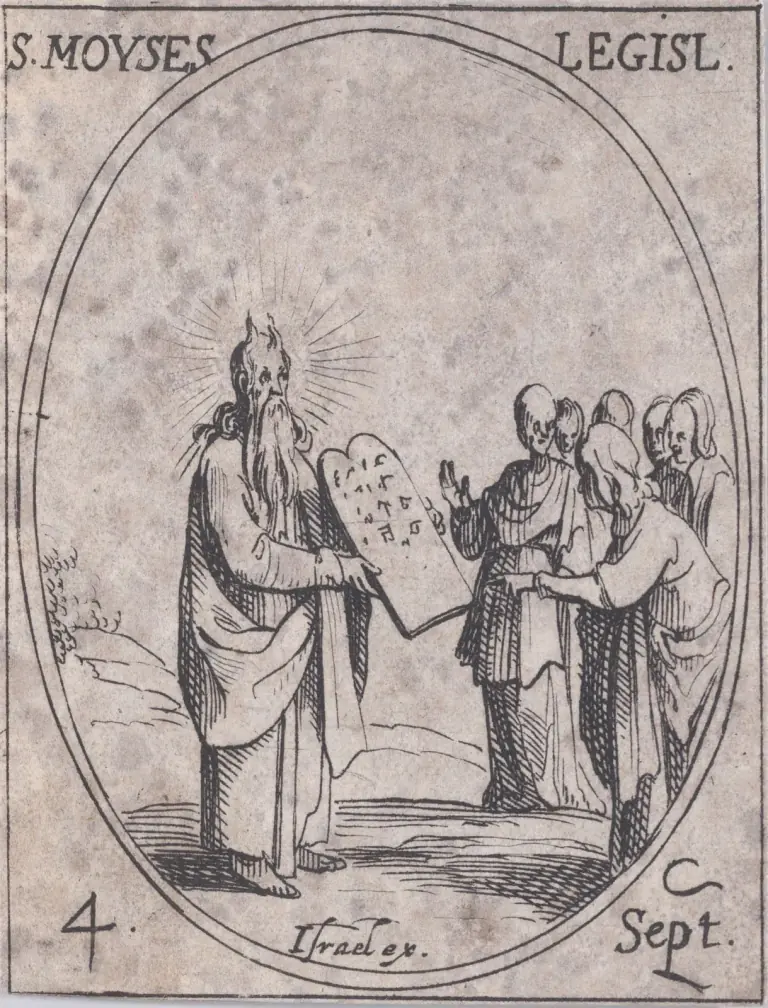
When he came down from Sinai a second time, the Douay-Rheims says, "he knew not that his face was horned from the conversation of the Lord," and the people were afraid to come near. 10 Its note explains the word: "That is, shining, and sending forth rays of light like horns." 10 Reilly keeps the old phrase and says his face was "emblazoned with luminous horns." 1 That reading explains the two points of light on Moses' head in Callot's etching on this page.
Death on Mount Nebo
The people wandered in the desert for a generation. Reilly says that Moses himself was barred from the Promised Land, "presumably because of a momentary lack of trust in God at the Water of Contradiction." 1 Before the end he gave the discourses that make up Deuteronomy, spoke of a future prophet like himself, and blessed the tribes. 1
Then he climbed Mount Nebo, "to the top of Phasga over against Jericho," and God showed him the land: "Thou hast seen it with thy eyes, and shalt not pass over to it." 11 "Moses the servant of the Lord died there, in the land of Moab," at a hundred and twenty years, and "no man hath known of his sepulchre until this present day." 11 The book closes with his epitaph: "And there arose no more a prophet in Israel like unto Moses, whom the Lord knew face to face." 11
Reilly ends with the Transfiguration, where Moses appears beside Elijah, "side by side with Elias," and below the Christ whom, Reilly says, he had foreshadowed and foretold. 1
What is Saint Moses the patron saint of?
Saint Moses' feast day
Saint Moses' feast day is September 4. 45 The current Roman Martyrology, in the text published by the Italian bishops, commemorates on that day Saint Moses, prophet, chosen by God to free his oppressed people in Egypt and lead them to the promised land, to whom God revealed himself on Sinai as "I am who am" and gave the Law, and who died full of days on Mount Nebo in the land of Moab, in sight of the promised land. 4
The day is an old one. The 1897 English edition of the Roman Martyrology has the same entry on September 4: "On Mount Nebo, in the land of Moab, of St. Moses, lawgiver and prophet." 5 It is not the anniversary of his death, which no source dates. 111
Praying with Saint Moses
The Church holds Moses up first as a man of prayer. Benedict XVI said he led the people "above all, by praying." 2 The Catechism says the same thing more precisely: "He does not pray for himself but for the people whom God made his own." 3
His prayer was not polite. The Catechism lists his arguments with God: God is love, so he is righteous and faithful; he "cannot contradict himself"; he "must remember his marvellous deeds, since his glory is at stake." 3 Benedict XVI called the intercessor "the man torn between two loves," for God and for the people. 2
He was also refused. Moses asked to be blotted out of God's book in place of the people and was told that each would answer for his own sin, and he died outside the land he had spent forty years walking toward. 711 Scripture remembers him not for arriving but as the prophet "whom the Lord knew face to face." 11
Saint Moses the Prophet, pray for us.
Sources
- 1.Thomas à Kempis Reilly, "Moses," The Catholic Encyclopedia, Vol. 10 (New York: Robert Appleton Company, 1911).
- 2.Benedict XVI, General Audience on Moses' intercession for the people, June 1, 2011, Libreria Editrice Vaticana.
- 3.Catechism of the Catholic Church, 2574-2577, "Moses and the prayer of the mediator," Libreria Editrice Vaticana.
- 4.Roman Martyrology, entry for September 4, "San Mosè, profeta," as printed in "Santo del giorno," Conferenza Episcopale Italiana (in Italian).
- 5.The Roman Martyrology, September 4 (Baltimore: John Murphy Company, 1897).
- 6.Exodus 3, Douay-Rheims Bible (Challoner revision).
- 7.Exodus 32, Douay-Rheims Bible (Challoner revision).
- 8.Exodus 33, Douay-Rheims Bible (Challoner revision).
- 9.Numbers 12, Douay-Rheims Bible (Challoner revision).
- 10.Exodus 34, Douay-Rheims Bible (Challoner revision), with Challoner's note on verse 29.
- 11.Deuteronomy 34, Douay-Rheims Bible (Challoner revision).
Saints to turn to next
Others in this collection who are turned to for some of the same things.