Saint Methodius of Olympus
Died probably 311
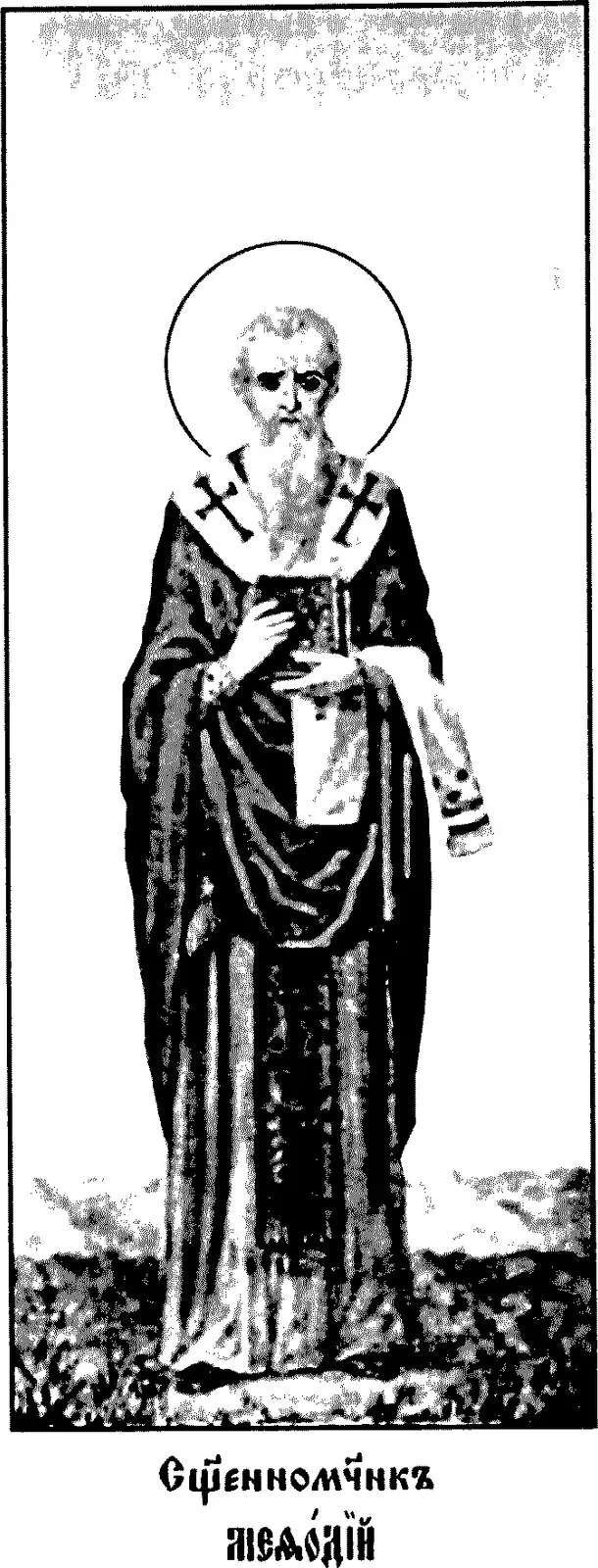
- Died
- A martyr, probably in 311, says the Catholic Encyclopedia 1; at Chalcis in Greece, says Jerome 2
Saint Methodius was a bishop of Olympus in Lycia who died a martyr, probably in 311, and who is remembered almost entirely through what he wrote. 125 The Catholic Encyclopedia calls him the first scientific opponent of Origen; his one work to survive whole is the Banquet of the Ten Virgins, a dialogue in praise of chastity modeled on Plato's Symposium, which ends with a hymn to Christ the Bridegroom. 13
What little is known
Very little of his life was recorded. Kirsch, in the 1911 Catholic Encyclopedia, writes that "very few reports have been handed down; and even these short accounts present many difficulties." 1 His date of birth is unknown. 1 Niccoli, on santiebeati, says that the only certain fact of his life is his martyrdom. 4
Eusebius, who wrote the history of the Church in those years, does not mention him at all. Kirsch thinks this was probably because Methodius had opposed some of Origen's theories, and Niccoli writes of the disdainful silence with which Eusebius surrounded his name for the same reason. 14
The earliest account is a single paragraph in Jerome's book On Illustrious Men. It says that Methodius, "bishop of Olympus in Lycia and afterwards of Tyre," wrote books Against Porphyry "in polished and logical style," a Banquet of the ten virgins, "an excellent work On the resurrection, against Origen," and treatises On the Pythonissa and On free will, as well as commentaries on Genesis and the Song of Songs, "and many others which are widely read." 2
Olympus, and perhaps Tyre
That he was bishop of Olympus in Lycia, in the southwest of Asia Minor, the sources agree. 124 The rest is less sure. Jerome adds that he was afterward bishop of Tyre, and the older Roman Martyrology repeated it. 26 Kirsch calls this "not reliable": no later Greek writer knows of it, and Eusebius names Tyrannio as bishop of Tyre during the persecution and Paulinus after it. He suggests Methodius may have been taken to Tyre during the persecution and died there. 1 The introduction to his santiebeati page makes him bishop of Olympus and of Philippi. 4
His death is just as uncertain. Jerome says he "was crowned with martyrdom at Chalcis in Greece" at the end of the recent persecution, "or, as others affirm, in the reign of Decius and Valerianus." 2 Kirsch sets the second possibility aside, since Jerome himself gives it as hearsay, and puts the martyrdom under Maximinus Daia, probably in 311. 1 Niccoli says it happened most probably in the persecution of Diocletian, perhaps in 311, in a place that cannot be determined. 4 The current Martyrology says he received the crown of martyrdom himself as the persecution of Diocletian was ending. 5
Against Origen
Kirsch calls Methodius "an important theologian as well as a prolific and polished author," and says his importance in the history of theology lies in his answer to Origen, the great Alexandrian. 1 He attacked especially Origen's teaching that the body raised at the resurrection is not the same body a person had in life, and his idea that the world is eternal. 14 His dialogue On the Resurrection argues that the same body will be raised to incorruption. 1
He did this without contempt. Kirsch writes that Methodius "recognized the great services of Origen in ecclesiastical theology," and that he was, like Origen, strongly influenced by Plato and fond of the allegorical reading of Scripture. 1 Niccoli describes him as a firm opponent of Origen who was always fair to him. 4
Most of his work survives only in pieces. The Banquet alone has come down complete in Greek; large parts of On Free Will and On the Resurrection survive in Greek; four shorter works, on life, on the Jewish food laws, on leprosy and on the leech in Proverbs, survive only in Old Slavonic versions; and the books Against Porphyry are lost. 14 Niccoli adds that Against Porphyry is the first known Christian refutation of the philosopher's attack on the faith. 4
The Banquet of the Ten Virgins
The Banquet is a dialogue within a dialogue. Gregorion tells Euboulios what he heard from the virgin Theopatra: how ten young women went by "a very rough, steep, and arduous path" to the garden of Arete, Virtue, the daughter of Philosophy, and sat down to dinner beneath a spreading agnos tree. 3 When the meal was over, Arete asked each of them to speak in praise of virginity, beginning with Marcella, the eldest. 3
Marcella begins: "Virginity is something supernaturally great, wonderful, and glorious." 3 She says it walks on earth but reaches up to heaven, and that it is not enough to keep the body undefiled while neglecting the soul. 3 At the end Arete makes the same point more sharply. Chastity is not honored, she says, by someone who restrains the flesh but is proud, or greedy, or careless of a neighbor's needs; "all the members are to be preserved intact," the tongue, the eyes, the hands and the mind as well as the body. 3
Arete crowns all ten and gives the largest crown to Thecla. 3 Then the virgins stand under the tree and Thecla leads a hymn of twenty-four stanzas, with the others answering after each one: "I keep myself pure for You, O Bridegroom, and holding a lighted torch I go to meet You." 3 Kirsch calls it "a hymn on Christ as the Bridegroom of the Church," and Niccoli an admirable hymn to chastity. 14
The book does not end on the hymn. Euboulios and Gregorion go on to ask whether the person who feels no desire is better than the one who feels it and resists, and decide for the second: the better pilot is the one who brings the ship through "great and perplexing storms," not the one who sails in a calm. 3
What is Saint Methodius the patron saint of?
Saint Methodius's feast day
Saint Methodius's feast day is June 20. The current Roman Martyrology, as the Italian bishops print it, commemorates him on that day as bishop of Olympus and martyr, who wrote works of an elegant and polished style and at the end of the persecution of Diocletian received the crown of martyrdom himself. 5
The older Roman date was September 18. The 1897 English edition of the Martyrology enters him there as bishop "of Olympius in Lycia, and afterwards of Tyrus, most renowned for eloquence and learning," crowned with martyrdom at Chalcis in Greece according to Jerome. 6
Praying with Saint Methodius
He disagreed with the most brilliant theologian of the age, and he did it in writing, at length, and without sneering. He argued against Origen on the resurrection and still acknowledged what the Church owed him. 14
His chief book is about chastity, but its argument is wider than the body. Arete's closing speech counts pride, greed and indifference to a neighbor as failures of chastity too. 3 Niccoli, summing up his thought, says that for Methodius chastity is the virtue that makes the others possible. 4
The book ends by praising the struggle rather than the calm. In Gregorion's and Euboulios's last exchange, the soul that is troubled by desire and holds its course is called stronger than the one that is never troubled. 3
Of how he died almost nothing is known. Jerome is not sure of the reign, and the modern writers are not sure of the place. 124 What he left is the hymn that the virgins sang with lighted torches, and its refrain. 3
Saint Methodius of Olympus, pray for us.
Sources
- 1.J. P. Kirsch, "St. Methodius of Olympus," The Catholic Encyclopedia, Vol. 10 (New York: Robert Appleton Company, 1911).
- 2.Jerome, On Illustrious Men (De Viris Illustribus), chapter 83, "Methodius," translated by Ernest Cushing Richardson, Nicene and Post-Nicene Fathers, Second Series, Vol. 3 (1892), New Advent.
- 3.Methodius, The Banquet of the Ten Virgins, Introduction, Discourse I and Discourse XI, translated by William R. Clark, Ante-Nicene Fathers, Vol. 6 (1886), New Advent.
- 4.Mario Niccoli, "San Metodio di Olimpo, vescovo e martire," with an introduction and the Roman Martyrology entry, Santi e Beati, santiebeati.it (in Italian).
- 5.Roman Martyrology, entry for June 20, "San Metodio, vescovo di Olimpo e martire," Santo del giorno, Conferenza Episcopale Italiana (in Italian).
- 6.The Roman Martyrology, September 18 (Baltimore: John Murphy Company, 1897), Internet Archive.
Saints to turn to next
Others in this collection who are turned to for some of the same things.