Saint Meinrad
c. 800 - January 21, 861
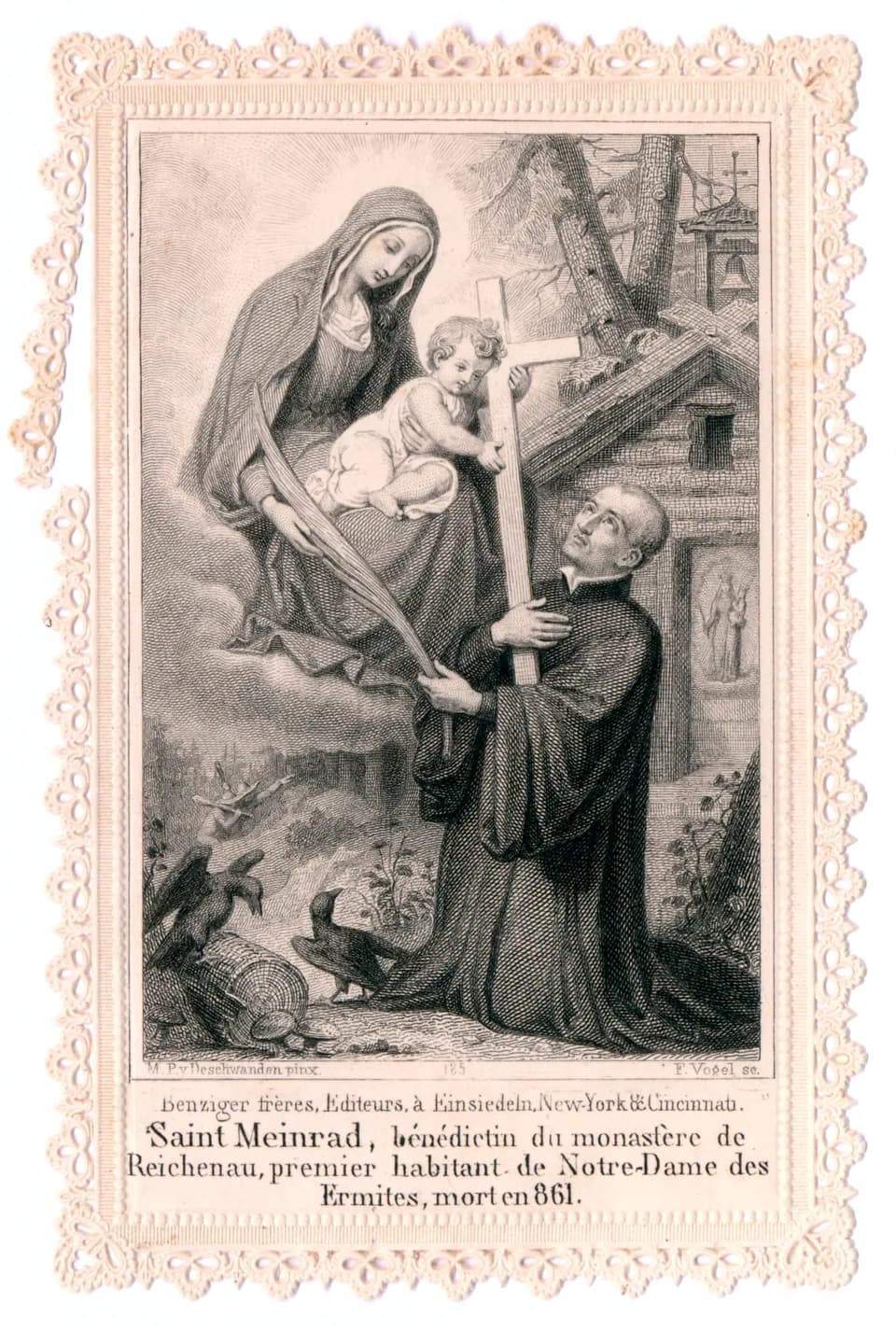
- Title
- Martyr of Hospitality 2
Saint Meinrad was a Benedictine monk of Reichenau who left his monastery to live alone, first on a mountain above Lake Zurich and then for twenty-six years in a forest clearing beyond it. 13 On January 21, 861, two robbers came to his door. He fed them, and they killed him. 23 The Abbey of Einsiedeln stands where his hut stood, and his feast is kept on January 21. 25
A schoolboy at Reichenau
He was born about the year 800 in what is now Germany. 2 Einsiedeln Abbey, the monastery built on the site of his hermitage, places his birth shortly before 800 in the Sülchgau, near Rottenburg on the Neckar, and gives the old Alemannic form of his name, Meginrat. 3
The sources describe his family differently. The Catholic Encyclopedia says he was "of the family of the Counts of Hohenzollern." 1 Einsiedeln says his people belonged to the Alemannic nobility, and that it was only in the eleventh century that he was made into a count's son. 3
His parents sent him young, probably at five by Einsiedeln's account, to the monastery school on the island of Reichenau in Lake Constance. 13 He did well in the study of Scripture, became a deacon at twenty-five, and was then ordained a priest. 3 The encyclopedia says he studied under two abbots who were his kinsmen, Hatto and Erlebald. 1 Einsiedeln says Erlebald was his uncle, was elected abbot in 823, and soon afterward advised him to take vows as a monk. 3 It adds that the old Life of Meinrad describes him as obedient, strict in fasting, tireless in prayer and generous to others. 3
From the Etzel to the Dark Forest
Abbot Erlebald sent him to teach at a small dependent house on Lake Zurich, which the encyclopedia names as the priory of Bollingen. 13 There he began to want a life of solitude. 3 The archabbey in Indiana that bears his name tells of a moment, depicted on the shrine in its church, when he confided his wish to a woman described as "dear to Christ," and she promised to help him if he went. 6
He settled first on the Etzel, a mountain on the south shore of the lake. 13 According to Einsiedeln, too many people came there to ask his advice, and about 835 he moved deeper into what was called the Dark Forest, to the edge of a small plain that was hard to reach and bitterly cold in winter. 3 He stayed twenty-six years. 3 The abbey's Chapel of Grace now stands on the spot. 4
The encyclopedia tells this part more briefly and differently. It mentions only the hermitage on the slopes of Mount Etzel, and it says he took with him "a wonder-working statue of Our Lady" given him by Abbess Hildegarde of Zurich, the same statue, it says, that pilgrims to Einsiedeln venerate. 1 Einsiedeln's page on Meinrad says nothing about a statue. 3
Solitude did not keep people away for long. Saint Meinrad Archabbey says that "his reputation as a wise and holy man led people to seek him out for counsel and prayer," and that he "graciously attended to his guests' needs, physical as well as spiritual." 2 Einsiedeln says he fasted, welcomed visitors, and gave what he had to the poor who found their way to him, and it notes that he was not spared temptations in his remote valley. 3 His name, it points out, means great counselor. 3
The two robbers
In January 861 two men came to the hermitage. The archabbey says they believed he had treasure hidden there, "gifts from the people he had counseled." 2 The encyclopedia says they "coveted the treasures offered at the shrine by devout pilgrims." 1
Meinrad seems to have known what they were. The archabbey says he had "a premonition of his impending death" and still "invited the robbers in and offered them food and drink." 2 Einsiedeln says he entertained them hospitably and let them understand that he saw through them. 3 They beat him to death. 3 Then, the archabbey says, they "fled in fear without taking anything." 2
Both monasteries pass on the story of what happened next. Meinrad kept two ravens, and the birds followed the killers all the way to Zurich, where the men were recognized, tried and executed. 36 The encyclopedia does not mention the ravens. 1 The date of the killing was January 21. 3
For giving his murderers a meal he has been called the "Martyr of Hospitality." 2
Einsiedeln
His body was carried back to Reichenau and buried there. 3 The clearing did not stay empty. Other hermits settled at the place where he died, and the encyclopedia says it "was never without one or more hermits emulating St. Meinrad's example." 14 In 934 Eberhard, the cathedral provost of Strasbourg, gathered them into a community under the Rule of Saint Benedict and became its first abbot. 4 The encyclopedia tells the same story with a looser date, some eighty years after Meinrad's death. 1
That community is the Abbey of Einsiedeln, whose name the encyclopedia connects with the hermits who began it. 1 Meinrad's relics came back from Reichenau in 1039, for the consecration of the second abbey church, and since 1984 his head has rested in a silver reliquary in the high altar. 13 The encyclopedia, writing in 1909, counted 150,000 to 200,000 pilgrims a year and said the pilgrimages "have never ceased since the days of St. Meinrad." 1
In 1854 Einsiedeln sent monks to southern Indiana. 16 Einsiedeln says they went to serve German-speaking immigrants; the encyclopedia says the colony was sent "to work amongst the native Indian tribes." 14 The house they founded was named for the hermit, and it became an independent abbey in 1870. 24
What is Saint Meinrad the patron saint of?
Saint Meinrad's feast day
Saint Meinrad Archabbey states it plainly: "The feast of St. Meinrad is celebrated on January 21." 2 Einsiedeln keeps the same day, the anniversary of his death, with solemn vespers, a procession, and a blessing given with the relic of his head. 5 The encyclopedia notes a second day at Einsiedeln, October 13, the anniversary of the return of his relics in 1039. 1
Praying with Saint Meinrad
Meinrad wanted to be alone with God, and he kept moving farther out to manage it. 3 The record does not show him succeeding. People followed him up the Etzel and into the forest, and each time he let them in. 23
He seems to have treated the interruptions as part of the life he had chosen. The archabbey's account puts the two things side by side: he desired solitude, and he looked after his guests. 2 Einsiedeln's adds that the poor who came to him went away with gifts. 3
The last guests are the hard part of the story. By both monasteries' telling he knew, or guessed, what the two men had come for, and he fed them anyway. 23 The sources do not say what he was thinking, and the page will not supply it. They record only that he opened the door.
The monks of Saint Meinrad in Indiana describe what they inherited from him as "searching for God, assisting others and offering hospitality to all." 6 Einsiedeln says that without him neither the monastery nor the town around it would exist. 3
Saint Meinrad, pray for us.
Sources
- 1.George Cyprian Alston, "Abbey of Einsiedeln," The Catholic Encyclopedia, vol. 5 (New York: Robert Appleton Company, 1909).
- 2."Life of St. Meinrad," Saint Meinrad Archabbey, St. Meinrad, Indiana.
- 3."Heiliger Meinrad," Kloster Einsiedeln (in German).
- 4."Geschichte," Kloster Einsiedeln (history timeline, in German).
- 5."Meinradstag," Kloster Einsiedeln (in German).
- 6."St. Meinrad: The Man, The Martyr, The Place," Echoes from the Bell Tower, Saint Meinrad Seminary and School of Theology, April 14, 2016.
Saints to turn to next
Others in this collection who are turned to for some of the same things.